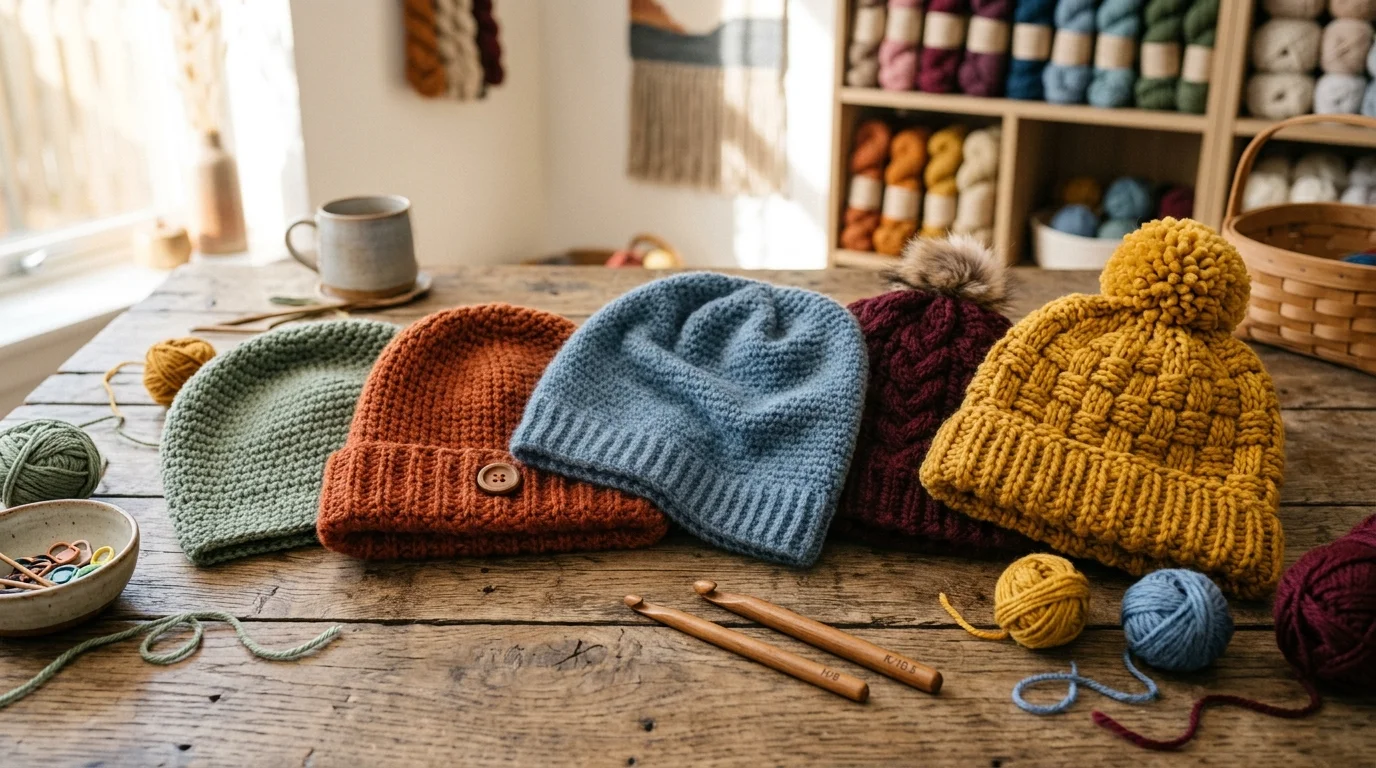
A beanie is one of the fastest, most forgiving hat shapes you can crochet, and it’s also one of the most useful gifts to have on hand — nearly everyone can use a warm hat, and a finished one takes an evening or two rather than weeks. Wikipedia describes the knit cap, commonly called a beanie in American English, as a simple tapered shape designed to provide warmth in cold weather, and that same basic tapered-circle logic is exactly what every crochet version below builds from.
Below are five crochet patterns for beanies, all built from standard, well-documented technique — magic ring, even rounds, and basic stitch texture — rather than a single designer’s copyrighted pattern. Mix and match the brim styles, stitch textures, and sizing notes freely.
Table of Contents
What ties these crochet patterns for beanies together?
Every hat in these crochet patterns for beanies starts the same way: a flat circle built from a magic ring and increasing evenly every round, which becomes the crown. Once the circle reaches head-width, you stop increasing and work even rounds to form the sides, then finish with whichever brim style you prefer. That shared structure is why learning one of these five makes the other four noticeably faster to pick up.
Yarn and hook sizing follow the Craft Yarn Council’s standard yarn weight system. Worsted weight on a mid-size hook is the most forgiving starting point across all five of these crochet patterns for beanies, producing fabric dense enough to block wind without being too stiff to wear comfortably.
1. Basic Flat-Crown Beanie
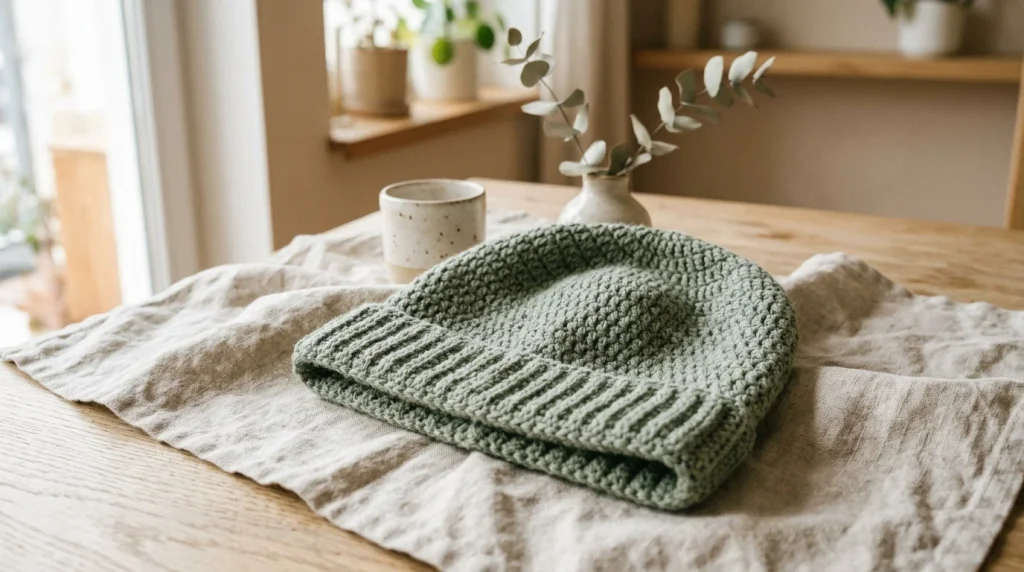
The simplest of these crochet patterns for beanies, and the one to learn first if you’re new to hats.
Skill level: Absolute beginner
Yarn: Worsted weight (#4), approximately 100–120 yards
Hook: 5 mm (H)
Start with a magic ring, work 6 single crochet into it, and increase evenly by 6 stitches every round until the flat circle measures about 7 inches across — a standard adult crown width. Stop increasing, then work even rounds of single crochet, with no further shaping, until the hat reaches a total depth of 8–9 inches, then fasten off. No separate brim is needed; the last few even rounds naturally curve into a snug fit at the forehead.
2. Folded Double-Thick Brim Beanie
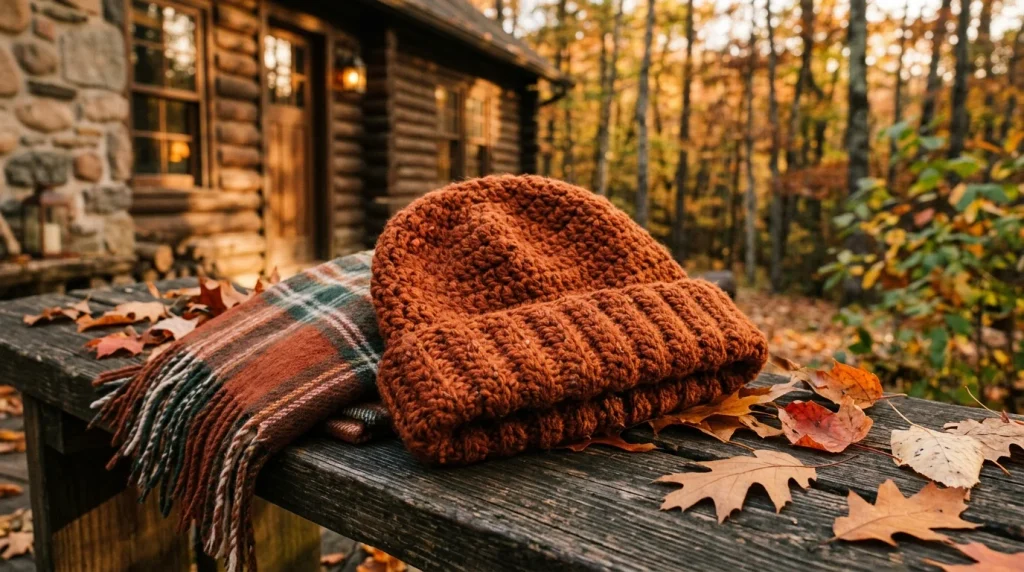
A folded brim adds real warmth over the ears without any extra technique beyond working a longer plain section.
Skill level: Beginner
Yarn: Worsted weight (#4), approximately 130–150 yards
Hook: 5 mm (H)
Follow the same crown construction as pattern one, but once you switch to even rounds, work 4–5 extra rounds beyond what pattern one calls for. Once finished, fold the bottom few rounds up and inward to create a doubled band at the brim — the extra length you crocheted becomes the fold rather than needing a separately worked ribbed section. This is one of the warmer crochet patterns for beanies here, since the folded section means two layers of fabric sit directly over the ears.
3. Slouchy Beanie
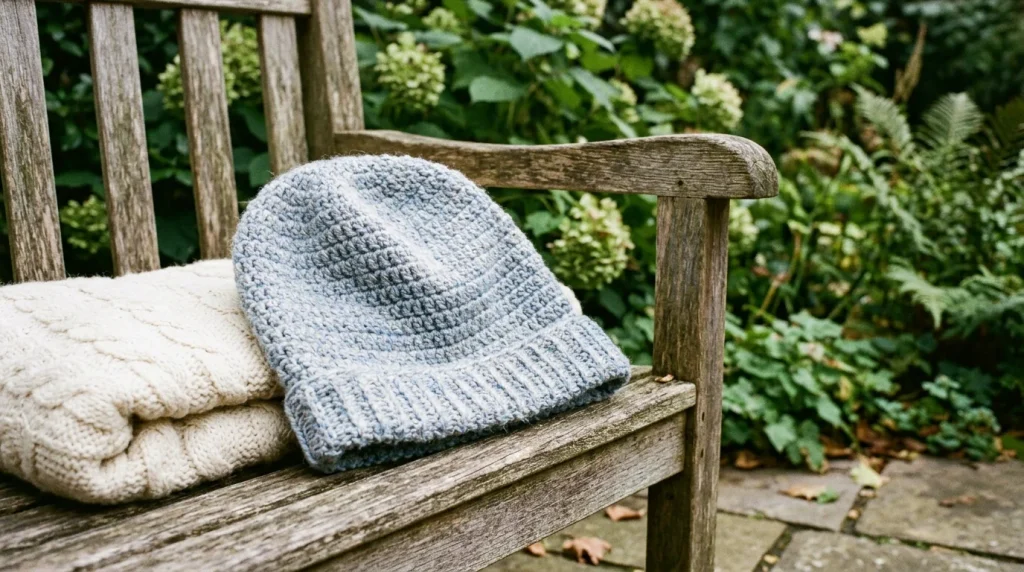
Simply increasing for longer before switching to even rounds turns the same basic structure into a relaxed, slouchy shape.
Skill level: Beginner, comfortable with basic stitches
Yarn: Worsted weight (#4), approximately 150–180 yards
Hook: 5.5 mm (I)
Work the same magic-ring start as pattern one, but continue increasing until the flat circle reaches 9–10 inches across rather than stopping at 7. Switch to even rounds and work until the piece reaches 9–10 inches of total depth, then finish with 2–3 rounds of single crochet worked in the back loop only for a snugger band at the forehead. The wider crown is what creates the slouch — the rest of the construction is identical to pattern one.
4. Textured Cable-Look Beanie
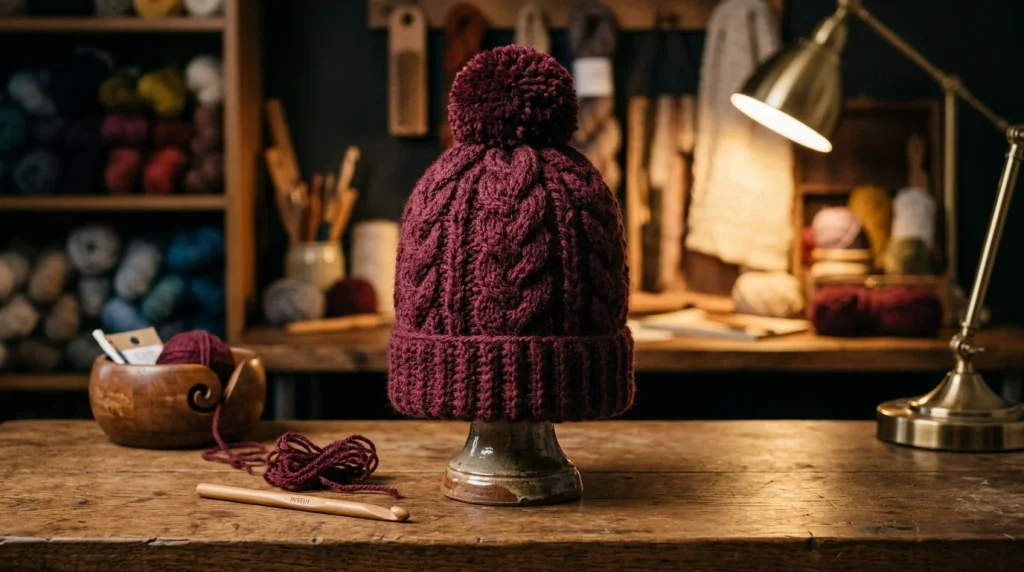
Front post and back post double crochet create a raised, cable-like texture without any actual cabling technique.
Skill level: Beginner-intermediate
Yarn: Worsted weight (#4), approximately 130–150 yards
Hook: 5 mm (H)
Build the crown the same way as pattern one. For the even-round section, alternate 2 front post double crochet, 2 back post double crochet across each round, stacking the same stitch type directly above the one in the previous round to build visible raised ribs running up the sides of the hat. This is one of the more visually distinct crochet patterns for beanies on this list, since the raised texture reads as far more advanced than the stitch technique actually requires.
5. Chunky One-Skein Beanie
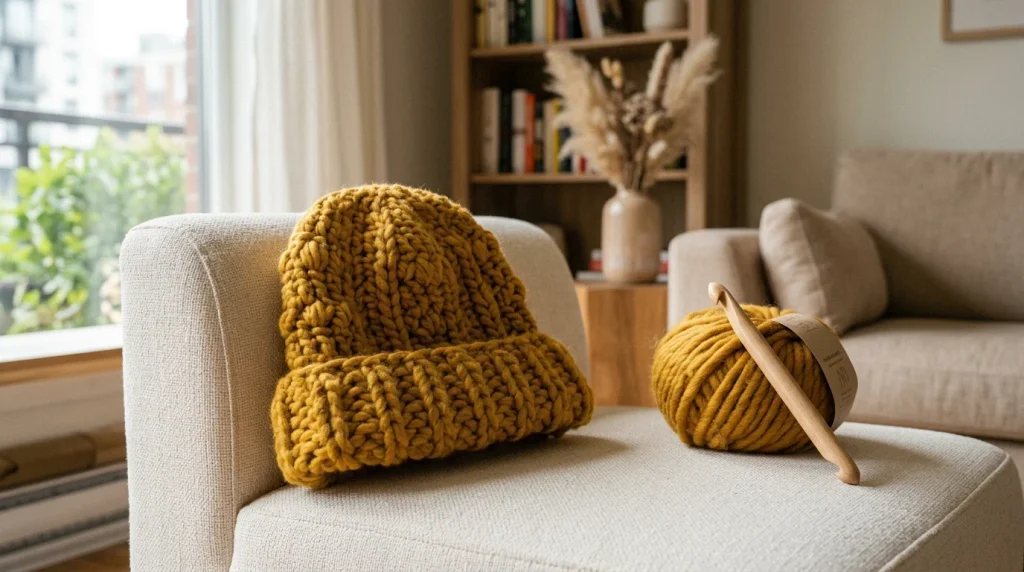
For the fastest possible finish, bulky yarn on a large hook turns a beanie into a one-sitting project.
Skill level: Absolute beginner
Yarn: Bulky weight (#5), one skein, approximately 100–110 yards
Hook: 7–8 mm (K–L)
Follow the same magic-ring crown structure as pattern one, but because bulky yarn covers more ground per stitch, you’ll reach the 7-inch crown width in roughly half the rounds. Work even rounds until the depth reaches about 8 inches, then fasten off. This is the quickest of these five crochet patterns for beanies to complete, often finishable in a single evening.
Choosing which of these crochet patterns for beanies to start with
The basic flat-crown version is the most forgiving starting point if you’ve never made a hat before, since there’s genuinely nothing beyond counting increase rounds to track. The chunky one-skein version is the fastest if you’re working against a gift deadline. Save the textured cable-look beanie for once basic stitches feel automatic, since tracking front post versus back post placement needs a bit more attention than a plain round of single crochet.
Getting the sizing right
The measurements above assume an average adult head circumference of about 22 inches. For a smaller size — a child or a petite adult — stop the crown increases about half an inch earlier than the pattern specifies, and reduce the total depth by about an inch. For a larger head, add one extra increase round before switching to even rounds, and extend the depth by roughly an inch.
Gauge affects fit more here than it might seem for something this simple. If your increases run looser than the pattern assumes, the crown comes out wider than intended and the hat sits loosely rather than snugly; if your tension runs tighter, sizing up a hook size usually corrects it without needing to change the stitch counts.
Common mistakes to avoid
Uneven increase spacing is the most frequent issue across any of these crochet patterns for beanies — if the 6 increase points aren’t spaced evenly around each round, the crown comes out slightly cupped or rippled instead of lying flat. Counting total stitches at the end of every round, rather than only when the fabric already looks off, catches this early.
Switching to even rounds too early is the second common mistake. If the increasing stops before the crown actually reaches head width, the hat ends up tight and shallow rather than properly fitted, since there’s no later shaping to compensate for a crown that was cut short.
FAQs
Can I add a pom-pom to any of these crochet patterns for beanies?
Yes — a pom-pom attaches easily to the center point of the crown on any of the five, either store-bought or hand-wrapped from leftover yarn, without needing to change the construction at all.
What yarn weight works best for a first beanie?
Worsted weight is the most forgiving starting point across these crochet patterns for beanies, since it’s widely available and produces a fabric dense enough to block wind without needing a particularly tight gauge.
Why does my beanie look more like a bowl than a hat?
This usually means the crown was increased past the point it should have stopped — if the flat circle grows wider than the intended crown width before switching to even rounds, the hat flares out instead of sitting snugly.
How much yarn do crochet patterns for beanies typically need?
Most of the five above use well under 200 yards, which makes this category a practical way to use up partial skeins left over from larger projects like blankets or sweaters.
Do these crochet patterns for beanies work for both adults and kids?
Yes, with the sizing adjustments noted above. The basic flat-crown and chunky one-skein versions are the easiest two to resize for a child, since their construction has the fewest extra steps to adjust proportionally.
Can I combine two of these crochet patterns for beanies into one hat?
Often, yes — the folded brim technique from pattern two, for instance, layers cleanly onto the slouchy crown from pattern three, since both rely on the same basic crown-then-even-rounds structure. Mixing a crown style from one pattern with a brim or texture from another is a reasonable way to customize the fit and look without inventing a new construction from scratch.

Leave a Reply