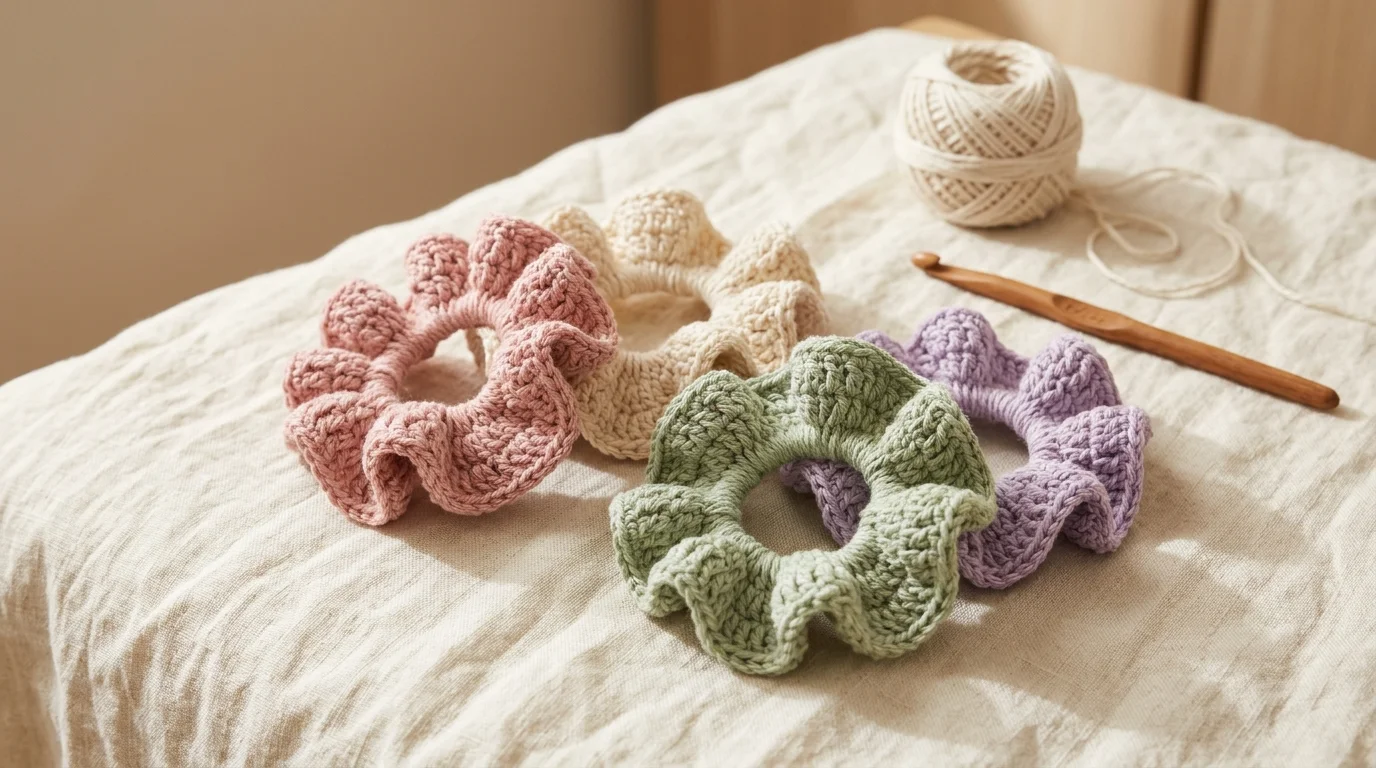
A crochet scrunchie is a ruffled band of crocheted fabric wrapped around a hair elastic. It holds a ponytail like the store-bought kind, eats up hardly any yarn, and you can finish one in a single sitting. Below you’ll find two ways to build it, a yarn comparison, sizing logic, a bracelet version, and the mistakes people run into most.
Table of Contents
What Is a Crochet Scrunchie?
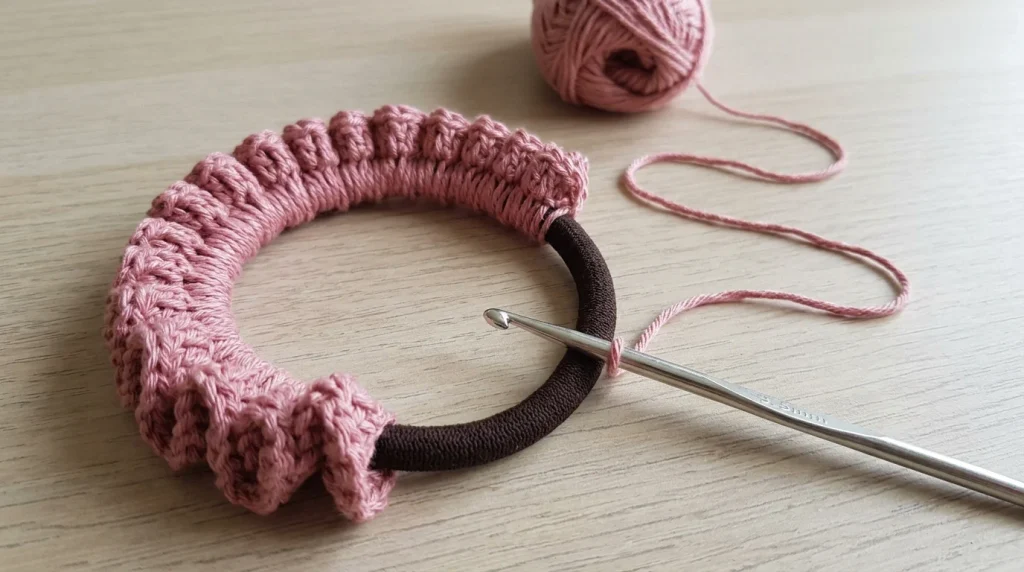
Think of it as two layers. Inside sits an elastic that grips your hair. Outside is a crocheted cover with more fabric than the elastic can stretch flat, so the stitches bunch into soft folds. That bunching is the entire look, and every crochet hair scrunchie relies on it, whatever stitch you choose.
Plenty of shops list the same thing as a crochet hair tie. Same object, different label. Among crochet hair accessories it’s about the quickest to finish, which explains why beginner lists love it. Making a set? The crochet headband pattern uses the same basic stitches.
Materials for a Crochet Scrunchie Pattern
Gather these before you start:
- Yarn: a small amount, since the fabric is only a narrow ring or strip. A leftover partial ball works.
- Hook: pick a size from the range on your yarn label. Going down one size gives a denser fabric that hides the elastic.
- Hair elastic: a plain, snag-free ponytail band for the first method, or flat or round elastic cord for the seamed one.
- Yarn needle: for weaving in ends and closing the seam.
- Stitch marker: optional, though it helps when you’re working in rounds.
Instructions use US terms: single crochet (sc), half double crochet (hdc), double crochet (dc). I haven’t given a fixed stitch count, because your elastic and your tension decide that number. The steps show you how to count instead.
Best Yarn for Crochet Scrunchie Projects
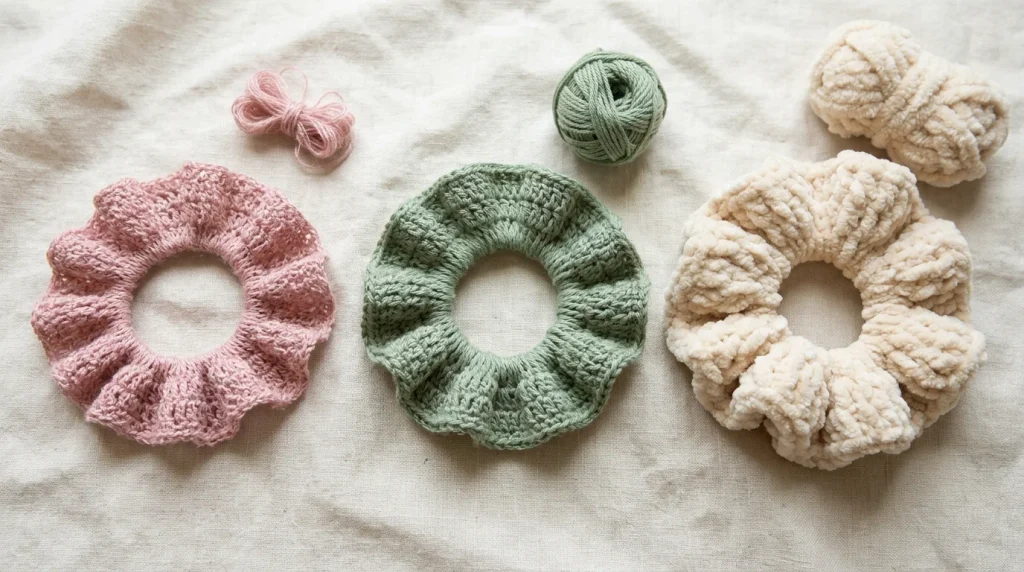
The best yarn for crochet scrunchie work is whatever you’d be comfortable wearing against your hair all day. Check how it feels, how it drapes, and how much it fuzzes. The Craft Yarn Council sorts yarn into numbered weight categories, and your label tells you which one you’ve got. Thinner yarn gives a dainty scrunchie. Thicker yarn gives a plush one.
| Yarn type | How it behaves | Good to know |
|---|---|---|
| Cotton | Firm, holds ruffles | Little stretch; washes easily |
| Acrylic | Soft and springy | Widely available; can pill with friction |
| Cotton-acrylic blend | Balanced | Softer than cotton, holds shape better than acrylic |
| Velvet or chenille-style | Plush and floppy | Stitches are hard to see, so mark your rounds |
| Wool | Warm and elastic | Can felt in hot water; hand wash |
Swapping yarns inside one weight category keeps the size close to a pattern’s. Jump to a different category and the size changes, so work your first round and test it on the elastic before going further. The yarn weight guide covers substitution in more depth.
Easy Crochet Scrunchie: Work Over the Elastic
No seams, no foundation chain. That’s why this version suits a crochet scrunchie for beginners.
- Attach the yarn. Tie a slip knot onto the elastic and leave a tail to crochet over. Push the hook through the middle of the band, yarn over, pull up a loop, yarn over again, and pull through both loops. First sc done.
- Cover the band. Keep going around, packing stitches snug against each other until no elastic peeks out. The count depends on your band, so jot it down. Slip stitch into the first sc to join.
- Make the ruffle. Chain 1, then work 2 sc in every stitch and join. Doubling the stitches creates more fabric than the inner ring can hold flat, and that’s what ruffles.
- Build width. Add one or two rounds of sc, hdc, or dc in each stitch. Want it fuller? Repeat the doubling round, though a fuller ruffle means more yarn and a floppier finish.
- Finish. Fasten off, thread the tail onto a yarn needle, and bury it inside the ruffle.
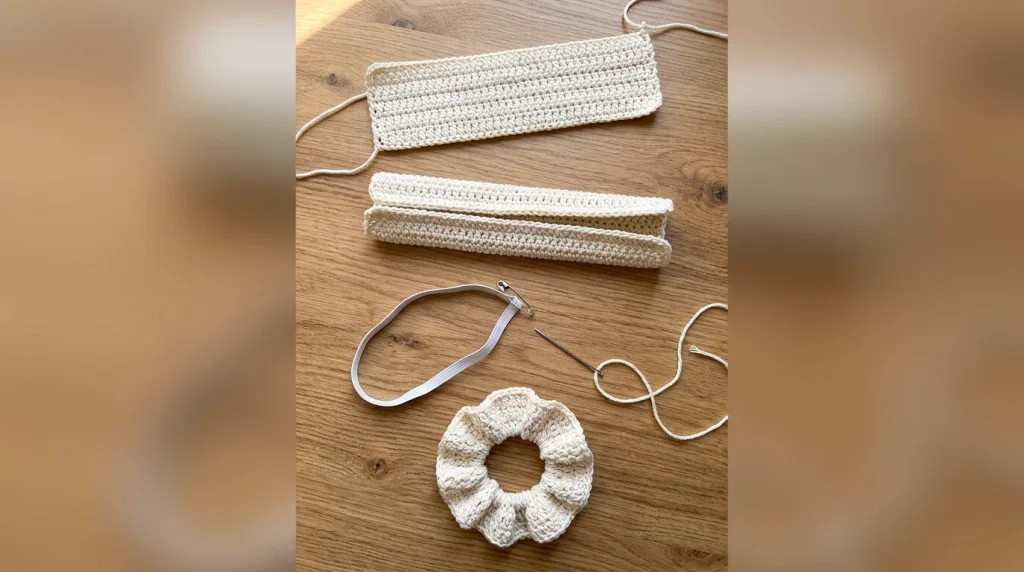
Crochet Scrunchie With Elastic Threaded Through
This route gives a smoother tube, and you pick the elastic length yourself. More steps, though. The finished piece looks closer to a fabric scrunchie.
- Chain enough that the strip, laid in a loop, is clearly larger than your elastic loop. Around double the elastic’s length is a fair starting point for obvious gathers. A strip close to the elastic’s length gives a flat band.
- Work rows of sc or hdc until the strip is as wide as you want. A wider strip makes a puffier scrunchie.
- Fasten off with a long tail, fold the strip lengthwise, and whipstitch the long edges into a tube.
- Pin a safety pin to one end of the elastic and feed it through the tube. Knot the ends together firmly.
- Whipstitch the open ends of the tube shut so the knot hides inside.
That seam is the weak point. Use a sturdy stitch and tug on it before you wear the thing.
Can You Make a Crochet Scrunchie in 10 Minutes?
Some titles promise a crochet scrunchie in 10 minutes. Read that as a target, not a promise. Your time depends on yarn weight, how many rounds you add, and how fast you stitch. Thin yarn with one ruffle round finishes sooner than bulky yarn with three. Your first attempt will probably run longer, because you’re figuring out where the hook goes around the elastic. And the over-the-elastic method beats the seamed one on speed, since you skip the chain, the rows, and the sewing.
Sizing and Fullness
Two choices shape the result: the elastic and the number of increase rounds.
- Elastic size: thick hair needs a bigger or stronger band. Too small and it digs in. Too loose and it slides out.
- Increase rounds: each doubling round adds ruffle. One gives a modest frill, two give a dramatic one.
- Yarn weight: bulky yarn makes volume with fewer rounds, while fine yarn needs more to look full.
- Stitch height: dc drapes and flops more than sc, which stands up and keeps a firmer ruffle.
Since the elastic sets your stitch count, no universal total exists. Count your first round, write it down, and reuse it for matching pieces.
Crochet Scrunchie Bracelet Variation
A crochet scrunchie bracelet is the same build in miniature. Grab a thin elastic cord or a small hair band, fine yarn, and work one or two rounds. Check that it slides over your hand, then that it sits loose on the wrist. Many people wear one as a spare hair tie, which is half the appeal. Skip it for small children’s wrists, and never leave it tight on anyone’s arm.
Common Mistakes and Fixes
The elastic shows between stitches. Your tension is loose or the hook is too big. Drop a size and pack the first round tighter.
The ruffle lies flat. Too few increases, or yarn too thin to hold the extra fabric. Add a doubling round or try a heavier strand.
The ruffle looks chaotic. You added too many increases at once. Work evenly after one doubling round, and add more only if you want volume.
The round twists. Before joining, make sure the stitches all face the same way, then slip stitch. A marker in your first stitch helps.
It pinches your hair. The elastic is too tight, or the ruffle hangs off center. Choose a gentler band and weave ends inside.
The elastic snaps or the seam opens. Knot the elastic hard in the seamed method, and close the tube with strong stitches.
US and UK Terms
Patterns change by country, and mixing them changes your fabric. A US single crochet is a UK double crochet, and a US double crochet is a UK treble, as this US and UK terms chart shows. See “sc” in a pattern? It’s written in US terms.
Care and Finishing
Hand wash in cool, clean water and air dry. Press the ruffle gently into shape while still damp. Skip hot water with wool, since it can felt. Check the elastic now and then, because it loosens with wear before the crochet does. A crochet scrunchie lasts longest when you treat the elastic as the part that wears out first. With the seamed method, snip a few seam stitches, pull the old band out, and feed in a fresh one. Rotating two scrunchies lets each one recover. Store them loose in a drawer, not stretched over a hook or doorknob, because elastic that stays stretched loses grip. If the ruffle flattens in storage, fluff it gently with your fingers.
FAQs
How much yarn does a crochet scrunchie use?
Very little yarn overall. It depends on yarn weight, round count, and ruffle fullness, and a leftover partial ball usually covers it.
Can I use any hair tie as the base?
Yes. Pick a plain, snag-free band without metal joins, since metal can catch stitches and hair.
Which stitch works best?
Single crochet gives a firm ruffle and hides the elastic well. Half double and double crochet drape more.
Will it snag my hair?
Smooth yarn and ends woven inside keep snagging low. Rough or very fuzzy yarn catches more

Leave a Reply