Sweaters ask more of a pattern than most crochet projects do. Gauge has to be right, not just close. The construction method decides how forgiving your mistakes will be. And the yarn you pick decides whether the finished piece drapes like a sweater or stands up on its own like a poster board.
Before you commit to a crochet sweater pattern, it helps to know how the different construction methods work, what a gauge swatch is actually telling you, which yarn and hook combination suits a garment rather than a small project, and a few sweater and cardigan styles worth being able to tell apart.
Contents
- How a Crochet Sweater Pattern Is Actually Built
- Cardigan, Pullover, or Something Between
- What Your Gauge Swatch Is Really Telling You
- Yarn and Hook Size for a Garment, Not a Small Project
- Free vs. Paid Crochet Sweater Patterns
- Fit Problems Worth Solving Before You Start
- What to Check on a Pattern Listing Before You Buy
- A Few Sweater and Cardigan Styles Worth Knowing Apart
- Frequently Asked Questions
How a Crochet Sweater Pattern Is Actually Built
Most crochet sweater patterns use one of three construction methods, and the pattern description usually says which.
Top-down patterns start at the neckline and work downward through the yoke, increasing at set points until the piece is wide enough to split into a body section and two sleeves. You try the garment on as you go, which makes it easier to catch a length or fit problem before you’ve bound off. Raglan shaping (four diagonal increase lines running from underarm to neck) and circular yoke shaping (increases spaced evenly around the round) are the two most common versions.
Bottom-up patterns work the back, front, and sleeves as separate pieces, then join them with seams. This takes longer and adds a finishing step, but seams give a garment more structure, which helps in drapier yarns that would otherwise sag under their own weight. It’s also the easier method to swatch-test, since you can measure a single piece against your gauge before the whole garment depends on it.
Granny square and motif construction builds the sweater or cardigan out of joined squares, hexagons, or other repeated units rather than shaped panels. It’s the most forgiving of the three when your gauge doesn’t match the pattern exactly, since you can add or leave off a row of motifs to adjust the finished size. The tradeoff is a looser, often more open-work fabric, which suits a lighter cardigan better than a close-fitting pullover.
Cardigan, Pullover, or Something Between
“Crochet sweater pattern” covers more than one kind of garment, and the difference changes what you should look for.
A cardigan opens down the front, so it doesn’t have to clear your head or sit tight at the shoulders. It layers over whatever’s underneath, which makes fit slightly more forgiving. A crochet cardigan pattern usually asks less precision at the yoke and more attention to the button band and closure, since that’s the part people actually notice.
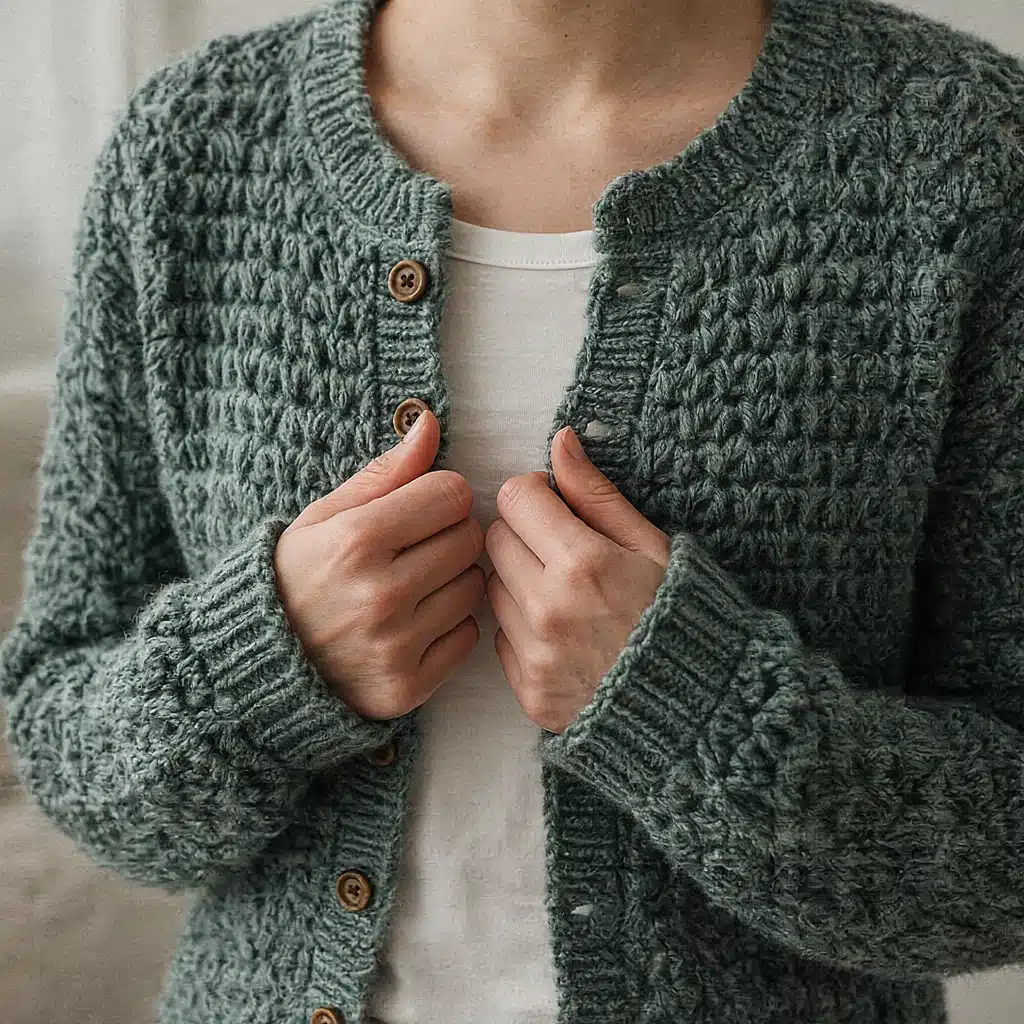
A pullover has no opening, so the neckline and shoulder shaping matter more: too narrow and it won’t go over your head comfortably, too wide and it gapes. A crochet pullover sweater pattern will usually specify how much ease to build in around the neck opening for exactly this reason, and the neckline shape itself is worth checking before you start — a crew neck sits close to the throat, while v neck crochet sweater patterns need a decrease line down the center front that has to be planned into the yoke shaping rather than added afterward.
In UK-written patterns, a pullover crochet sweater is usually labeled a jumper: same garment, different name. Worth knowing before a free crochet jumper pattern leaves you searching for the word “sweater” and never finding it.
What Your Gauge Swatch Is Really Telling You
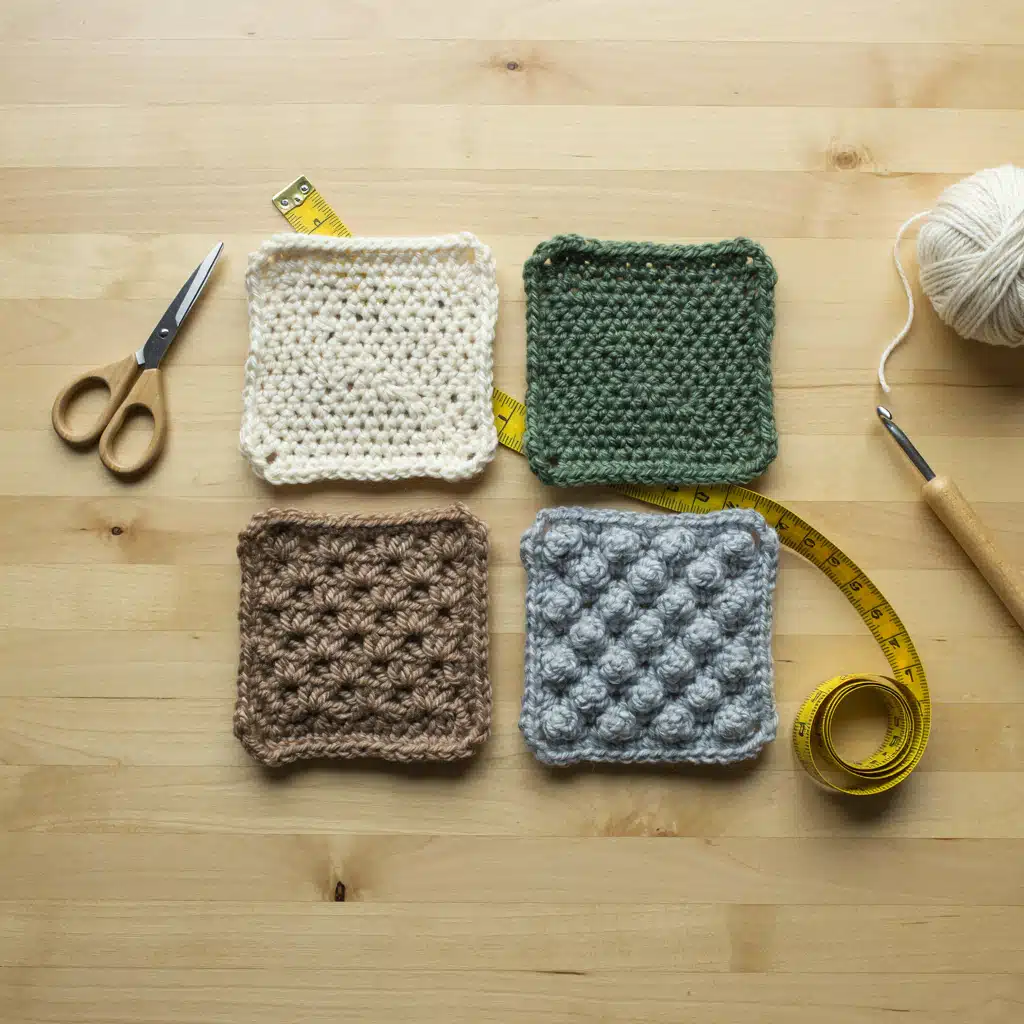
A gauge swatch matters more for a sweater than almost any other project, because a small tension difference gets multiplied across every inch of a garment instead of staying contained to one blanket square or coaster.
A few things worth doing with the swatch beyond just checking stitch count:
- Work it at least 4 inches square, bigger than the usual minimum, since a small swatch under- or over-estimates your real tension.
- Block it the way you plan to block the finished sweater. Cotton and cotton-blend yarns especially can grow or relax noticeably once wet-blocked, which changes your actual gauge after the fact.
- Check row gauge, not just stitch gauge. Row gauge affects where armhole shaping and waist shaping land, so if it’s off, the sleeves or body length can come out wrong even when the stitch count matches.
- Note how much stretch the swatch has. Crochet fabric generally has less give than knit fabric, so most crochet sweater patterns are written with zero or positive ease (a finished measurement equal to or larger than your body) rather than the negative ease you’ll sometimes see in knitting patterns, which relies on the fabric stretching to fit.
Yarn and Hook Size for a Garment, Not a Small Project
The right yarn for a coaster and the right yarn for a sweater aren’t the same decision, mostly because of weight and drape.
Worsted weight (#4) is the most common default for crochet sweater patterns, thick enough to work up in a reasonable amount of time without adding so much bulk that the finished garment feels heavy on the shoulders. DK weight (#3) makes a lighter, drapier sweater or cardigan, at the cost of more hours and more yardage. Bulkier yarns finish fastest but add real weight.
Ball bands don’t always agree on terminology, so it helps to check a yarn’s number against the Craft Yarn Council’s standard yarn weight system before assuming two “worsted” yarns will behave the same way when you’re comparing yarn recommendations across different crochet sweater patterns. It’s worth trying a swatch on and wearing it around the house for an hour before committing a whole sweater’s worth of yardage to it.
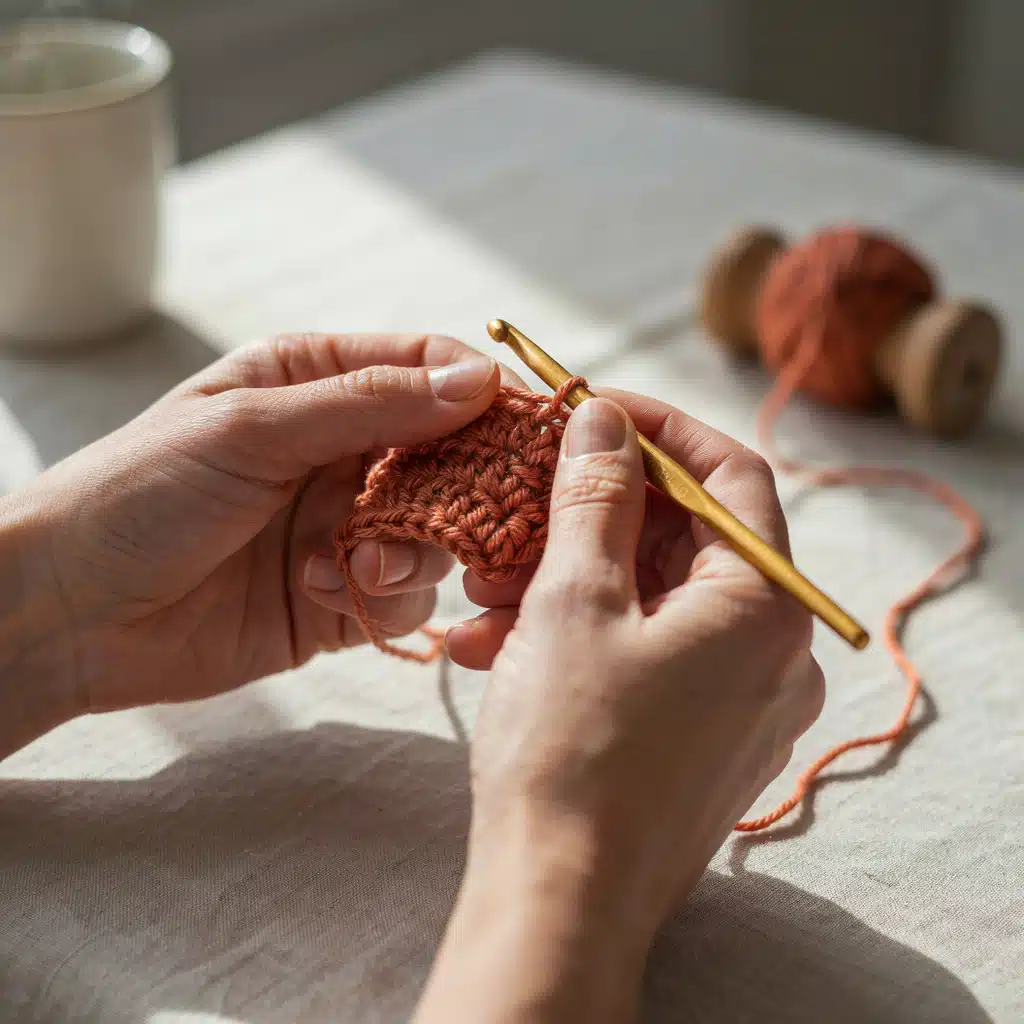
Fiber changes the outcome as much as weight does. Cotton has little stretch and a lot of stitch definition, and it drapes downward rather than clinging: good for an open cardigan, less good for anything meant to hug the body. Wool and wool blends add warmth and some natural elasticity, and they tend to hold their shape better over a day of wear. Acrylic is the most budget-friendly option and holds color well, though it can look flat or stiff compared to a natural fiber unless the pattern calls for blocking, which softens the drape somewhat.
Whatever hook size the pattern recommends, treat it as a starting point rather than a rule. Swatch with it first, and size up or down until your gauge matches the pattern’s, even if that means using a hook a size or two off from what’s printed on the yarn label.
Free vs. Paid Crochet Sweater Patterns
Free crochet sweater patterns and free crochet cardigan patterns exist in plenty, scattered across blogs, Ravelry, and YouTube — but garments are where the gap between free and paid patterns tends to show up most.
A lot of the free crochet sweater patterns and free crochet cardigan patterns you’ll find online are written for a single size and a single gauge, without a full range of finished measurements to grade against. That’s fine if the size happens to match you closely. If it doesn’t, resizing a garment pattern is a lot more involved than resizing a hat. Paid, instant-download patterns more often include a graded size range with a finished-measurements chart and a schematic (a diagram showing the garment’s flat dimensions), which makes it much easier to check before you start whether the finished piece will actually fit.
Neither option is inherently better made. The real difference is how much sizing information you’re given up front, and whether you’re willing to do the math yourself if a free pattern only covers one size.
Fit Problems Worth Solving Before You Start
Most fit problems with a crochet sweater pattern trace back to one of a few causes, all avoidable before the first row.
Sleeves that come out too short or too long usually point to a row gauge mismatch rather than a counting error. Worth checking against your swatch before you’re two-thirds of the way up a sleeve. A boxy, shapeless result is often just the construction method doing exactly what it’s built to do: drop-shoulder patterns (where the sleeve is worked straight into the body without a curved armhole) are simpler to execute but naturally boxier than a raglan or set-in sleeve.
Edges that curl or flare at the hem, cuffs, or neckline usually need a stabilizing border — a round or two of single crochet or reverse single crochet — rather than being left as the last row of the main stitch pattern.
One less obvious mismatch: swatching flat when the sweater itself is worked in the round, or the other way around. Row tension can shift slightly between right-side and wrong-side rows in some stitch patterns, so a flat swatch doesn’t always predict in-the-round gauge exactly. When a crochet sweater pattern specifies working in the round, it’s worth swatching in the round too, even though it takes a little longer to set up than a flat square.
What to Check on a Pattern Listing Before You Buy
A crochet sweater pattern listing usually states a skill level, and it’s worth reading past the label itself. “Beginner” or “easy” generally means basic stitches worked in straight rows or simple rounds with minimal shaping. “Intermediate” usually adds raglan or set-in sleeve shaping, colorwork, or texture stitches. “Experienced” can mean anything from fitted set-in sleeves to complex stitch patterns combined with garment shaping at the same time. The Craft Yarn Council keeps a standardized project level system that a lot of designers reference, though not every pattern follows it exactly.
Terminology is worth checking too. US and UK crochet terms use the same stitch names for different stitches: a US single crochet is a UK double crochet, and a US double crochet is a UK treble. A crochet sweater pattern written for one market and worked using the other market’s stitch definitions will come out a noticeably different gauge and drape, not just a different name for the same result. Most well-written patterns state which system they use somewhere in the first page, but it’s easy to miss if you’re skimming straight to the instructions.
Size range matters as much as skill level when you’re picking a crochet sweater pattern, especially for a fitted garment. Check whether the listing gives finished garment measurements (bust or chest circumference at minimum) across its full range, including plus sizes, rather than just a list of body sizes like “S/M/L.” A finished-measurement chart lets you compare the actual garment dimensions to your own body plus your intended ease, instead of guessing based on a clothing size label that varies from one designer to the next.
Beyond sizing, a complete pattern listing or PDF should tell you the yardage and yarn weight needed per size, the hook size and any notions (stitch markers, a tapestry needle, buttons), the gauge the designer swatched at, and ideally a schematic. None of that guarantees the pattern is well written, but its absence is a reasonable flag to swatch cautiously and read reviews before starting.
A Few Sweater and Cardigan Styles Worth Knowing Apart
Not every crochet sweater pattern fits neatly into one category, but a handful of shapes come up often enough to be worth naming and telling apart.
Drop-shoulder pullovers are the simplest shape to construct and a common recommendation for a first sweater, since there’s no curved armhole shaping to get wrong — a good match if you’re still working through beginner-friendly crochet patterns before taking on a fitted garment.
Raglan pullovers use four diagonal increase lines and give a closer, more tailored fit than a drop shoulder, without the more advanced set-in sleeve construction that separates the sleeve entirely from the body.
Granny square cardigans join motifs into a garment shape rather than shaping fabric directly, and they’re one of the more approachable ways into garment-making if you already know how to join squares from blanket-making.
Structured cardigans with set-in sleeves take more shaping know-how but give the most tailored result of the group, closer to a ready-to-wear silhouette.
Eyelet detailing shows up across most of these: a double crochet long-sleeved pullover sweater with an eyelet yoke, for instance, gets its texture from evenly spaced chain-space rows rather than a change in stitch height, and it reads as more finished than the same shape worked in a single plain stitch throughout.
If you’d rather start from a pattern that’s already graded and tech-edited than sort all of this out from scratch, the shop’s own cardigan and sweater patterns are written the same way as the rest of this guide recommends — clear stitch counts at every size, aimed at confident beginners and up.
Frequently Asked Questions
What’s the easiest construction method for a first crochet sweater?
A granny square cardigan or a drop-shoulder pullover. Both are more forgiving of small gauge differences than a fitted raglan or set-in sleeve construction, and neither relies on negative ease to fit well, which makes either a reasonable first crochet sweater pattern to try.
Do I need to swatch if I already know my gauge from other projects?
Yes. Gauge changes with the specific yarn, hook, and stitch pattern in front of you, and blocking can shift it further. A swatch from a different project with different yarn doesn’t tell you much about this one.
Can I substitute yarn in a crochet sweater pattern?
Usually, as long as the substitute matches gauge. Matching gauge alone doesn’t guarantee the same result, though — a different fiber at the same gauge can still drape, stretch, and wear differently than what the pattern was designed around.
Do the same construction principles apply to a dog sweater crochet pattern?
Broadly, yes — the same basic shaping logic scales down. Ease and stretch matter less, since the fit is more forgiving on a dog than on a person, and neck and leg openings are usually simplified rather than shaped the way a human sweater’s neckline would be.
Are US and UK crochet terms the same?
No, and this trips up more sweater projects than it should. The stitch names overlap but point to different stitches — a US single crochet is a UK double crochet, for example — so working a crochet sweater pattern in the wrong system changes gauge, not just vocabulary. Check which system a pattern uses before you swatch.

Leave a Reply