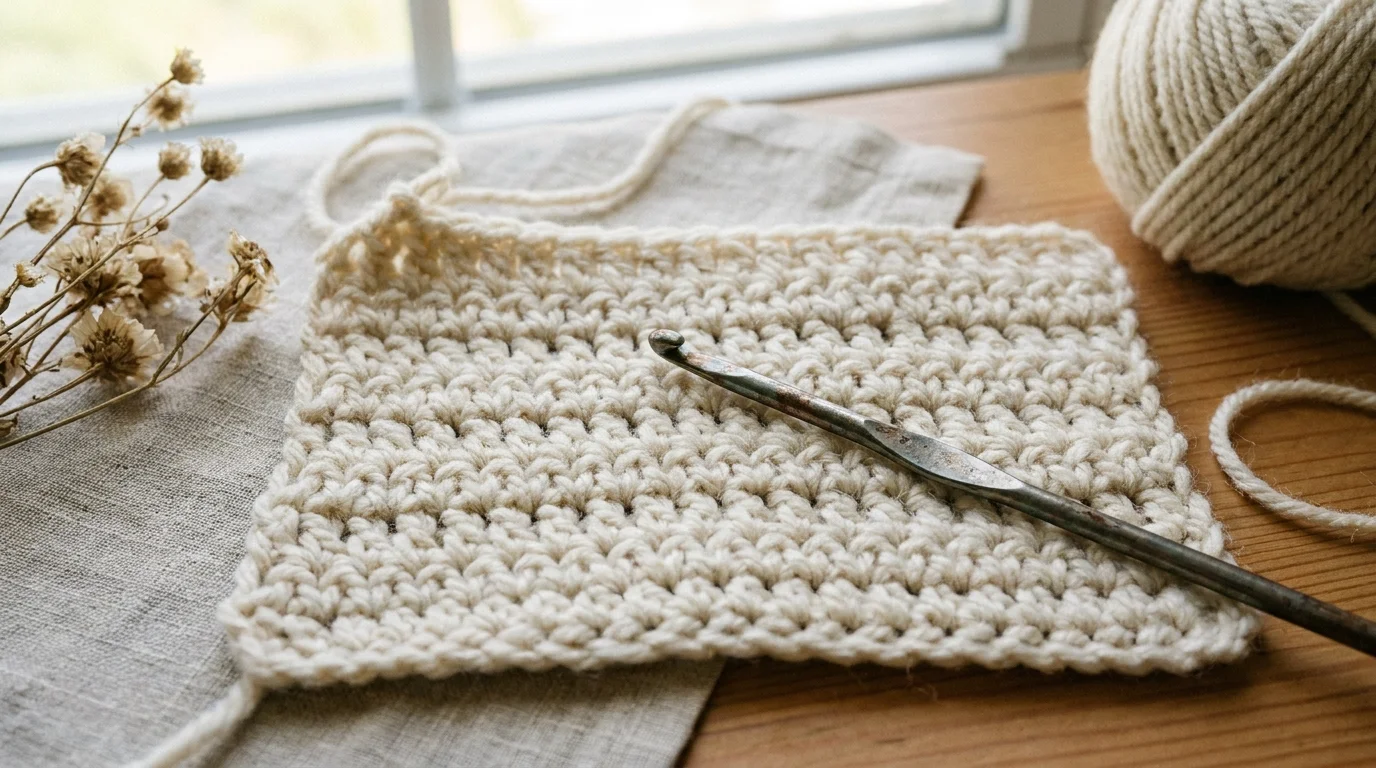
The half double crochet stitch (HDC) is a basic crochet stitch that creates fabric taller than single crochet but shorter than double crochet. It is a useful choice for blankets, hats, scarves, garments, and other projects where you want a balance of texture, coverage, and drape. Once you understand the yarn-over sequence and where to insert your hook, you can use this stitch in rows, rounds, and shaping.
This tutorial uses US crochet terminology and explains the process from the first foundation chain to common variations, including increases and decreases.
At a Glance
- Skill level: Beginner
- Abbreviation: HDC
- Terminology: US crochet terms
- Main technique: Yarn over, insert the hook, pull up a loop, then pull through all three loops.
- Common uses: Blankets, beanies, scarves, sweaters, and textured accessories.
- Turning chain: Often two chains, although patterns differ on whether it counts as a stitch.
Table of Contents
What Is a Half Double Crochet Stitch?
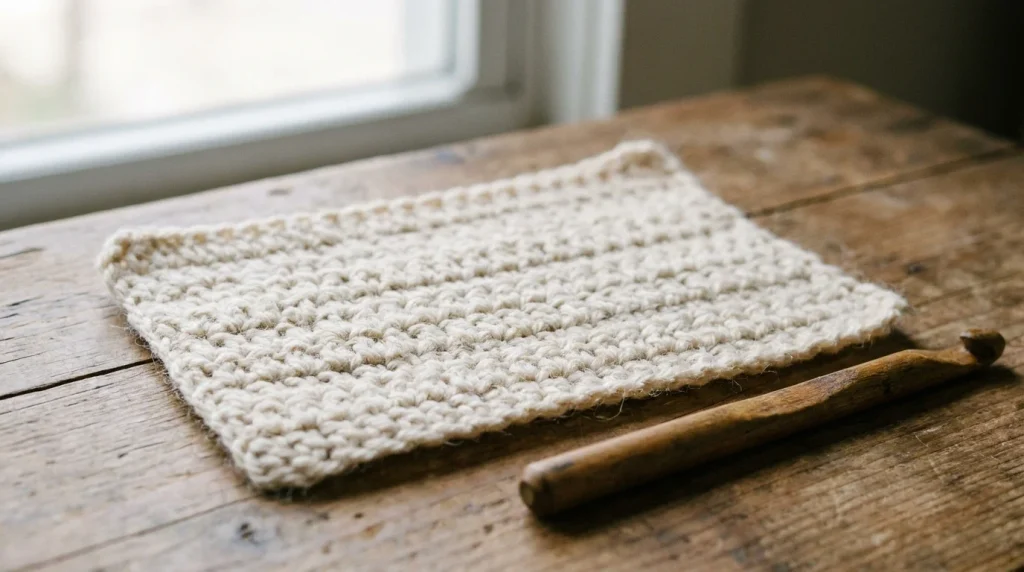
A half double crochet stitch is a medium-height basic stitch made by pulling yarn through three loops on the hook in one final movement. Its height sits between single crochet and double crochet, giving you a fabric that builds more quickly than single crochet without being as tall as double crochet.
The abbreviation HDC appears in US crochet patterns. If a pattern says “hdc in each st across,” make one half double crochet in every stitch across the row.
This stitch is particularly useful when you want a fabric with fewer gaps than a loose double crochet fabric. Your finished result will still depend on the yarn, hook size, and personal tension.
What You Need to Start?
Gather these simple supplies:
- Medium-weight yarn in a light or medium color so you can see the loops.
- A crochet hook appropriate for the yarn label.
- Scissors.
- A yarn needle for weaving in the ends.
- Stitch markers, if you find it difficult to identify the first or last stitch.
For practice, medium-weight yarn and a hook around 5 mm are a reasonable starting combination, but check the yarn label. You don’t need to buy special supplies just to learn this stitch.
How to Half Double Crochet in 7 Easy Steps?
The movement becomes easier once you remember that you begin with a yarn over and finish by pulling through all three loops together.
Step 1: Make a Foundation Chain
Start with a slip knot on your hook. Make 12 chain stitches for a small practice swatch.
This chain is your foundation row. Keep it loose enough that you can insert your hook into each chain without forcing it through the yarn.
Step 2: Yarn Over
Bring the working yarn over the hook from back to front. This is called a yarn over, often abbreviated YO.
Keep the yarn positioned on the hook rather than pulling it so tightly that the loop becomes difficult to move.
Step 3: Insert the Hook
Skip the first two chains from your hook and insert it into the third chain. For the foundation row, you are working into the chain itself rather than into a completed stitch.
The two skipped chains provide the starting height. Different patterns may specify a different starting method, so follow the instructions when working from a particular design.
Step 4: Yarn Over and Pull Up a Loop
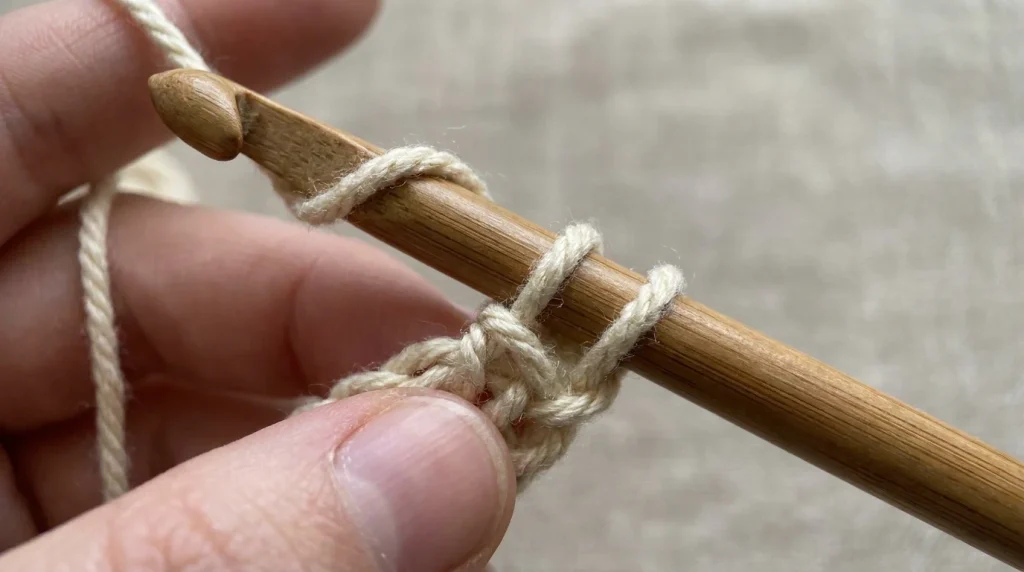
Wrap the yarn over the hook again. Pull the hook back through the chain, bringing the new loop with it.
You should now have three loops on your hook. This is the important checkpoint before finishing the stitch.
Step 5: Yarn Over Again
Wrap the working yarn over the hook once more. You now have the yarn ready to pass through all three loops.
Keep the hook opening angled slightly toward the yarn so the loops can slide over it without snagging.
Step 6: Pull Through All Three Loops
Draw the yarn through all three loops in one movement. You should be left with one loop on your hook, and one half double crochet is complete.
Unlike a double crochet, you don’t stop after pulling through two loops and repeat the process. Pulling through all three at once is what distinguishes HDC from DC.
Step 7: Repeat Across the Row
Yarn over, insert your hook into the next chain, yarn over and pull up a loop, then yarn over and pull through all three loops.
Repeat this sequence until you reach the end of the foundation chain. With 12 starting chains, skipping the first two leaves 10 chains for your HDC stitches.
For the next row, chain two and turn your work. Work into the first HDC of the previous row, then continue across, aiming to maintain the same stitch count.
How to Work Half Double Crochet in Rows?
Working in rows creates a flat piece of fabric, making this method useful for scarves, blankets, washcloths, and rectangular panels.
After completing your first row, chain two and turn. Unless your pattern specifically says otherwise, treat this turning chain as height rather than an additional stitch. Work the first HDC into the first actual stitch of the previous row.
Continue making one HDC in each stitch across. At the end, check that you have the same number of stitches as the previous row. Repeat the turning chain and row until your piece reaches the desired length.
Tip: Count your stitches at the end of every row while learning. Missing the first or last stitch can gradually make your fabric narrower or wider.
How to Crochet HDC in the Round?
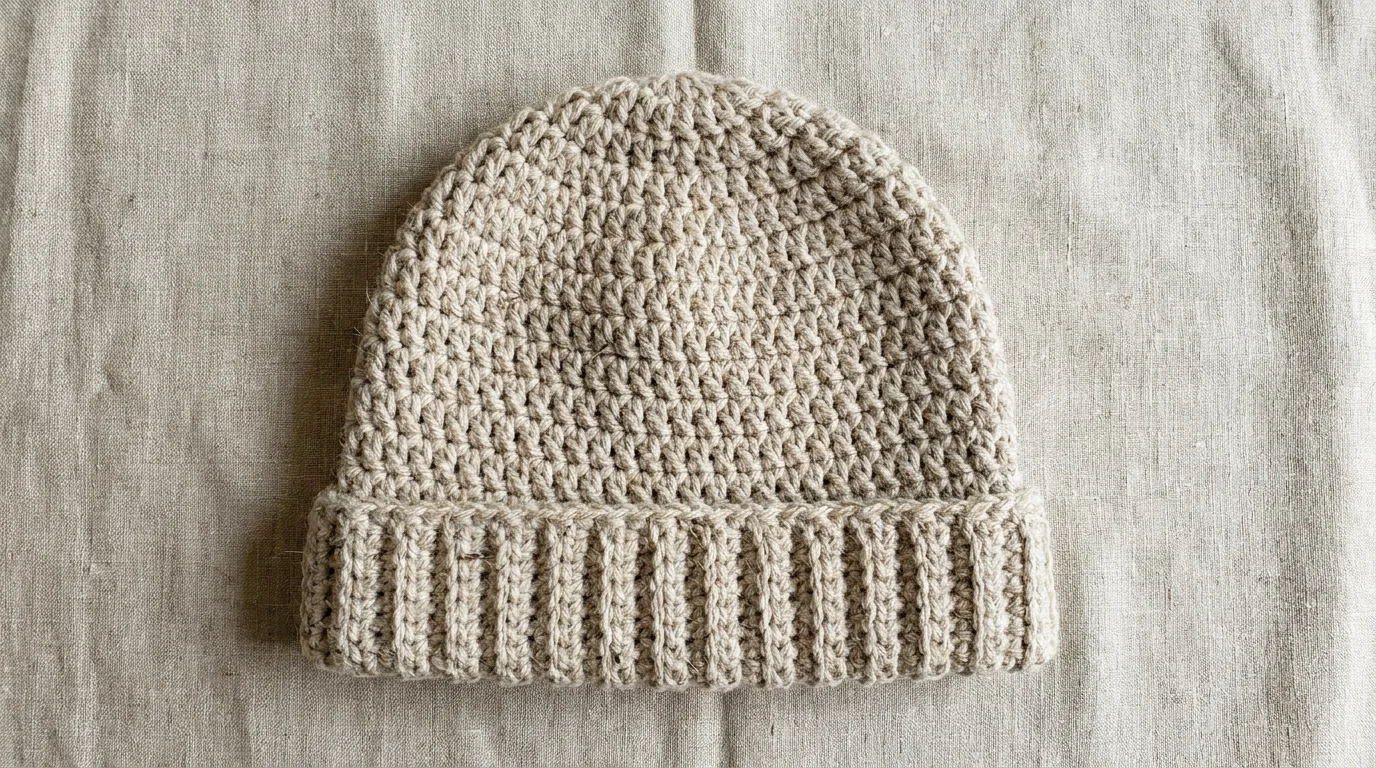
The half double crochet stitch also works in rounds, which makes it useful for hats, cowls, sleeves, and other tube-shaped projects.
You can work joined rounds or continuous spiral rounds. In joined rounds, finish each round with a slip stitch where the pattern directs, then begin the next round with the specified turning chain. In a spiral, continue directly into the next stitch without joining each round.
For a simple joined round, work HDC into every stitch around, then join to the first HDC with a slip stitch if instructed. Follow the pattern’s directions for the starting chain because some designers count it as a stitch and others don’t.
When making a hat or another shaped item, increases may be necessary to expand the fabric. Simply working the same number of stitches around will generally maintain the circumference rather than create a flat, expanding crown.
Half Double Crochet Increase: How Does It Work?
A half double crochet increase adds stitches by working two HDC stitches into the same stitch from the previous row or round.
For example, if you have 10 stitches and make one increase in a single stitch, your new total becomes 11 stitches. If you work two HDC into each of the 10 stitches, the total becomes 20.
Patterns often spread increases across a round to create a gradual curve. The exact number and placement depend on the shape and gauge required, so don’t assume every hat or circle uses the same increase formula.
Mark the stitch where an increase belongs if you find it easy to lose track. Count the completed stitches after each round to catch mistakes early.
Half Double Crochet Decrease: How to HDC2tog
A half double crochet decrease combines two neighboring stitches into one. The abbreviation is commonly written as HDC2TOG, meaning “half double crochet two together.”
To make a standard HDC2TOG:
- Yarn over and insert your hook into the first stitch.
- Yarn over and pull up a loop. Leave the loops on your hook.
- Yarn over and insert your hook into the next stitch.
- Yarn over and pull up another loop.
- Yarn over and pull through all five loops on your hook.
You should now have one completed decrease where two stitches were worked together. The stitch count drops by one.
This technique helps shape hat crowns, sleeves, and garment panels. Work decreases at the positions specified in your pattern for a balanced result.
Half Double Crochet vs Double Crochet
Both stitches begin with a yarn over, but they differ in how you finish the stitch.
| Feature | Half double crochet | Double crochet |
|---|---|---|
| US abbreviation | HDC | DC |
| Final pull-through | Through 3 loops at once | Through 2 loops, twice |
| Relative height | Medium | Taller |
| Fabric | Often moderately dense | Often more open |
| Common uses | Hats, blankets, garments | Blankets, shawls, airy fabric |
Choose HDC when you want a useful middle ground between the compact single crochet and the taller double crochet. Choose DC when extra height and a more open fabric suit the project.
For another basic stitch lesson, visit the single crochet stitch tutorial. It helps clarify the difference between the shortest basic stitch and taller stitches such as HDC.
Common Half Double Crochet Problems and Fixes
Why Are My Edges Uneven?
Uneven edges usually come from missing the first or last stitch, or accidentally working into the turning chain when the pattern doesn’t count it. Count your stitches at the end of each row and place a marker in the first and last stitch if necessary.
Why Does My Fabric Feel Too Tight?
Tight tension can make it difficult to insert the hook and leave your fabric stiff. Try relaxing your grip and pulling up loops to a consistent height. If needed, test a larger hook on a small swatch and compare the fabric.
Why Are There Holes Between Stitches?
Some gaps are normal, but large or inconsistent holes can come from uneven tension or accidentally stretching the loops. Keep your yarn-over movements consistent and avoid pulling one stitch much taller than the next.
Why Is My Stitch Count Changing?
You may be skipping a stitch, working twice into one stitch unintentionally, or counting the turning chain inconsistently. Check the pattern’s turning-chain rule and count your completed HDC stitches rather than relying on the number of chains at the edge.
Tips for Better HDC Results
- Use a light-colored yarn for practice. Very dark yarn can make individual loops difficult to see.
- Check your hook size. The recommended size on a yarn label is a starting point, not a guarantee of the gauge a pattern requires.
- Keep loop height consistent. Pulling some loops higher than others can create an uneven surface.
- Read the pattern’s terminology. US and UK stitch names differ, so check which system the designer uses.
- Make a swatch for sized projects. For garments and fitted hats, gauge affects the finished dimensions. Measure your swatch before calculating your final stitch count.
The Craft Yarn Council’s crochet abbreviations guide is a useful reference when you encounter unfamiliar pattern instructions.
FAQs
Is half double crochet good for beginners?
Yes. It uses a repeatable sequence and is a useful next step after learning chain stitches and single crochet. Practicing on a small swatch helps you learn the loop count and recognize the top of each stitch.
How many chains do I need to start HDC?
It depends on the number of stitches required. A common method is to chain two more than the number of HDC stitches you want, then work into the third chain from the hook. Follow your pattern if it specifies a different foundation.
Does the turning chain count as a stitch?
Not always. Many patterns use a chain-two turning chain for height without counting it as a stitch, while some designers count it. Check the pattern notes and apply the same rule throughout the project.
What is HDC called in UK crochet terms?
The closest standard UK equivalent is half treble crochet, usually abbreviated HTR. US double crochet is called treble crochet in UK terminology, so checking the terminology system is important before following a pattern.
Can I use HDC for a blanket?
Yes. HDC is a practical blanket stitch because it builds fabric faster than single crochet and often produces fewer gaps than double crochet. Yarn choice and tension will affect the blanket’s weight, warmth, and drape.
How do I make HDC2TOG?
Work the first half double crochet up to the point where you have pulled up a loop, then repeat that partial stitch in the next stitch. Yarn over and pull through all five loops to complete the decrease.
Is HDC taller than single crochet?
Yes. HDC is taller than single crochet but shorter than double crochet. This makes it useful when you want a fabric that grows at a moderate pace without the height of DC.
Final Thoughts
Learning the half double crochet stitch gives you another reliable technique to use across blankets, hats, scarves, and garments. Remember the sequence: yarn over, insert the hook, pull up a loop, yarn over again, and pull through all three loops.
Start with a small swatch, count each row, and practice increases and decreases once the basic movement feels comfortable. When you’re ready for a project, explore our crochet blanket guide or browse crochet patterns for beginners to put your new skill to use.

Leave a Reply