
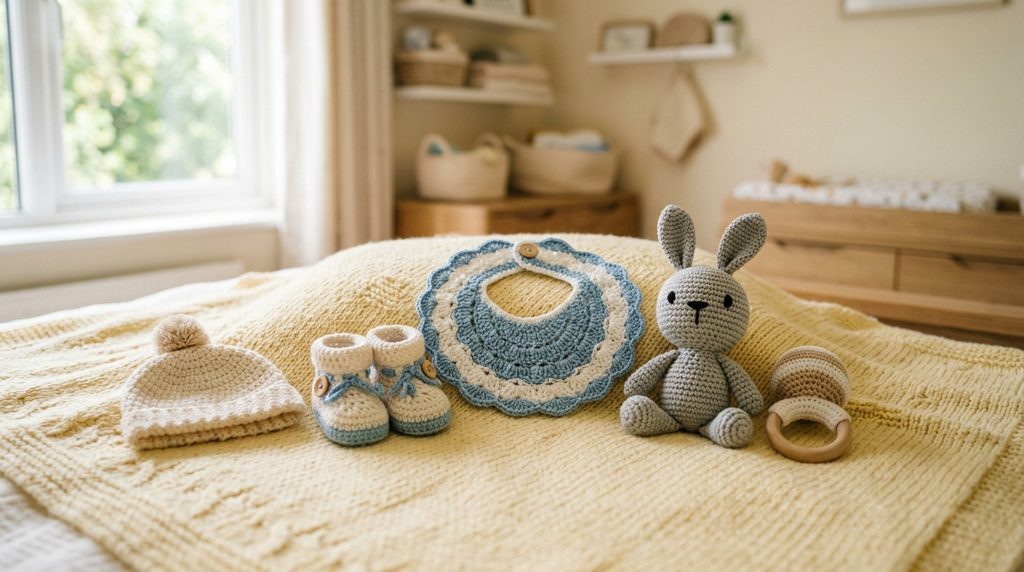
Baby crochet covers some of the most rewarding small projects in the whole craft, mostly because they finish quickly, use relatively little yarn, and tend to be genuinely treasured by whoever receives them. Historically, a new arrival’s first wardrobe was called a layette, and handmade layette sets — a blanket, hat, sweater, and booties, all worked by hand — were common well before ready-made baby clothing took over. Baby crochet today carries that same spirit, even if most people are making one or two pieces rather than a full matching set.
What makes baby crochet worth the time investment isn’t just the size — small projects finish fast regardless of what you’re making — it’s that a handmade piece tends to get kept in a way store-bought items rarely do. A hat outgrown in a few months still ends up in a keepsake box more often than a mass-produced version would, simply because someone made it by hand for a specific child.
This roundup walks through eight baby crochet projects worth knowing, what makes each one worth the effort, and a few real safety points worth understanding before you start, since baby items carry different considerations than adult accessories do.
Table of Contents
1. The Baby Blanket
A blanket is often the first baby crochet project people attempt, since it doesn’t require any shaping and mistakes are easy to spot before they get buried under dozens more rows. One real safety point worth knowing here: the American Academy of Pediatrics recommends against loose blankets in a crib for babies under 12 months, due to suffocation and entanglement risk. A handmade blanket is still a wonderful gift — it’s just better suited to supervised tummy time, stroller use, or a crib once a baby is older, rather than being placed in with a sleeping infant.
A lighter, more open stitch also drapes better over a stroller or car seat than a dense, heavy one, which makes a blanket meant for daytime use a slightly different project than one intended purely as a keepsake to display.
2. Baby Booties
Small, quick, and a good way to practice basic shaping without committing to a full garment, booties are a natural next step after a blanket. Because they’re worked in miniature, a booty pattern is also a reasonable place to try a stitch pattern you haven’t used before, without the time investment a larger project would need.
Booties made for a baby who isn’t walking yet don’t need a hard sole the way toddler shoes would — a soft, simple foot shape worked entirely in yarn is both easier to make and more comfortable for a foot that’s still developing.
3. A Baby Hat
Hats scale down easily from adult patterns, and a soft, simple beanie in a lighter weight yarn works well for a baby’s more delicate skin. Avoid anything with long ties or dangling embellishments on a hat meant for regular wear, since loose strings near the neck and face carry their own risk for infants and young children.
If you want the full construction logic behind hat shaping — crown increases, body length, and brim — before scaling a pattern down to baby size, our complete crochet hat guide covers the technique in more depth.
4. A Crochet Bib
A bib is a genuinely practical piece of baby crochet, useful rather than purely decorative, and it uses very little yarn. A firmer cotton yarn holds up better to the frequent washing a bib gets than a softer acrylic blend would.

5. A Baby Cardigan or Sweater
More involved than the smaller projects on this list, a baby cardigan introduces basic garment construction at a forgiving scale, since the small size means less yarn and a shorter timeline than an adult version of the same build. If you want a complete matching set rather than a single piece, our strawberry-themed baby gift set walks through a coordinated hat, cardigan, booties, and blanket built together.
Ties or ribbon closures are generally a safer choice than buttons for a baby cardigan meant for regular wear, since a small button that works loose over time is a genuine choking risk for an infant who puts everything in their mouth.
6. An Amigurumi Toy
Soft, stuffed animals are a favorite in baby crochet specifically because they double as both a toy and a keepsake. Safety matters more here than almost anywhere else on this list — plastic safety eyes carry a real choking risk for young children, so embroidered eyes are the safer choice for anything meant to go directly into a baby’s hands. Our full amigurumi duck pattern covers this safety consideration in detail, along with the stuffing and construction technique itself.
Stuffing choice matters too. Polyester fiberfill is washable and holds its shape well, which suits an item that’s going to be handled, dropped, and washed repeatedly far more than natural stuffing materials that can compress or clump over time.
7. A Swaddle-Style Wrap
Worked in a lighter, more open stitch than a standard blanket, a swaddle-style wrap is meant for supervised use rather than unsupervised sleep, similar to the safety note under the blanket entry above. A breathable cotton or bamboo-blend yarn suits this piece better than a heavier wool, since the whole point is a light, airy layer rather than a warm, dense one.
8. A Set of Baby Burp Cloths
Practical, fast, and a good stash-buster for smaller amounts of leftover cotton yarn, burp cloths round out this list as among the quickest baby crochet projects to finish. They’re also a reasonable first project for someone brand new to crochet, since a flat, simple rectangle in a sturdy stitch is genuinely all that’s needed.
Choosing Your First Baby Crochet Project
If you’re newer to crochet generally, burp cloths or a simple hat are the most forgiving places to start, since both involve minimal shaping and finish quickly enough to build confidence before moving to something bigger. Our beginner-focused guide covers the broader basics if you’re still getting comfortable with foundational stitches.
Booties and bibs are a reasonable next step once basic stitches feel comfortable, followed by a blanket or swaddle wrap once you’re ready for a larger, longer project. Save the cardigan and amigurumi toy for once you’ve built up some general construction experience, since both ask for more shaping and finishing than the earlier projects on this list.
There’s no real downside to working through several of these projects in roughly this order rather than jumping straight to the most ambitious one. Each smaller piece reinforces a skill the bigger projects rely on, so time spent on booties or a bib before attempting a full cardigan tends to pay off in fewer mistakes later.

FAQs : Baby Crochet
What yarn is safest for baby crochet projects?
A soft, machine-washable cotton or a cotton-acrylic blend is generally the safest and most practical choice, since baby items need frequent washing and babies have more sensitive skin than adults. Avoid novelty yarns with loose fibers or sequins that could come loose.
Should I use buttons on baby crochet garments?
Small buttons carry a choking risk for infants and young children, so snaps or ties sewn on securely are a safer closure choice for anything a baby might handle directly. If buttons are used, they should be sewn on very securely and checked periodically for looseness.
Is it safe to put a handmade blanket in a baby’s crib?
Not for unsupervised sleep in babies under 12 months, per current AAP guidance — loose blankets, along with pillows and stuffed toys, carry suffocation and entanglement risk in a crib. A handmade blanket is better used during supervised awake time, or once a baby is old enough that current safe-sleep guidance no longer applies.
How much yarn does a typical baby crochet project need?
This varies enormously by project — a hat or a pair of booties might use well under a quarter skein, while a full blanket needs several skeins depending on size and stitch density. Weighing a similar finished piece, or checking a specific pattern’s yardage, gives a far more accurate number than any single general estimate.
What’s the best baby crochet project for a baby shower gift?
A hat, a set of booties, or burp cloths tend to be the safest and most universally useful gifts, since they don’t depend on precise sizing the way a garment does and are practical from day one regardless of the baby’s exact measurements at birth.

Leave a Reply