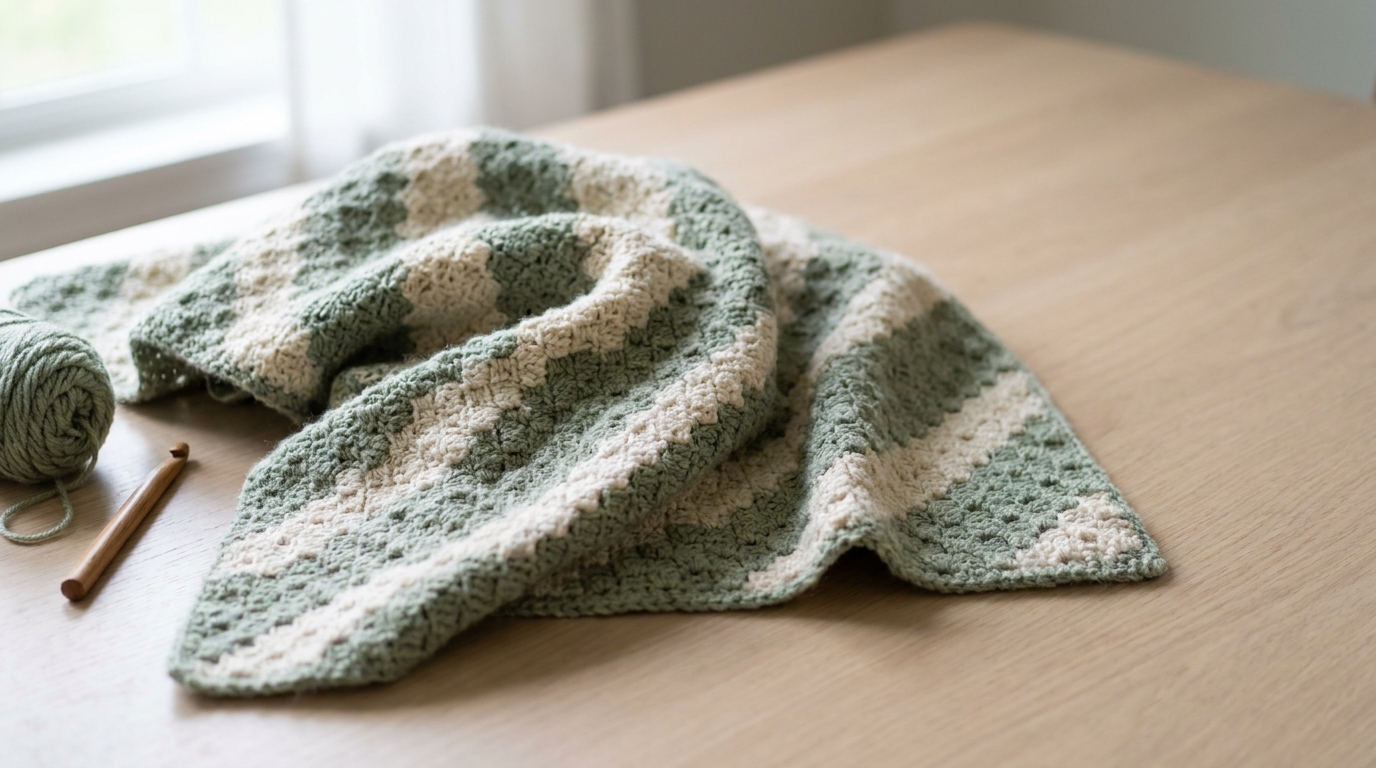
Most crochet stitches get you a flat row, then another flat row on top. C2C crochet doesn’t. You start at one corner with a single little block, and the whole piece grows sideways on a diagonal until it’s as wide as you want. Then you shrink it back to a point. A block is three double crochets and a chain-3 space, nothing more, and the same block builds blankets, pillows, scarves and even pixel pictures. This guide walks through the blocks, how the shaping works, charts, color changes, and the slip-ups that bite almost everyone once.
Quick Facts
- What it is: corner to corner crochet, worked on the diagonal in rows of blocks
- Who it suits: beginners who can chain, slip stitch and double crochet
- The block: chain 3 plus 3 double crochets, worked into a chain-3 space (US terms)
- Good for: blankets, rectangles, pillows, charted designs
- Yarn: medium weight (CYC category 4) is a friendly starting point; use the hook size on the label
- Terms: US throughout, with a UK note further down
Table of Contents
What C2C Crochet Actually Is?
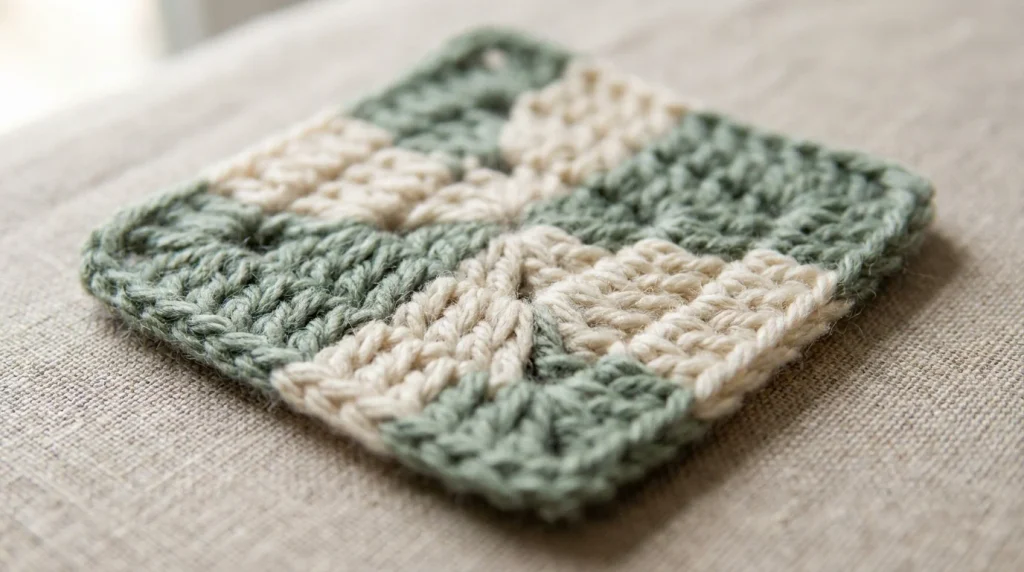
C2C stands for corner to corner. Instead of crocheting straight across and turning, you build the fabric one diagonal row at a time. Row one has a single block. Row two has two. Row three has three, and the piece spreads out into a triangle. Once it’s wide enough, each row loses a block, and the triangle closes into a square or rectangle.
The nice part is how countable it is. Every block is identical, so size is just arithmetic. Twelve blocks across means twelve blocks across, whatever your yarn is doing. The blocks also look like small tiles, which explains why c2c crochet shows up so often in graph patterns. A square on the chart is a block on your hook. A little heart, a name, a cartoon face: all of it comes down to which color goes in which tile.
There’s another upside. You never start with a huge foundation chain, so you aren’t counting 150 stitches before you’ve made a single one. You can also stop whenever the piece looks big enough, which is handy if you’re working from a pile of leftover yarn. Plenty of people find c2c crochet easier to enjoy for exactly this reason: you see a clean triangle growing from the first row.
You only need three skills: chain, slip stitch, double crochet.
Gather Your Supplies for C2C Crochet
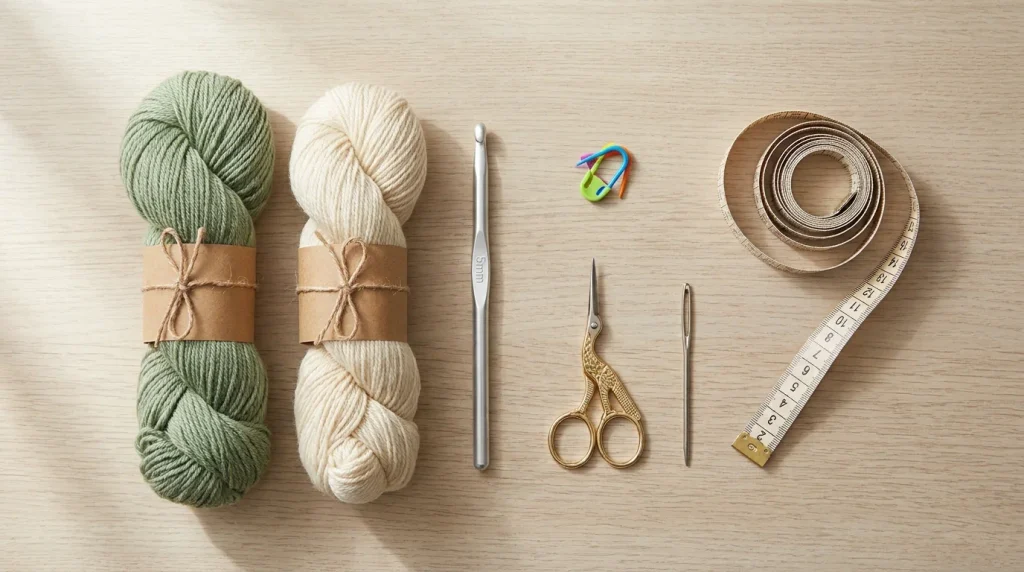
Yarn, a hook, scissors, a yarn needle. Add a stitch marker or a bit of scrap yarn to flag the right side, since it’s surprisingly easy to forget which side is which on a diagonal piece.
About yarn: go smooth, and go medium weight. The Craft Yarn Council numbers yarn from 0 (lace) to 7 (jumbo), and category 4 is the medium group. Light and mid-tone colors show the blocks clearly. Very dark yarn is miserable for a first project because you can’t see where your stitches went, and fuzzy yarn blurs the block edges. Start with the hook size on the label. If the swatch feels stiff like cardboard, go up a size.
And please make the swatch. Work five blocks by five blocks, measure it, divide the width by five, and you’ve got your block width. That one number is what lets you plan a blanket without guessing.
A Quick Note on UK Terms
Everything here is in US terms. UK patterns call the double crochet a treble, so where a US pattern says “dc” a UK one says “tr.” If your pattern seems to be off by one stitch, this breakdown of what TR means in crochet will sort out which system you’re reading.
How to C2C Crochet Step by Step
I’m using the 6:3 method, the most common one: chain 6 to begin a row, chain 3 to begin each block after that. These steps follow widely published conventions for the technique. Try them on your swatch before you start anything big, because that’s the cheapest way to catch a misread.
- Chain 6 and make the first block. Double crochet into the fourth chain from the hook, then into the next two chains. The three chains you skipped become the chain-3 space, and the three double crochets finish the block. Turn.
- Begin row 2 with a fresh block. Chain 6, then double crochet into the fourth chain from the hook and the next two chains. This block sits at the edge and is what makes the row wider.
- Join it to row 1. Slip stitch into the chain-3 space of the block below, chain 3, then work 3 double crochets into that same space. Turn. You’ve got two blocks.
- Keep going with increase rows. Chain 6 and make the starting block. Then across the row: slip stitch into the next chain-3 space, chain 3, 3 double crochets in that same space. Each row has one block more than the one before, so row 5 has five.
- Stop when you hit your width. For a square, count the blocks along one side. When a row has that many, you’re at the widest point.
- Switch to decrease rows. Turn, then slip stitch across the three double crochets of the first block and into its chain-3 space. Chain 3 and make 3 double crochets in that space. Carry on across with slip stitch, chain 3, 3 double crochets in each chain-3 space. At the last block of the row below, slip stitch into the chain-3 space and stop. No new block there. Turn.
- Finish on one block. Every decrease row has one block fewer than the last. When one remains, cut the yarn, pull the tail through, weave in the ends.
If the count isn’t climbing by one each row, look at step 2. Skipping the chain-6 starting block before the first slip stitch is the usual cause.
C2C Crochet Increases and Decreases
C2C crochet increases and decreases are what shape the piece. Add a block at the start of a row and it widens. Skip the last block and it narrows. Everything you’ll ever make this way uses three kinds of row.
| Row type | How it starts | How it ends | Block count |
|---|---|---|---|
| Increase row | Chain 6, make a new block | Last block worked, turn | One more |
| Straight row | Chain 6, make a new block | Slip stitch into last chain-3 space only, turn | Same |
| Decrease row | Slip stitch across the first block | Slip stitch into last chain-3 space only, turn | One less |
A straight row adds a block at one end and drops one at the other. The count stays put, and that’s what stretches a square into a rectangle.
Working Out the Number of Rows
Call the shorter side a blocks and the longer side b blocks. Total rows = a + b − 1. You increase for a rows, work b − a straight rows, then decrease for a − 1 rows. Total blocks = a × b.
| Finished shape (blocks) | Total rows | Total blocks |
|---|---|---|
| 10 x 10 | 19 | 100 |
| 15 x 20 | 34 | 300 |
| 20 x 30 | 49 | 600 |
The 5:2 Alternative
Plenty of people prefer the 5:2 method. You chain 5 at the start of an increase row, then double crochet in the third chain from the hook and in the two chains after it. Same size block, slightly different feel. Choose one and don’t mix them within a project.
Reading C2C Crochet Graph Patterns and Charts
A c2c crochet chart is a grid. One square, one block, and the square’s color is the yarn color. You work it diagonal by diagonal, beginning at the corner marked as row 1.
The first diagonal holds one square, the second holds two, the third holds three. Those are your increase rows. After the widest diagonal the numbers fall again, and those are your decreases. Since you turn at the end of every row, you read the chart in alternating directions, and the key or row arrows will tell you where to begin.
Some designers skip the grid and write each row as a color sequence instead. Same information, different packaging. With a paper chart, put a sticky note under the row you’re on. Losing your place halfway along a diagonal is how most picture blankets go wrong.
For examples of how designers apply the stitch to pictures, Interweave’s overview of C2C basics covers increasing, decreasing and color changes in both double crochet and half double crochet.
Color Changes in C2C Crochet
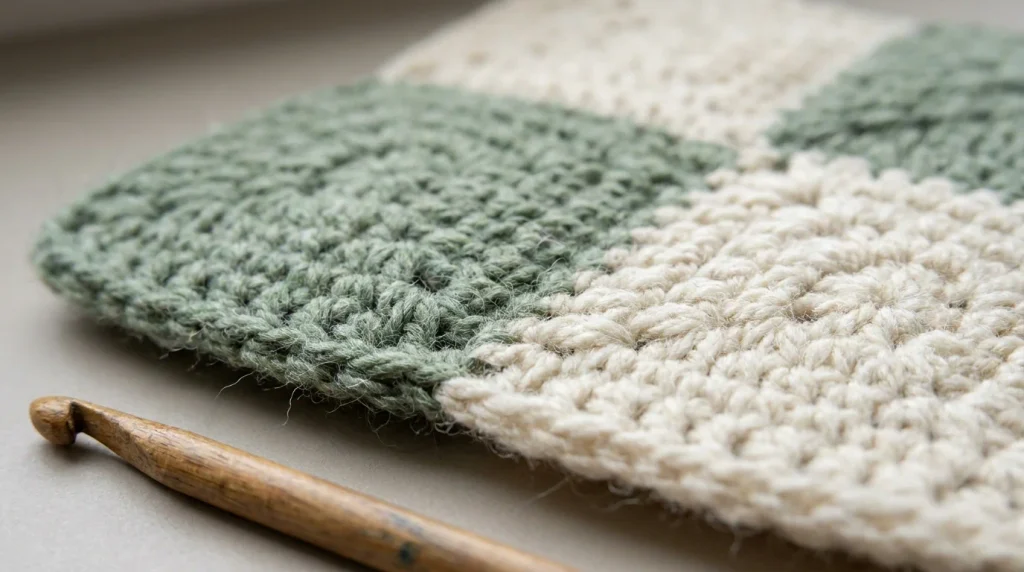
To change colors in c2c crochet, work the slip stitch that joins the old block to the next with the new yarn, then chain 3 and make the new block in the new color. Some patterns switch on the last double crochet of the old block instead. Either works if you do it the same way every time.
A basic mid-row change goes like this:
- Finish the last block in the old color.
- Hook into the next chain-3 space and slip stitch with the new yarn.
- Chain 3, then 3 double crochets in the new color.
- Leave tails of around 4 inches (10 cm) so they’re easy to weave in.
Want a stripe across the whole piece? Change at the start of a row instead. Chain 6 in the new color and carry on.
Pictures are fussier. If a color only appears in a few blocks, give it its own small ball or bobbin instead of dragging yarn along the back. Carrying is fine across a block or two. Across a longer gap the strand pulls the fabric tight and shows through the gaps between blocks. Christa Co Design’s decrease tutorial has photos of a color change on a decrease row, which is the trickiest place to do one.
Making a C2C Crochet Blanket
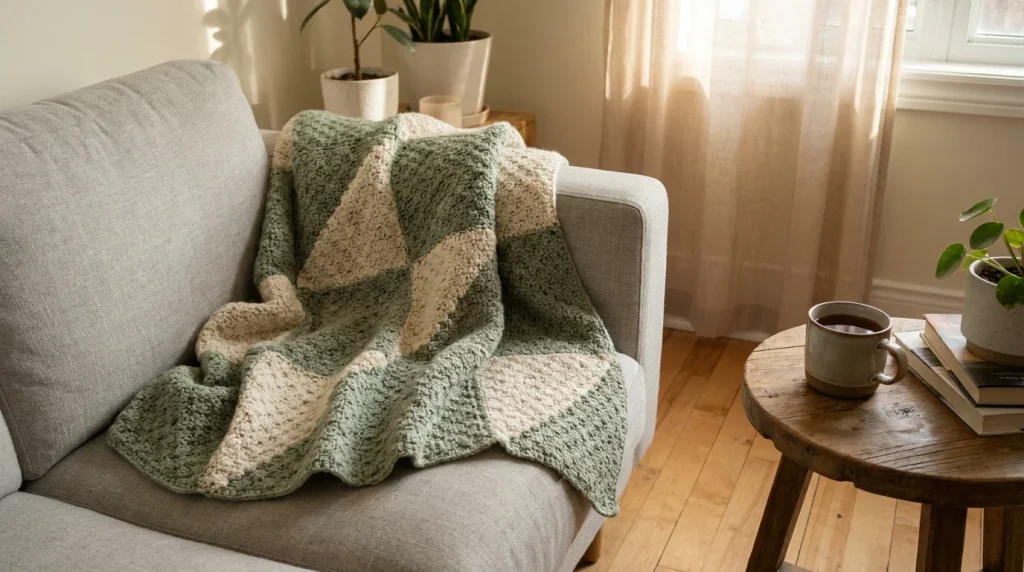
A c2c crochet blanket is a large rectangle. Increase to the short side, work straight rows until you reach the length, then decrease. The extra effort is all in the planning: size, yarn and border.
Pick the Size in Blocks
Take the block width from your swatch. Divide the finished width you want by it and round to a whole number. A blanket 36 blocks wide, with each block 1.5 inches across, comes out around 54 inches wide. Do the same for the length.
Estimate the Yarn
Weigh the swatch, divide by 25 (the number of blocks in it), then multiply by your total block count. Add roughly 10 percent for the border and ends. It’s an estimate and nothing more, so on a big blanket buy one extra skein from the same dye lot.
One practical tip: a c2c crochet blanket takes a while, so keep a paper tally of finished rows. Phones get picked up, dogs need walking, and a tally beats trying to count diagonals later.
Finish With a Border
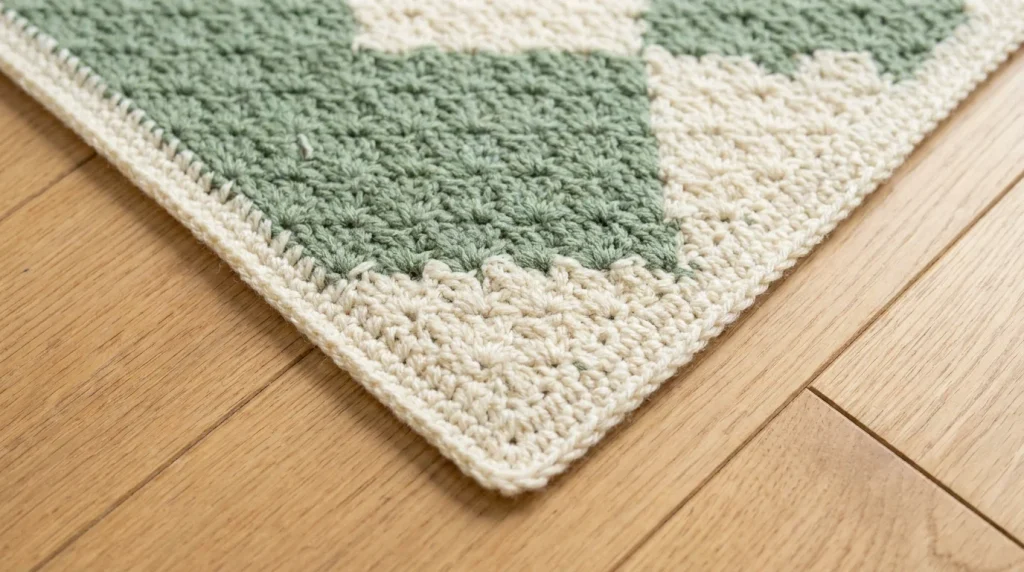
C2C edges come out stepped and zigzagged. A round of single crochet around the outside squares everything up and tucks the stitch tips away. Put 3 single crochets in each corner so it lies flat and doesn’t cup.
C2C Crochet Problems and How to Fix Them
Most c2c crochet problems come back to tension, counting or joining.
Wavy edges. Your slip stitches are probably too tight or too loose. They have no height, so give them the same tension as your double crochets and don’t yank them snug.
A piece that leans. Turn the same direction every row, and always slip stitch into the chain-3 space, never into the top of the double crochets.
Row counts that don’t match the chart. Count the blocks on the diagonal after each row until it’s automatic. A marker in the first block of every tenth row helps.
Gaps between blocks. Usually the slip stitch landed in the wrong space, or the double crochets went into the stitches instead of into the chain-3 space. Work them into the space.
Holes at the start of rows. The chain-6 is too long or too loose. Snug each loop before you turn and keep the chains an even length.
C2C Crochet Variations Worth Trying
Once the double crochet version feels easy, c2c crochet branches out.
Half double crochet blocks. A slightly smaller, denser block. It uses chain 2 and two half double crochets in place of chain 3 and three double crochets. New to the stitch? This half double crochet guide is a good warm-up.
Small projects. A c2c dishcloth, scarf or pillow front is a low-stakes place to practice color changes before a blanket. A scarf is a long narrow rectangle only a few blocks wide. These finish fast, so you see the pattern click without giving up weeks.
Pixel art. Every block acts as a pixel, so graph patterns turn the technique into a drawing tool. Hearts, stripes and letters are easy starting shapes, and a simple chart is a good test before anything detailed.
Other ways to build a blanket. If you’d rather make separate motifs, the granny square pattern works in rounds. And for a wavy blanket that also grows from a repeating row, try the ripple stitch tutorial.
FAQs
Is c2c crochet hard for beginners?
Not really. C2C crochet for beginners uses only the chain, slip stitch and double crochet. The part that trips people up is keeping count, and a small swatch makes that much easier.
Is corner to corner crochet the same as c2c?
Yes. C2C is just the usual abbreviation. A corner to corner crochet pattern and a c2c pattern are the same thing.
What stitch is used in c2c crochet?
Double crochet, mostly, with chain 3 forming the space. Half double crochet is the other popular choice, and a few designers use fancier stitches for texture.
Do you turn your work in c2c crochet?
Yes, at the end of every row. It’s also why charts alternate their reading direction.
When do I start decreasing in a c2c crochet blanket?
When the short side hits your target number of blocks. For a square, that’s the row with the same block count as the side length. For a rectangle, work straight rows first, then decrease.
How much yarn does a c2c crochet blanket need?
No fixed answer, because yarn weight, hook size and tension all change the total. Weigh a five-by-five swatch, divide by 25, multiply by your total blocks and add a buffer. The number you get reflects your own gauge.
Final Thoughts
C2C crochet is one block, one rule for growing and one rule for shrinking. Learn those, work out your size in blocks, and the rest is counting. Make the swatch, try the 6:3 method exactly as written, then move on to a blanket or a chart when it starts to feel automatic.
Want more to try next? Browse the crochet stitches category or the beginner guides.

Leave a Reply