
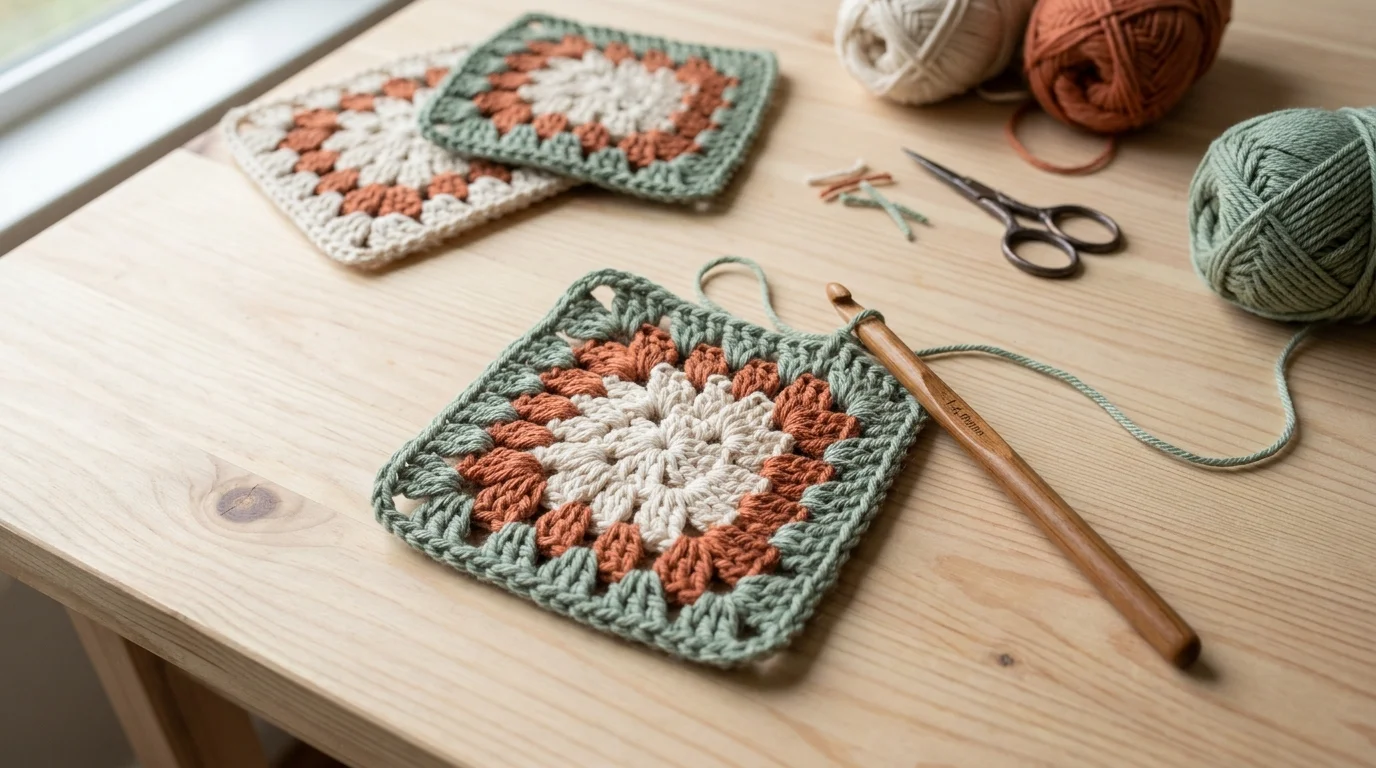
A granny square pattern is a set of round-by-round instructions for a square motif worked from the center out. You build it from clusters of three double crochet stitches separated by chain spaces. Three skills cover the classic version: chain, slip stitch, double crochet. Those are the same basics Interweave lists for this motif. Learn one square and you can make coasters, pillow fronts, bags, or a whole blanket. Everything below uses US terms, and nothing gets turned.
Table of Contents
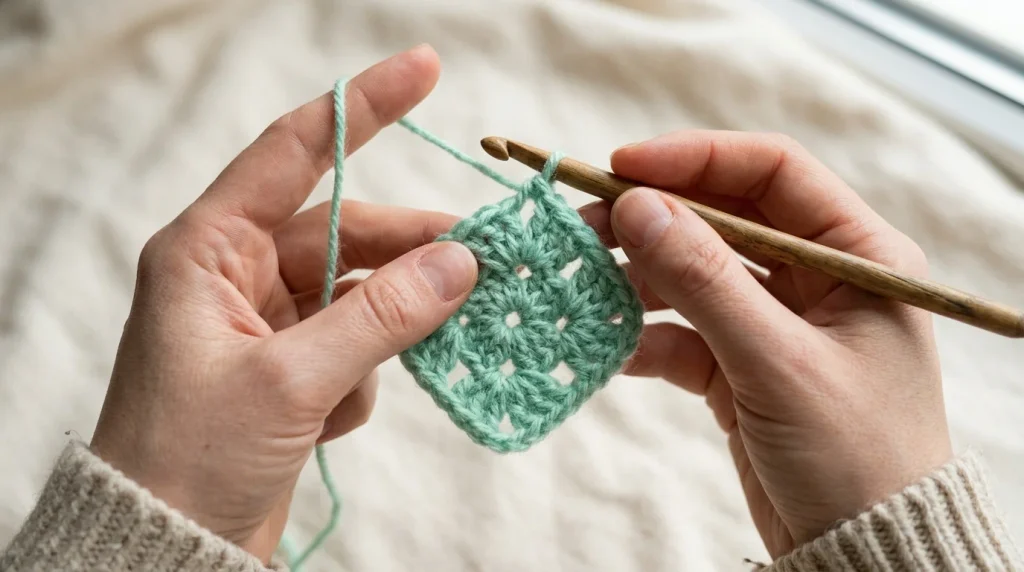
What Makes a Classic Granny Square Pattern?
Double crochet. Clusters. Chain spaces. That’s the whole vocabulary.
Each round sits on the one before it, so the square grows at the same rate in all four directions. Wikipedia’s granny square entry describes the motif the same way.
Corners do the shaping. Every corner holds two clusters of three double crochet with two chains between them, and those chains are what turn the fabric ninety degrees. Skip them and you get a circle instead of a square. Plenty of people learn that the hard way.
The structure repeats, which is why adding rounds scales a granny square pattern from a coaster up to a blanket. It’s also why the motif eats scrap yarn so well. Wikipedia notes that multicolor versions are a practical use for leftovers.
Materials for a Granny Square Pattern
Yarn. Worsted, because you can actually see what you’re doing. The Craft Yarn Council puts worsted at 4 on its 0-to-7 scale — medium, right in the middle. Go smooth and light-colored if you can. Dark, fuzzy yarn hides every mistake, which sounds helpful right up until you need to find one.
Hook. Whatever the ball band says, to start. Then swatch. Stiff fabric means go up a size. Gaps between clusters means go down.
Notions. Scissors. Yarn needle for the ends. Stitch markers earn their keep on your first few squares. Tape measure, because finished size rarely matches what you guessed.
Check US or UK Terms First
US double crochet (dc) equals UK treble (tr). US slip stitch equals UK slip stitch. US single crochet equals UK double crochet. Mix the systems and your stitch height changes, then the square won’t lie flat and you’ll spend an hour blaming the pattern.
Abbreviations used below: ch = chain, sl st = slip stitch, dc = double crochet, sp = space, rnd = round.
Granny Square Pattern: Step by Step
Starting Ring
Chain 4. Join with a slip stitch into the first chain to form a ring. A magic ring works too and pulls the center closed with no hole. Either is fine.
Round 1
Round 1 is where most of the thinking happens. Chain 3 — that counts as your first double crochet, so don’t skip it — then put 2 dc into the ring. Chain 2 for the first corner. Now 3 dc into the ring, chain 2 again, and keep repeating until four clusters and four chain-2 corners have gone in. Slip stitch to the top of the starting chain 3 to close the round. You end with four clusters, one per side, and a chain-2 space between each pair.
Round 2
Slip stitch across the next two stitches and into the first chain-2 corner space. Chain 3. Work 2 dc, chain 2, and 3 dc into that same space — that’s your first full corner. Chain 1 to move on.
The next corner space gets (3 dc, ch 2, 3 dc), chain 1 again, and that pattern carries around all four corners. When you get back to the start, chain 1 and join to the top of the starting chain 3. Eight clusters now.
Round 3
Slip stitch to the first corner space. Chain 3, then work 2 dc, ch 2, 3 dc into that corner. Chain 1. Side space next: 3 dc into the chain-1 space on the side, chain 1, then move on to the next corner. Repeat around every side and join. Round 3 gives each side space one cluster. Corners still get two.
Round 4 and Beyond
The rule stays the same. Corner group into each corner space, 3 dc into every chain-1 space along the sides, chain 1 after each cluster. Your cluster count is the check: four times the round number. Round 4 has 16, round 5 has 20. Stop when your granny square pattern reaches the size you want, fasten off with a six-inch tail, and weave it in.
Sizing a Granny Square Pattern
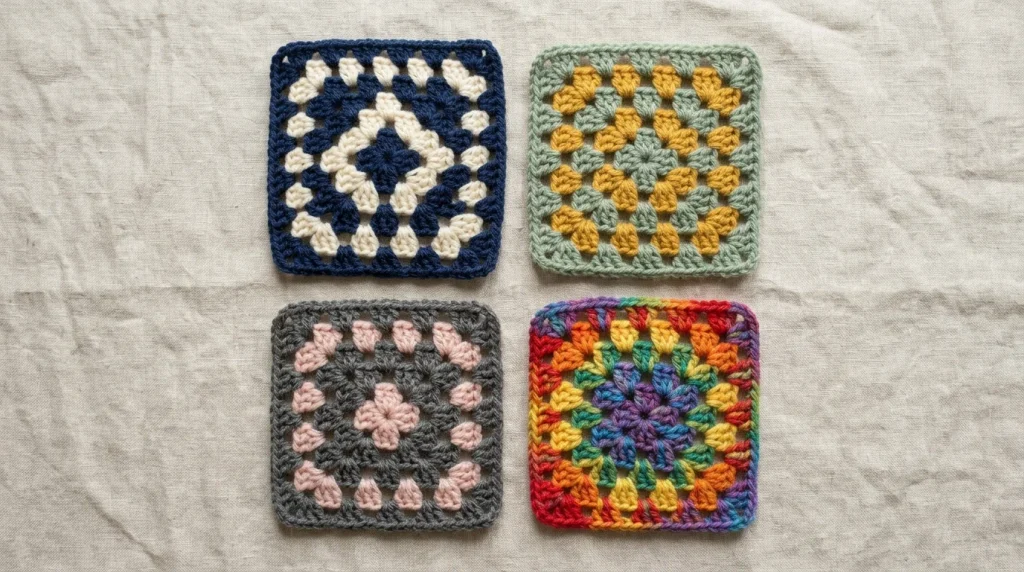
No fixed finished size. Gauge sets it. The same instructions in lace yarn make a doily-sized motif. In bulky yarn they make a coaster in three rounds. That’s not a flaw in the pattern. It’s how motif crochet works.
Measure your first square, then divide the width you want by that number. That tells you how many squares fit across your project. One square bigger? Add or remove a round. Many squares matching? Same hook, same yarn, same round count every time. Block them to the same measurement before joining, not after.
Solid Granny Square Pattern Variation
Holes bother you? Fill them. After round one, work a dc into each stitch along the sides and keep the (3 dc, ch 2, 3 dc) corner group. Denser, warmer, better for pillow covers and potholders. A solid granny square pattern also uses noticeably more yarn than the open version, so plan accordingly.
Fixing a Granny Square Pattern That Goes Wrong
The circle problem comes up a lot. Almost always it’s corners with too few stitches, or a chain-2 that got skipped somewhere. Each corner needs 3 dc, ch 2, 3 dc, so recount your clusters against the rule above and see which corner doesn’t match.
If the edges ruffle, the side spaces picked up extra stitches. One cluster per chain-1 space, no more. Cupping upward usually means tension’s too tight, so go up a hook size and try a fresh square.
Lopsided corners are almost always a missed corner or a slip stitch in the wrong chain. Mark the first corner space and recheck every round until you trust yourself. And if you keep getting a hole in the center, pull the starting tail hard or switch to a magic ring.
Color Planning for a Granny Square Pattern
Color is half the appeal, honestly.
Two-color rounds. Light, dark, light, dark. Clear stripes, no thinking required.
Bright center, neutral body. One loud round in the middle, then cream or gray carries the rest.
Scrap squares. Change color every round. Use whatever’s in the bag.
Analogous. Three shades of one hue — sage, moss, forest. Subtle, and it looks deliberate even when it wasn’t.
Change color at the joining slip stitch and start the new round in a corner. Keep the value contrast high or the clusters turn to mush. Two colors look identical in a photo? Convert it to grayscale and check again.
Joining the Squares
Every granny square pattern eventually hits the joining stage. Lay the squares out on the floor first, rearrange until the colors balance, and then commit.
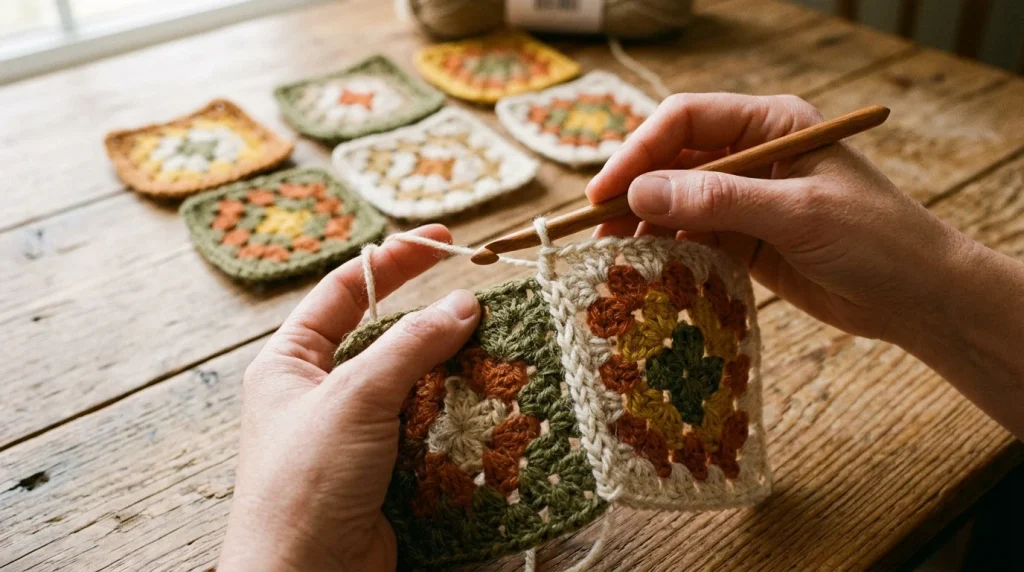
For a slip stitch seam, hold two squares right sides together and slip stitch through both loops along the edge. Firm, flat ridge. A whip stitch with a yarn needle through the back loops only is nearly invisible and flexes well. Join as you go saves the seaming session at the end — you attach each new square at the corner and chain-1 spaces on its last round. And the flat braid join sits on the front as a raised grid, neat on solid colors.
Where four squares meet, work those points last. Otherwise they pucker.
Projects Built on a Granny Square Pattern
Blankets, mostly. The crochet lap blanket pattern covers dimensions that are actually finishable. Smaller version: the crochet newborn blanket takes a handful of squares. Different construction entirely: the crochet throw blanket pattern goes corner-to-corner.
Bags work well too. The crochet tote bag guide covers handle anchoring and yarn choice, and squares suit the sides nicely. Wearables: crochet vest designs. Small gifts: crochet accessories.
Finishing and Blocking
Weave in every end before you block. Acrylic: pin it, steam lightly, keep the iron off the fabric. Cotton or wool: dampen, pin flat, let it dry.
FAQs
How many rounds does it need?
No rule. Three to five is typical for a motif, and finished size depends on yarn weight and hook.
Do I turn at the end of each round?
The classic open version usually doesn’t. Some crocheters turn and chain 3 each round for a slightly different texture. Both are valid.
Best yarn for a beginner?
Smooth worsted in a light color. You can see your stitches, and you can rip back without the yarn felting.
Can I use cotton?
Yes. Less stretch than wool, so watch your tension and block gently.
How do I get same-size squares?
Same yarn, same hook, same round count. Block evenly. There’s no shortcut.

Leave a Reply