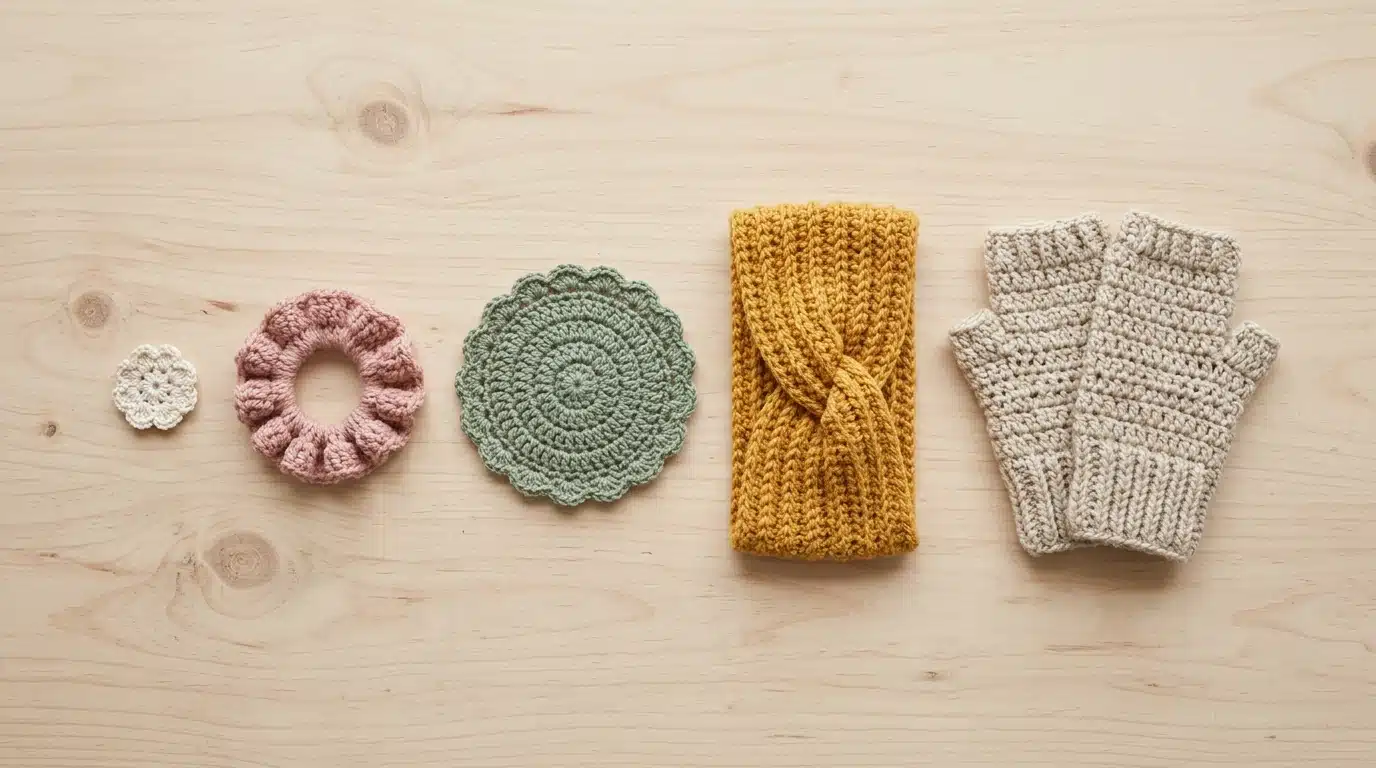
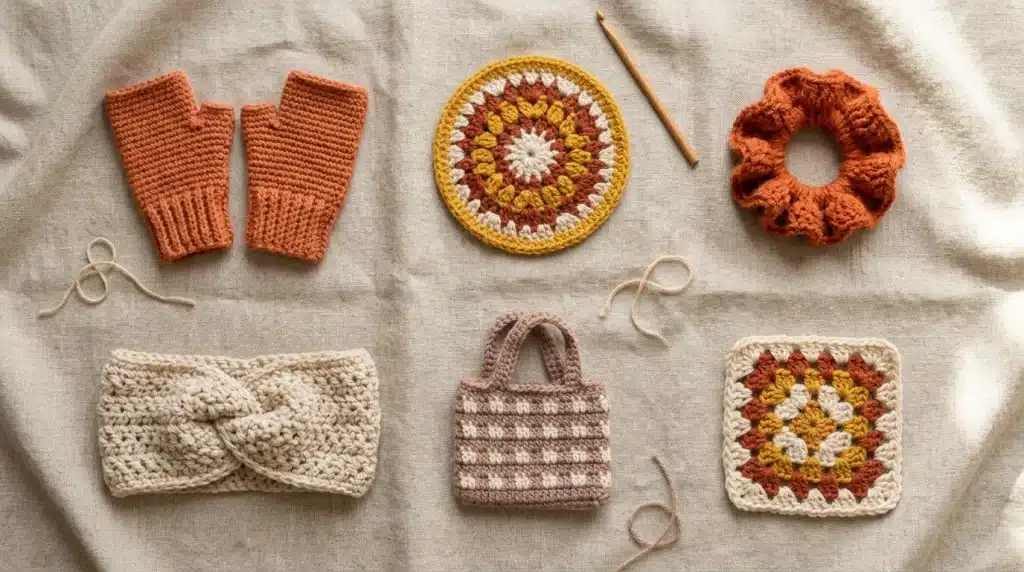
Crochet accessories are where most people’s second and third projects come from, right after the first scarf or dishcloth proves the basics have stuck. Not every project needs to be a full garment. Half the fun of this craft lives in the smaller stuff — the things that take an evening or a weekend rather than a month, use a fraction of a skein, and still teach you something you’ll use later on a bigger piece. That’s really what a fashion accessory is at its core: something secondary to the outfit that still does real work, whether that’s warmth, texture, or just a bit of personality.
This roundup covers a handful of crochet accessories worth making next, why each one earns its place on the list, and what skill it actually teaches you along the way — because the best accessory to pick usually isn’t the cutest one, it’s the one that builds toward whatever you want to make after it.
Table of Contents
Fingerless Gloves
These sit at the top of most people’s list once hats and scarves start to feel routine, mostly because there’s no finger-by-finger shaping involved — just a fitted tube with a gap for the thumb. Among quick crochet accessories, this one’s popularity makes sense: it’s fast, it uses very little yarn, and it teaches negative ease in a way that carries over into fitted garments later, since the whole design depends on the fabric being slightly smaller than the hand it covers.
They’re also forgiving in a way a lot of accessories aren’t. Because the thumb gap is really the only tricky part of the build, a first attempt that comes out slightly off is easy to understand and fix on a second try, rather than leaving you unsure what actually went wrong.
We’ve got a full step-by-step build covering gauge, thumb placement, and sizing if you want the complete pattern rather than just the overview.
Hooded Cowls
A hooded cowl solves a problem plain scarves never quite fix — neck coverage plus a hood to pull up when it’s windy, without the bulk of a full hooded sweater. Among two-part crochet accessories specifically, it’s a good next step once basic cowls feel too simple, since joining a fitted hood to a looser cowl body teaches you to work two different fit zones in one piece, which is a skill that carries directly into garment-making later on.
This one takes a bit more patience than gloves or a headband, mostly at the point where the hood attaches to the cowl body. Getting that join centered and even matters more here than in almost any other accessory on this list, since an off-center hood throws off the whole look of the finished piece.
Our complete hooded cowl pattern walks through both hood-building methods if you want to try this one properly.
Structured Caps
Not every crochet accessory needs to be soft and stretchy, and structured caps are proof of that. A brimmed cap — closer to a baseball cap than a beanie — teaches an entirely different skill set: panel construction, brim stiffening, and keeping a shape rigid rather than relying on stretch to hold it. It’s a good pick once you’re comfortable with basic construction and want to try something with real structure for the first time.
The brim is really the whole challenge with this one. Getting a flat, stable curve instead of a floppy edge takes some deliberate stiffening, whether that’s a doubled layer of stitches or an inserted stiffener, and it’s a genuinely different problem than anything a soft beanie or cowl asks you to solve.
Check out our step-by-step structured cap guide for the full brim-and-panel build.
Headbands and Ear Warmers
These are about as quick as crochet accessories get, often finishing in under an hour once you know the stitch pattern. A simple ribbed band worked flat and seamed into a loop, or a wider panel with a button closure, both work well here. Because the piece is small, it’s also a good place to practice a new stitch pattern you haven’t used before without committing to a full project’s worth of yarn.
If you’re trying to decide between a plain band and a wider, more decorative panel, the plain band is the faster build and the easier one to size correctly on a first attempt, while the wider panel gives more room to experiment with color or texture once you’re comfortable with the basic shape.
Market Totes and Project Bags
A sturdy tote worked in a firm stitch and a cotton or cotton-blend yarn holds its shape under weight far better than a soft, drapey yarn would. This is a good accessory for practicing tension consistency, since a bag with uneven stitches shows every inconsistency once it’s holding actual weight rather than just hanging decoratively on a hook or a shelf.
A basic tote also introduces handle construction, which is a small but genuinely useful skill on its own — a handle that’s too thin will stretch and dig into your hand under load, while one that’s properly reinforced holds up over repeated use in a way the rest of the bag doesn’t need to worry about.
Coasters and Small Motifs
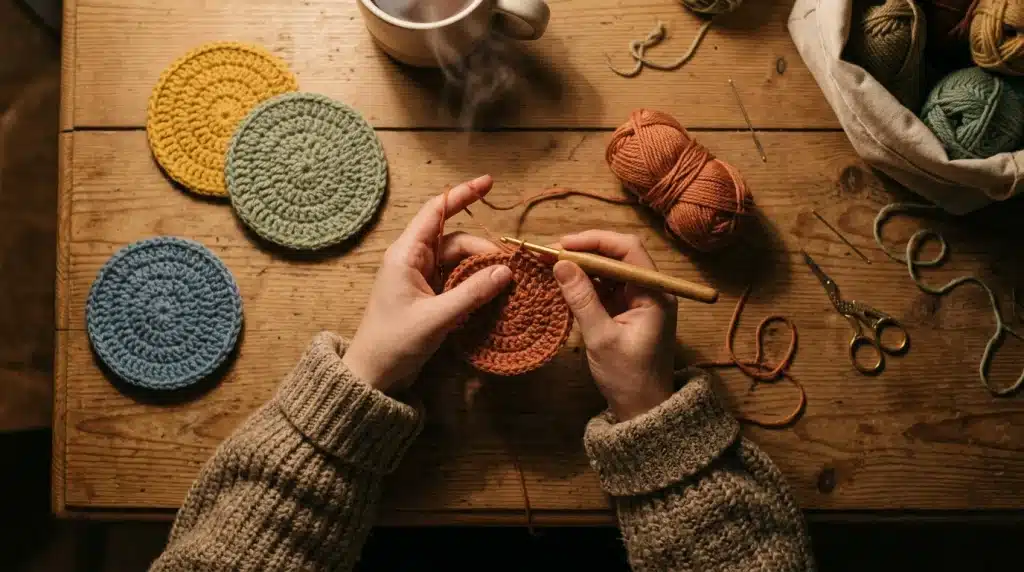
If you’re between bigger projects or want something to keep your hands busy while watching something, a set of coasters or small granny-square-style motifs is genuinely useful practice. Each one takes only a few minutes, which makes them a good place to try a new color combination or stitch you’re considering for a bigger project later, without much risk if it doesn’t work out.
This is also where a lot of people first practice joining multiple small pieces together, since a set of matching coasters or a handful of motifs sewn into a small mat both use the same basic joining logic that scales up into a full afghan or blanket eventually.
Scrunchies and Hair Accessories
These use barely any yarn and finish quickly, which makes them a reasonable gift option or a good stash-buster for leftover bits of yarn from bigger projects. They’re also a nice, low-pressure way to practice consistent tension in a small, repetitive round, since a scrunchie shows unevenness almost as clearly as a bag does, just on a much smaller and less time-consuming scale.
Because they use so little yarn, scrunchies are also a low-stakes place to try a stitch pattern you’ve been curious about but haven’t wanted to commit a full skein to testing.
Choosing What to Make First
If you’re newer to crochet, fingerless gloves or a simple headband are the most forgiving starting points among these crochet accessories — small enough that a mistake doesn’t cost much time, but real enough to actually wear once finished. Hooded cowls and structured caps ask for a bit more patience, since both involve joining two differently-shaped sections together, which is a step plain crochet accessories like coasters and scrunchies skip entirely.
A reasonable order to work through this list, if you’re going in roughly increasing order of difficulty, looks something like: coasters or scrunchies first to build basic consistency, then a headband or fingerless gloves once you’re comfortable with simple shaping, then a hooded cowl or structured cap once you’re ready to tackle two-part construction.
If you’ve been thinking about selling what you make, crochet accessories like these tend to be a practical place to start, since they’re quick to produce and easy to price individually. The Etsy Seller Handbook has decent general guidance on listing and pricing handmade goods if that’s a direction you’re considering, regardless of which platform you eventually choose.
FAQs
Which of these crochet accessories uses the least yarn?
Coasters and scrunchies use the least by a wide margin, often finishing on well under a quarter of a skein each. Headbands come next, followed by fingerless gloves.
What’s the best beginner project if I’ve never finished anything before?
A single coaster or a simple headband is the easiest full project to complete from start to finish, since neither involves shaping beyond a basic increase or decrease, and both are small enough to fix a mistake without unraveling much work.
Can I make any of these accessories with scrap yarn instead of buying new?
Yes, particularly coasters, scrunchies, and smaller motifs, since they don’t need much yardage and often look better with a bit of color variation than with one uniform skein.
How do I decide what accessory to make as a gift?
Fingerless gloves and headbands tend to be the safest gift choices, since sizing is more forgiving than a fitted hat or cap, and both work across a wider range of head or hand sizes without needing an exact measurement from the recipient.
Do I need different hooks for different accessories, or can I use one hook for most of these?
Most of these projects can be made with one or two hook sizes if you’re working primarily in worsted weight yarn. Structured caps and firm-bodied totes benefit from a slightly smaller hook than something like a soft cowl or a pair of gloves, but you don’t need a large hook collection to work through this whole list.
Is it better to finish one accessory type before starting another, or work on a few at once?
Either approach works, but finishing at least one full piece before starting a second tends to build confidence faster than juggling several half-finished projects, especially if you’re still getting comfortable with basic shaping and joining techniques.

Leave a Reply