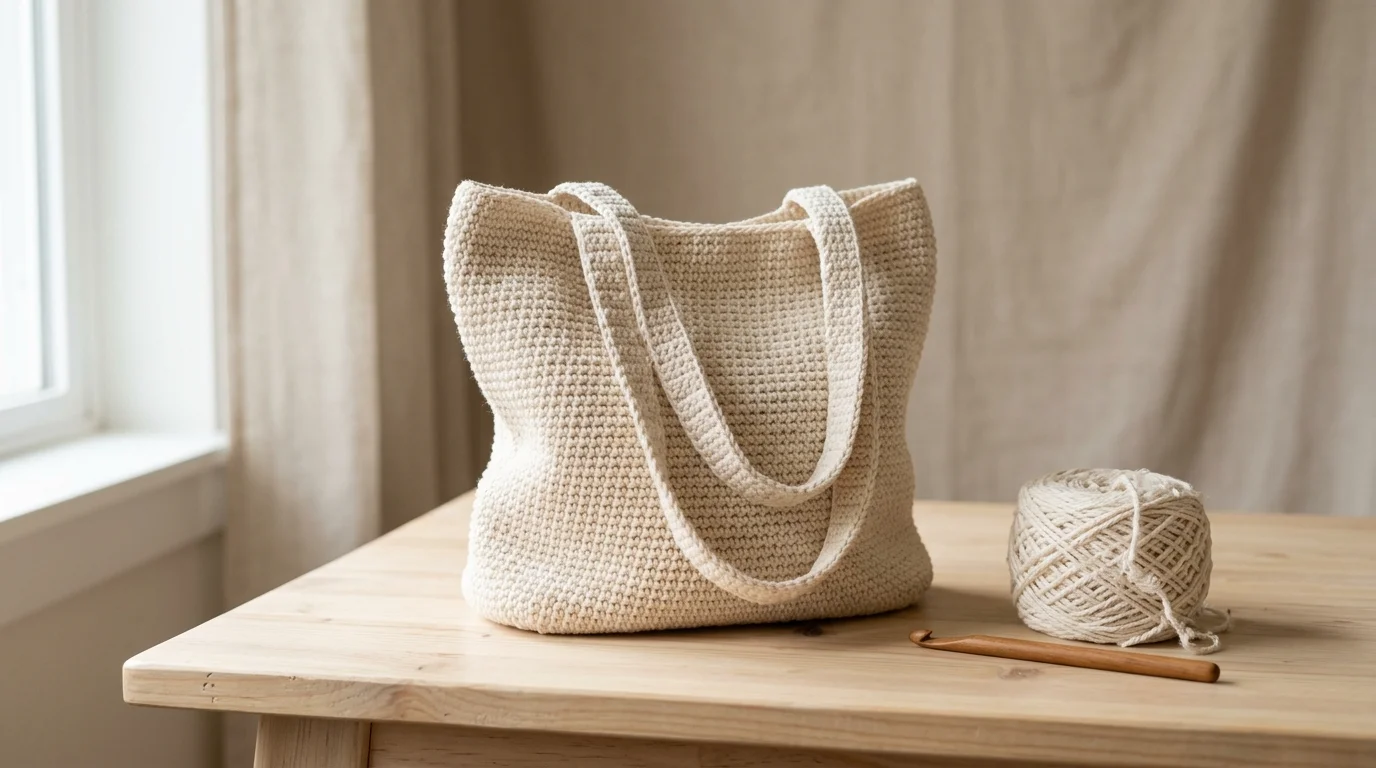
A crochet tote bag is one of the few projects where a small construction choice decides whether the finished piece carries groceries or slumps into a puddle. The same stitch count can give you a stiff market carrier or a floppy sack, depending on the yarn, the hook, and how the handles are anchored. This guide gives you a free crochet tote bag pattern built from one folded rectangle, so there are no rounds to count and no shaping to track. It also covers handles, lining, sizing math, and seven tips that keep the fabric firm.
The pattern is written from standard crochet construction rather than from a tested sample, so treat your first crochet tote bag as a large swatch.
Table of Contents
Pick yarn and hook before you chain anything
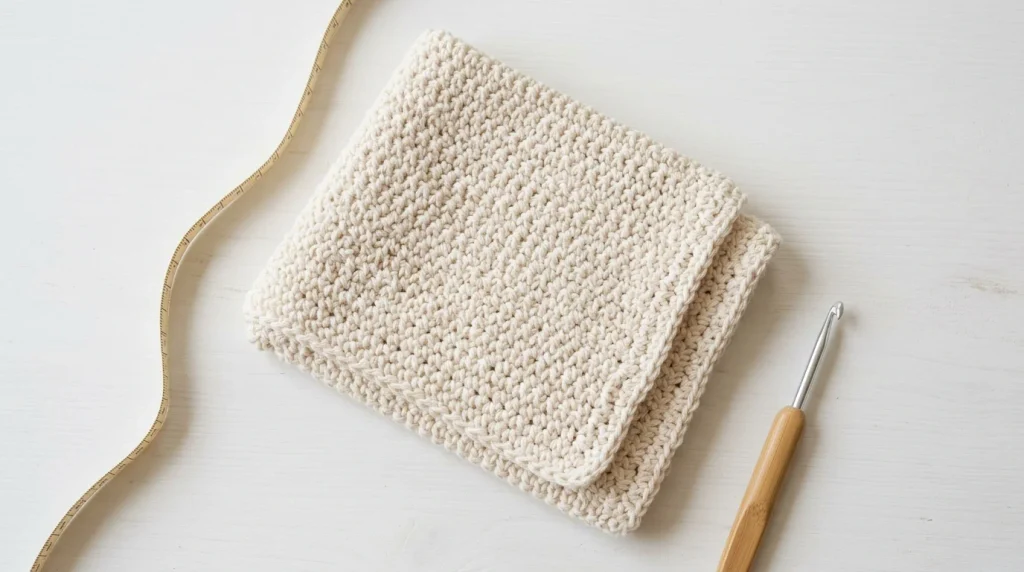
Bag fabric needs to be dense and firm, with very little give. Cotton and other plant fibers are the usual choice because they don’t spring back like wool, and they tend to stretch less under load than many acrylics. Acrylic works for a light bag, but use a smaller hook and keep the load modest.
Yarn weight follows the Craft Yarn Council’s standard yarn weight system. Medium (category 4) yarn is listed with a 5.5 to 6.5 mm hook, and bulky (category 5) with 6.5 to 9 mm. For a tote, go one hook size below what the label suggests. Smaller gaps between stitches mean a denser fabric, and density is what keeps a bag from sagging.
Thick cord yarns such as jute twine or T-shirt yarn make a stiff crochet bag pattern, but they are hard on the hands and need a larger hook, so work a longer swatch before buying enough for a full bag. Medium cotton and single crochet is the easiest pairing to control. If the stitch is new, the single crochet stitch tutorial walks through the motion, and the guide to reading a crochet pattern shows how patterns are written. Every step here uses US terms: ch (chain), sc (single crochet), sl st (slip stitch).
Free crochet tote bag pattern: the folded rectangle method
The whole crochet tote bag is one rectangle. You fold it at the middle, seam the sides, and edge the opening. There are no increases, which makes this a crochet tote bag for beginners who want a bag that actually holds its shape.
Gauge first. The council’s medium-yarn range is 11 to 14 single crochet stitches per 4 inches. Chain 41 and you’ll work 40 stitches per row, which lands at roughly 11½ to 14½ inches wide across that range. Swatch before you commit and count your own stitches per inch. The formula is simple: desired width in inches times your stitches per inch, plus one chain for the turning stitch.
- Foundation. Chain 41 with a hook one size larger than your working hook. A loose foundation keeps the bottom of the bag from pulling narrower than the top.
- Row 1. Sc in the second chain from the hook and in each chain across (40 sc). Ch 1, turn.
- Rows 2 onward. Sc in each stitch across (40 sc), ch 1, turn. Keep going until the rectangle measures twice the height you want for the finished bag. Straight rows like this work the same way as in the beginner crochet blanket guide, only narrower.
- Fold and seam. Fold the rectangle in half so the foundation edge meets the last row. The fold becomes the base. Slip stitch or whip stitch both sides closed, working through both layers.
- Edge the opening. Join yarn at a side seam, ch 1, and sc in each stitch around. Each top edge has 40 stitches, so round 1 should total 80. Work three rounds, then fasten off.
- Finish. Weave in ends through the stitches in two directions so they can’t work loose.
For a boxy base, pinch each bottom corner flat so the side seam lines up with the base fold, then sew straight across the point. The crochet tote bag will stand on its own corners instead of rounding out.
How to crochet a bag strap?
A flat strap is a narrow rectangle. Chain 8, sc in the second chain from the hook and across (7 sc), ch 1, turn, and sc in each stitch for every row after that. Seven stitches in medium yarn comes to roughly 2 to 2½ inches wide using the same council range. Work until the strap reaches the length you need, then fasten off.
Make the strap a few inches shorter than your target. Crocheted fabric gives under weight, and a strap that fits empty will hang low once the bag is loaded. Pin the strap in place and carry the loaded bag before sewing, so you can adjust the length while it’s still easy. For a crochet shoulder bag, measure from your shoulder down to where you want the bag to sit, and let the strap run the full distance.
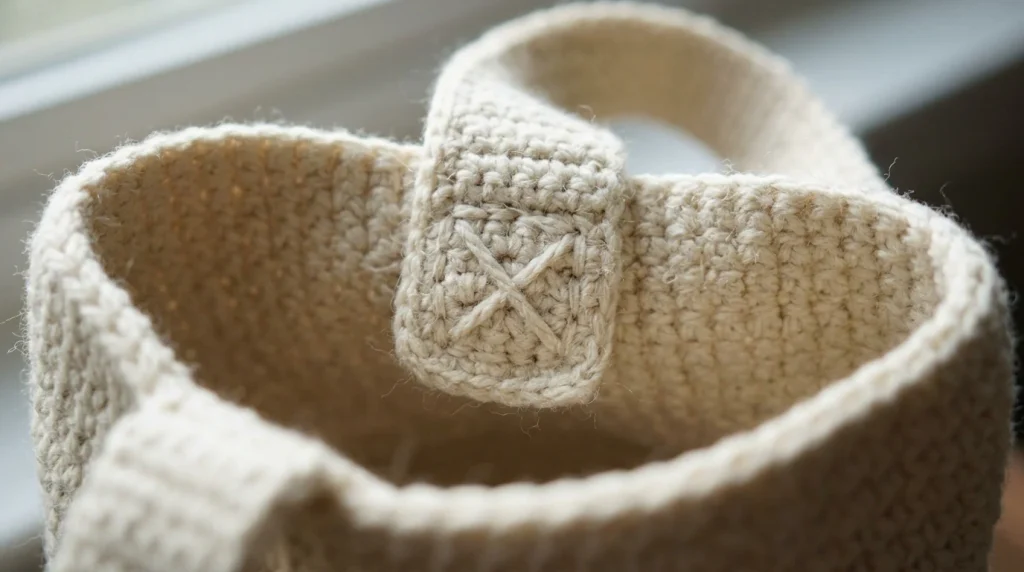
Crochet bag handles take more stress than the bag body, so anchor them well. Sew each end to the inside of the opening, overlapping several rows, then stitch a square with an X through it. The X spreads the pull across more stitches. For heavier loads, fold the strap around cotton webbing and sew the two together. The webbing carries the weight and the crochet covers it.
Crochet tote bag with lining
Open stitches let small items poke through, and the crochet fabric itself keeps stretching with use. A lining fixes both. A crochet tote bag with lining also gives you a place for an inside pocket, which is easier to sew onto flat fabric before assembly.
Measure the finished bag’s width and height after seaming. Cut two pieces of fabric to those measurements plus a seam allowance (half an inch is common). Sew them right sides together on three sides, leaving the top open. Slip the lining into the bag with wrong sides together, fold the top edge under, and stitch it by hand just below the single crochet edging.
Change the size without starting over
Width comes from the chain count and height comes from the row count. If your swatch gives you more stitches per inch than the range above, the crochet tote bag will come out narrower, so add chains. If you get fewer, remove them.
Yarn swaps move the width fast. The council lists 8 to 11 single crochet per 4 inches for bulky yarn, so the same 40 stitches would span about 14½ to 20 inches. That’s a very wide crochet tote bag. Recalculate the chain count from your own swatch whenever you change yarn or hook, even if the new yarn looks identical.
Common mistakes in a crochet tote bag
Sagging usually traces back to hook size or stitch height, not to the pattern. A hook that matches the label gives a drapey fabric that looks fine empty and stretches the first time it’s filled. Slanted sides happen when row ends are uneven, so count your stitches every few rows. Adding or skipping one stitch at the turn bends the edge, and a bent edge won’t seam flat. A twisted strap comes from sewing before checking that both ends face the same way, so lay it flat first. Judge the finished crochet tote bag only after it has been loaded once and hung up overnight.
7 tips for a sturdy crochet tote bag
- Swatch and wash it. Plant fibers can shrink or relax after the first wash, and you want to learn that on a square, not on a finished bag.
- Drop a hook size. Tighter stitches leave less room for the fabric to drift open.
- Chain the foundation loosely. A tight chain narrows the base and makes the bag flare at the top.
- Stay with short stitches. Single crochet is dense. Taller stitches such as double crochet leave larger gaps and stretch more.
- Anchor handles with a stitched square. A few loose whip stitches will tear out under real weight.
- Add a base insert. A firm piece cut to the base size, slipped between the lining and the crochet, keeps the bottom flat.
- Keep the load realistic. Even a dense bag gives under books or bottles, so match the yarn and handle method to what you’ll carry.
Granny square tote bag, beach tote, and shoulder bag variations
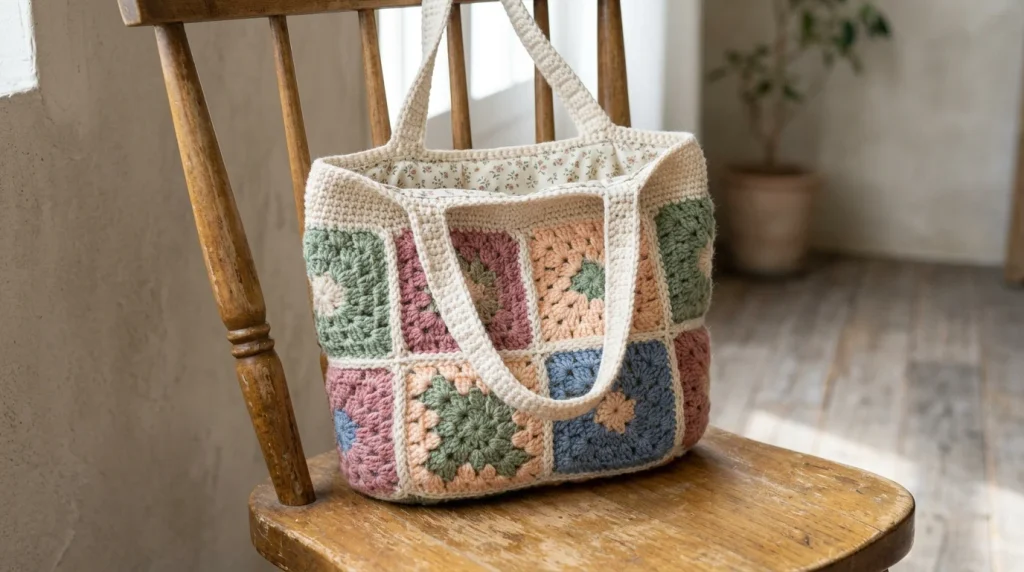
A granny square is a square worked in rounds from the center outward, and Wikipedia notes that crocheters join such motifs into purses, blankets, and other household textiles. For a granny square tote bag, make an equal number of squares for each side, join them into two matching panels, and seam the panels along the sides and base. The joining logic is the same as in the afghan crochet pattern, just smaller. Granny squares are open, so line the bag or use a tight stitch for the final round.
A crochet beach tote bag goes the opposite direction. An open mesh lets sand shake out and air pass through, and a longer strap lets the bag sit on your shoulder over a towel. Skip the lining and keep the weight low.
Convert the pattern into a crochet shoulder bag by lengthening the strap and narrowing the rectangle slightly, so the bag sits against your side instead of swinging out.
US and UK terms
If a crochet tote bag pattern calls for double crochet and the fabric looks too loose, check which system the designer uses. The council’s US, UK, and Canadian term table shows that a US single crochet is called a double crochet in the UK, and a US double crochet is a UK treble. Gauge is called tension in UK patterns. Mixing these up changes the stitch height, which changes how dense the bag is.
Care and finishing
Wash according to the yarn label, reshape the crochet tote bag flat, and let it dry fully before loading it again. Lined bags are easier to spot clean. If the strap on a crocheted tote bag stretches over time, undo the seam at one end, shorten it, and re-anchor it.
For more small projects with the same skills, browse the easy crochet accessories guide.
FAQs
How wide will this crochet tote bag be?
It depends on your gauge. With 40 single crochet stitches in medium yarn, the council’s range of 11 to 14 stitches per 4 inches gives roughly 11½ to 14½ inches. Bulky yarn at 8 to 11 stitches per 4 inches makes the same 40 stitches about 14½ to 20 inches wide. Swatch first and recalculate your chain count.
What yarn is best for a sturdy bag?
Cotton or another plant fiber in medium weight, worked in single crochet. Go one hook size below the label so the fabric stays dense.
How long should the strap be?
Measure from your shoulder to where you want the bag to sit, then make the strap a few inches shorter. Crocheted fabric stretches under load. A strap of 7 stitches in medium yarn is about 2 to 2½ inches wide.
Do I need a lining?
No, but open stitches, granny squares, and stretch-prone yarns all benefit from one. A lining also gives you a place for an inside pocket.
Why does my pattern’s “double crochet” look too loose?
UK patterns call a US single crochet a double crochet. Check which system the designer uses before you start.

Leave a Reply