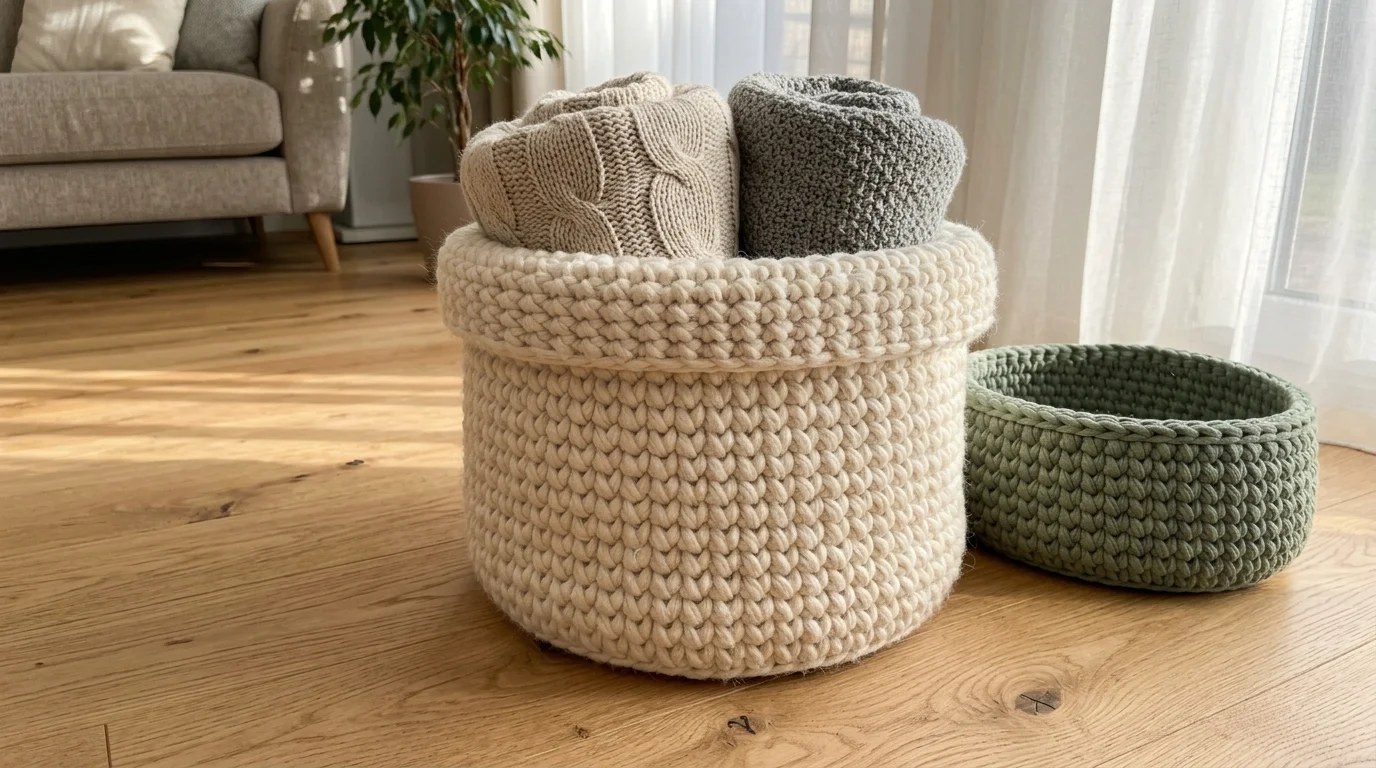
My first crochet basket was a disaster. I used the hook size on the label, crocheted loosely because loose felt natural, and ended up with something closer to a collapsed hat than storage. What fixed it wasn’t a secret stitch. It was density — tight single crochet, thick yarn, and a hook one or two sizes smaller than the label suggests. That’s the whole trick to a crochet basket that stands up.
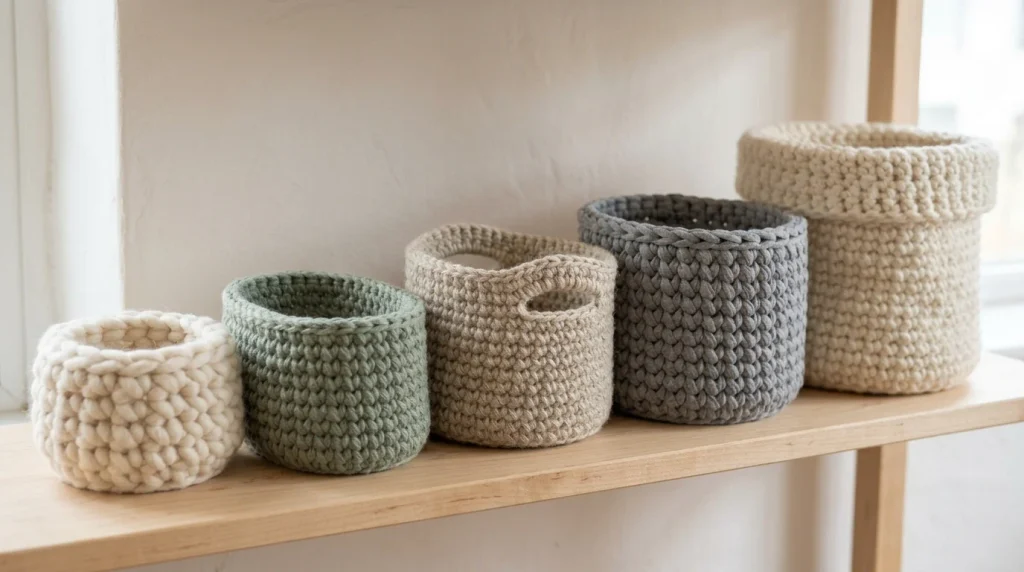
Five patterns follow, from a round beginner basket up to a tall bin for blankets. All of them work the same way: flat base, one back-loop round, straight walls.
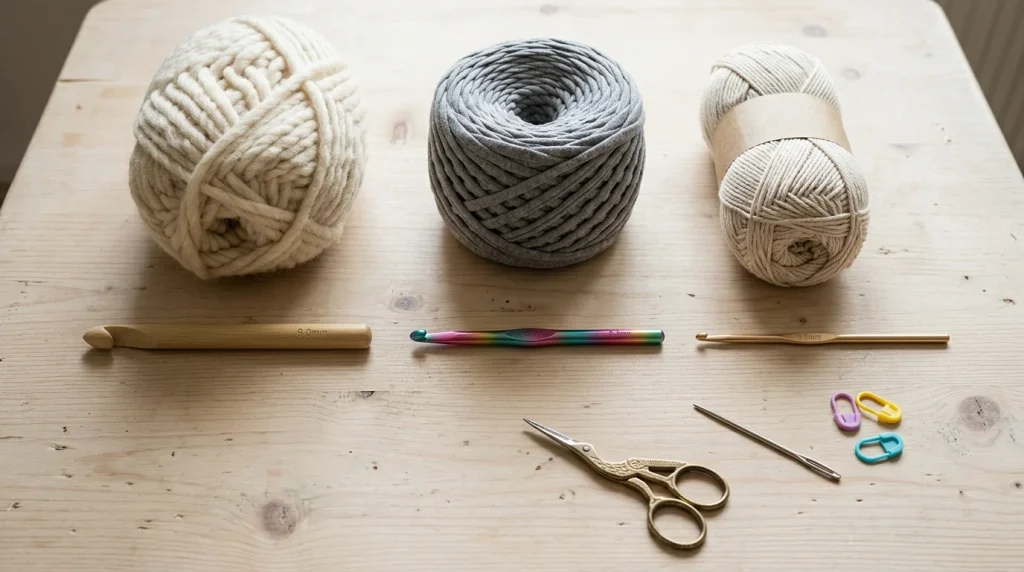
Table of Contents
- What Yarn Works Best for a Crochet Basket?
- Before You Start Your First Crochet Basket
- The Rule That Makes Every Crochet Basket Stand Up
- Pattern 1: Beginner Crochet Basket in Chunky Yarn
- Pattern 2: Oval Crochet Basket
- Pattern 3: Crochet Basket With Handles
- Pattern 4: T-Shirt Yarn Crochet Basket
- Pattern 5: Tall Crochet Basket With a Folded Cuff
- Keeping a Crochet Basket Firm
- Customizing Your Crochet Basket
- When Your Crochet Basket Goes Wrong?
- FAQs
- Conclusion
What Yarn Works Best for a Crochet Basket?
You want thick, firm, and stubborn. Stretchy yarn makes a crochet basket that sags the second you put anything heavy inside.
Chunky yarn is the quickest option. Cotton holds a crisper shape. T-shirt yarn gives you a heavy, soft bin that can take some weight.
| Yarn | Suggested hook | Result |
|---|---|---|
| Chunky (bulky) acrylic or cotton | 6.5 mm (K-10.5) | Firm walls, fast progress |
| T-shirt yarn | 9 mm (M/N-13) | Thick, slightly stretchy bin |
| Worsted cotton, held double | 5.5 mm (I-9) | Crisp, detailed stitches |
Buy more than you think you’ll need — dye lots shift between skeins. The Craft Yarn Council lists 6.5 to 9 mm hooks for bulky and 9 to 15 mm for super bulky.
Before You Start Your First Crochet Basket
Grab a yarn needle, scissors, and a stitch marker. Here’s the shorthand used below:
- sc — single crochet
- inc — two sc in the same stitch
- st(s) — stitch(es)
- BLO — back loop only
- sl st — slip stitch
- ch — chain
Work in a continuous spiral, no joining, and move the marker up each round. Pull every stitch snug. Sloppy tension is why so many baskets go floppy.
Never worked in rounds? Do a granny square pattern first to build the muscle memory.
The Rule That Makes Every Crochet Basket Stand Up
Every crochet basket here is a flat circle plus vertical sides. The circle grows by six stitches per round, which keeps it flat instead of cupping or ruffling. Once the base is the size you want, you stop increasing and the sides climb straight up. That single back-loop round in between bends the fabric at a clean angle.
Which means you can resize any pattern without math. Bigger basket? Add increase rounds before the BLO round. Taller basket? Add plain sc rounds after it.
Pattern 1: Beginner Crochet Basket in Chunky Yarn
This one teaches the method everything else reuses. Chunky yarn, 6.5 mm (K-10.5) hook.
- Round 1: Magic ring, 6 sc into it (6 sts).
- Round 2: Inc in each st (12).
- Round 3: Sc in next st, inc, repeat around (18).
- Round 4: Sc in next 2 sts, inc, repeat around (24).
- Round 5: Sc in next 3 sts, inc, repeat around (30).
- Round 6: Sc in next 4 sts, inc, repeat around (36).
- Round 7: Sc in next 5 sts, inc, repeat around (42).
- Round 8: Sc in next 6 sts, inc, repeat around (48).
- Round 9: Sc BLO in each st (48). Corner turned, walls start.
- Rounds 10–24: Sc in each st (48).
- Sl st into the next st, fasten off, weave in ends.
Flatten the base after Round 8 and look at it. Flat means your increases are right. Cupping means you missed one. Ruffling means you added one too many.
Pattern 2: Oval Crochet Basket
Ovals fit long shelves and narrow cubbies in a way rounds never do. Same yarn and hook as Pattern 1. The sides stay locked at 7 stitches while the two ends grow.
- Round 1: Ch 10. 3 sc in the 2nd ch from hook, sc in next 7 ch, 3 sc in last ch. Turn, work 1 sc in each of the 7 unused loops along the other side (20 sts).
- Round 2: Inc in each of the 3 end sts, sc in next 7, inc in each of the 3 end sts, sc in next 7 (26).
- Round 3: At each end, sc, inc three times. Sc in the 7 side sts (32).
- Round 4: At each end, sc in next 2 sts, inc three times. Sc in the 7 side sts (38).
- Round 5: At each end, sc in next 3 sts, inc three times. Sc in the 7 side sts (44).
- Round 6: At each end, sc in next 4 sts, inc three times. Sc in the 7 side sts (50).
- Round 7: Sc BLO in each st (50).
- Rounds 8–20: Sc in each st (50). Fasten off.
Pattern 3: Crochet Basket With Handles
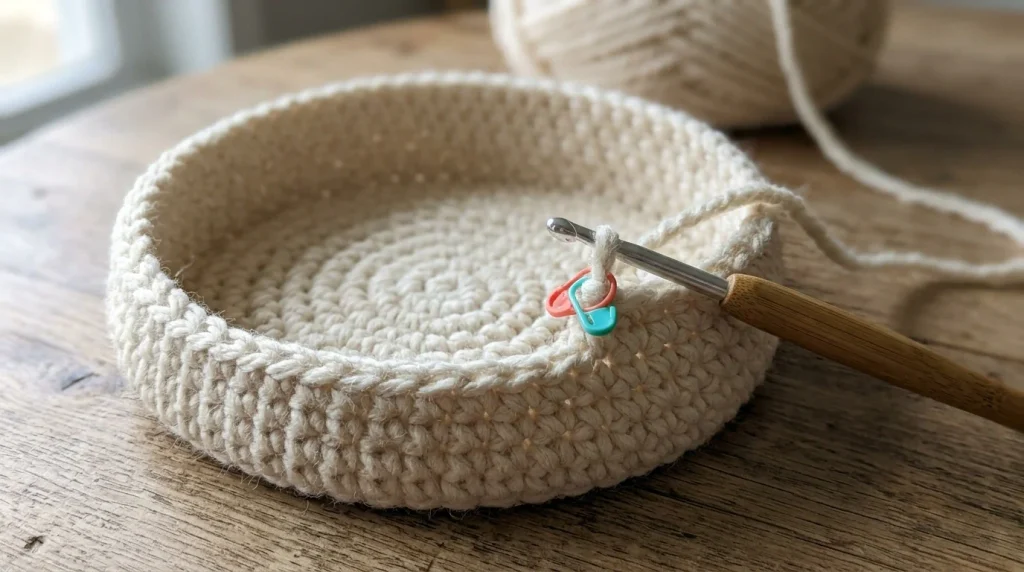
Work Pattern 1 through Round 20 (48 sts), then:
- Round 21: Sc in next 8 sts, ch 8, skip 8 sts, sc in next 16 sts, ch 8, skip 8 sts, sc in last 8 sts.
- Round 22: Sc in each st and each ch (48).
- Rounds 23–24: Sc in each st (48). Fasten off.
Those two rounds above the openings are what stop handles from stretching into sad loops. If you want them sturdier, this crochet tote bag guide covers anchoring properly.
Pattern 4: T-Shirt Yarn Crochet Basket
Jersey strip stretches, so this crochet basket stops growing sooner. 9 mm (M/N-13) hook, and try not to tug the strip while you work.
- Rounds 1–6: Follow Pattern 1 (36 sts).
- Round 7: Sc BLO in each st (36).
- Rounds 8–14: Sc in each st (36). Fasten off.
Pattern 5: Tall Crochet Basket With a Folded Cuff
Blankets, toys, yarn — this is the one that earns its floor space. Follow Pattern 1 through Round 9 (48 sts), then sc in each st for Rounds 10–32. Fasten off and fold the top 3 inches (7.5 cm) outward.
Want it wider? Keep increasing before the BLO round. Round 9 becomes sc in next 7 sts, inc (54), Round 10 becomes sc in next 8 sts, inc (60). Each extra increase round adds 6 stitches.
Keeping a Crochet Basket Firm
Smaller hook. That’s the fix nine times out of ten, because tight stitches leave the fabric nowhere to bend. Holding two strands together does the same job from the yarn side.
If a finished crochet basket still leans, dampen it lightly, shape it over a box, and let it dry.
Customizing Your Crochet Basket
Change colors at the start of a round for clean stripes — carry the unused yarn up inside, or cut it each time if that bothers you. A contrasting BLO round turns the corner into a design feature.
Lining the bin is worth the twenty minutes if you’re storing small things that slip through stitches. And if you like your storage to match, a crochet pillow cover in the same yarn ties the room together.
One more thing: a cardboard disc under the base stiffens the floor nicely. Just pull it out before washing.
When Your Crochet Basket Goes Wrong?
- Base cups into a bowl — missed increase. Recount against the totals above.
- Base ruffles — too many increases. Rip back to the last correct round.
- Walls flare — stitch count drifted after the BLO round.
- Walls flop — drop a hook size and tighten up.
- Handles sag — add an sc round above and below the openings.
FAQs
How much yarn does a crochet basket need?
Depends on size and yarn. Finish the base and a few wall rounds, weigh what you’ve used, then estimate the rest. Round up.
What stitch is best for a crochet basket?
Single crochet, no contest. Half double works but it’s looser, so downsize the hook.
Can you wash a crochet basket?
Check the label. Cotton and acrylic usually want spot cleaning — soaking distorts the shape. Reshape while damp.
What hook size should a beginner crochet basket use?
6.5 mm (K-10.5) with chunky yarn. Gappy fabric means go down a size.
How do you make a crochet basket taller?
More plain sc rounds after the BLO round. Base size doesn’t change.
Can you start a crochet basket without a magic ring?
Ch 2, work 6 sc into the 2nd ch. Slightly looser center — pull Round 1 tight and stitch the hole closed.
Cotton instead of chunky for a crochet basket?
Sure. Hold two strands with a 5.5 mm (I-9) hook, or use thick cotton cord for the stiffest walls you’ll get.
Conclusion
Same formula every time: flat base, one BLO round, straight walls. Start with Pattern 1, pay attention to how tension changes firmness, then branch out. Measure the base as you go — finished size is your tension’s business, not the pattern’s.
There are more free crochet patterns where this came from.

Leave a Reply