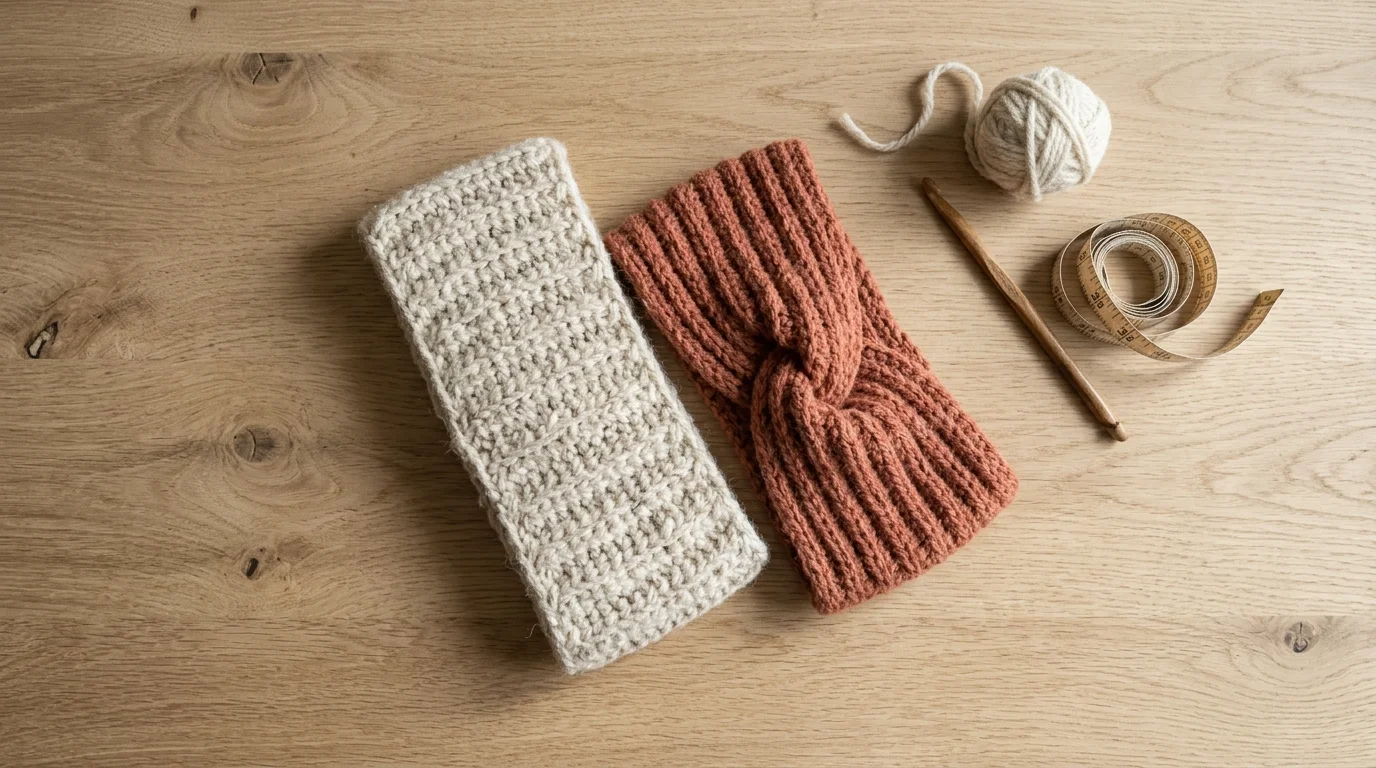
A crochet headband looks like two different projects when you compare an ear warmer with a turban, but the construction is nearly identical. Both are a ribbed rectangle worked in rows, then seamed into a loop. What changes is the width of the rectangle and what you do to it before the ends meet. That’s why the two free patterns below share one set of instructions and one sizing formula.
Neither pattern uses a magic ring or any crown shaping. If you’d like hats built on the same no-math idea, the four easy crochet hat patterns with no crown math are a good companion.
Table of Contents
Which crochet headband style fits your plan?
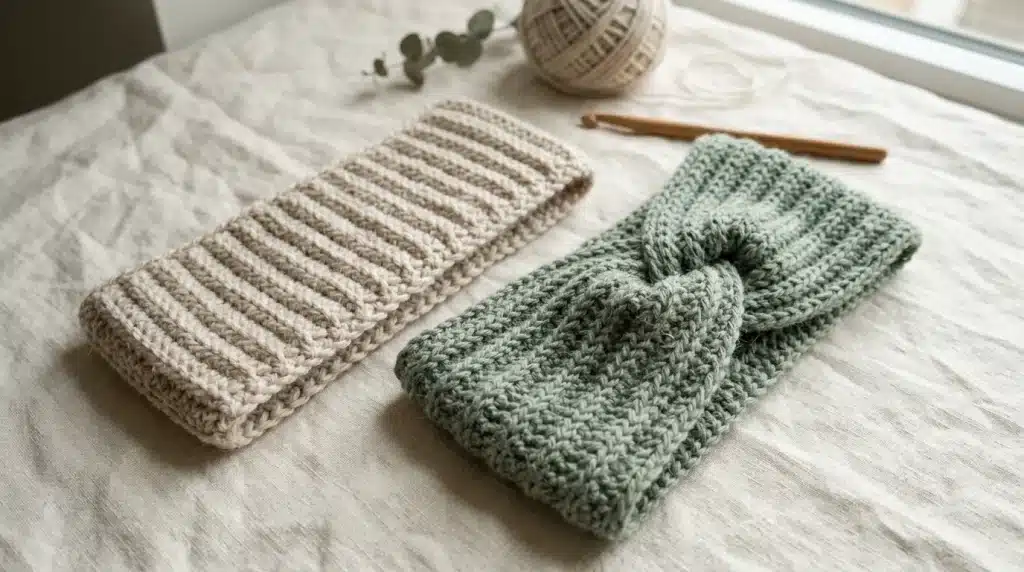
- Ear warmer: a wide band that covers the ears. Pick this for cold commutes, walks and anything outdoors.
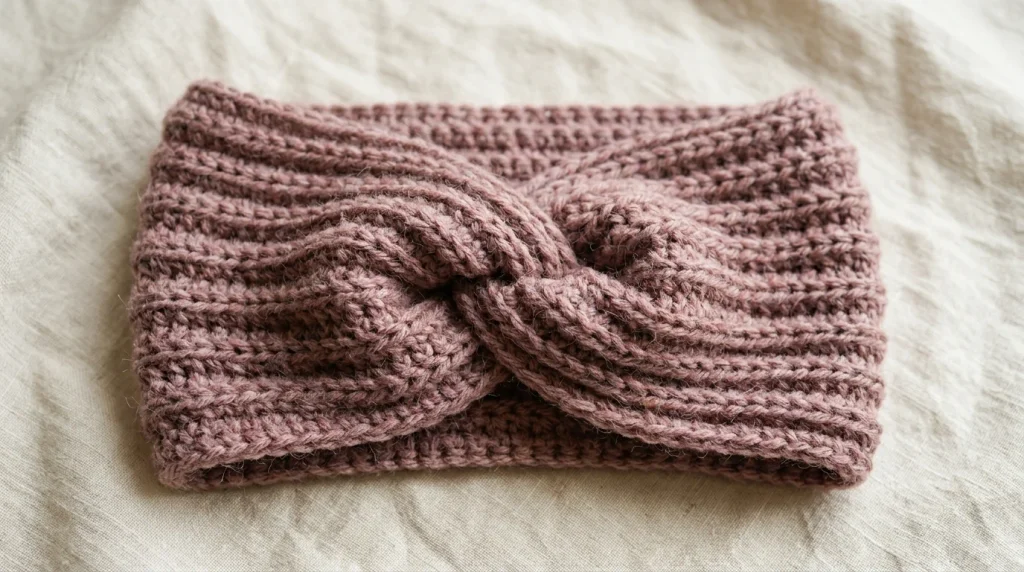
- Turban: a wide band with a twist at the front. Pick this when you want a fashion piece that also keeps hair back.
Everything else in this post (yarn, sizing, seaming) applies to both.
Materials for a crochet headband
- Yarn: worsted weight (CYC category 4) is the easiest to work with. Bulky (category 5) builds a warmer band faster, and DK (category 3) suits milder weather. The Craft Yarn Council’s yarn weight system explains the categories if a ball band is unclear.
- Hook: the size printed on the yarn label to begin with. You’ll adjust it after the swatch.
- Yarn needle for seaming, plus scissors and a measuring tape.
- Pins (optional) for holding the twist before you seam the turban.
Yardage depends on your yarn, gauge and width, so check your label against your swatch instead of guessing.
Swatch first: the numbers come from you
Every measurement in this crochet headband pattern is a formula, which means your swatch replaces a printed stitch count. Chain about 15, work half double crochet (hdc) into the third chain from the hook and across, then chain 2, turn, and work hdc in the back loop only of every stitch for about 12 rows. Measure it flat and count stitches per inch and rows per inch.
If the swatch feels stiff, try a larger hook. If you can see daylight through it, try a smaller one. A good crochet headband blocks wind and still stretches easily.
Then work out two numbers:
- Foundation chain = (band width in inches × stitches per inch) + 2
- Row count = (head circumference − negative ease) × rows per inch
Negative ease means the finished crochet headband is slightly smaller than the head. Crochet fabric stretches, and a band made to the exact head measurement ends up loose and slides upward. Springy yarn such as wool can go closer to the head size than cotton, which stretches and stays stretched.
To size a crochet headband, wrap a tape around the head where it will sit. If you’re making a gift and can’t measure, the Craft Yarn Council’s head circumference chart gives standard sizes. For a deeper walk through sizing, the nine-size approach in these crocheted hat patterns free uses the same measure-then-subtract logic.
Why a crochet headband ribs sideways?
Working in the back loop only leaves a ridge on every row. Those ridges run across the band’s width, and the fabric stretches along its length, which is the direction a headband has to give. The same sideways ribbing is used on the cuffs in the free beanie crochet pattern and the easy crochet toque pattern.
The back loop is the one farthest from you as you hold the work. If your ridges look patchy, you’ve slipped into both loops somewhere. Mark the first stitch of each row so you can check.
Free pattern 1: the crochet ear warmer headband
This version needs a width that covers the ear. To find it, measure on the wearer from just above the top edge of the ear to below the lobe. Add a little extra so the band doesn’t sit exactly at the edge of the ear, then multiply by your stitches per inch for the foundation chain.
Row 1: Chain your foundation number. Hdc in the third chain from the hook and in each chain across. Chain 2, turn.
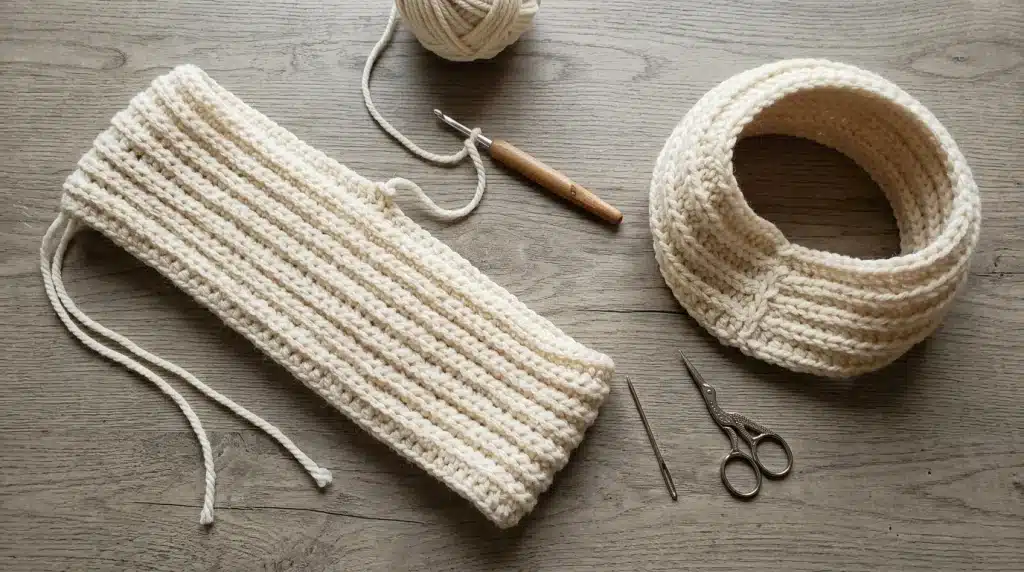
Row 2 and every row after: Hdc in the back loop only of each stitch. Chain 2, turn.
Repeat until you reach your row count, checking against the head now and then by stretching the band gently. Fasten off with a long tail, several times the band’s width.
Seam: Bring the short ends together with right sides out. Use mattress stitch for a flat seam, or whip stitch through the outer loops if you’d rather finish quickly. Weave the tail in along the seam line instead of across the ridges, so you can’t feel a lump at the back of the head.
Optional double layer: For extra warmth, make the rectangle twice as wide, fold it in half along its length and seam the long edge before joining the ends. Use worsted rather than bulky here, since the seam gets thick.
Wikipedia notes that this style is popular with skiers, snowboarders, runners and people who work in the cold, which fits what it’s built for.
Free pattern 2: the crochet turban headband
This crochet headband style uses the same stitches, but the band should be tall enough to cover from the hairline over the top of the head. Work out the width the same way you did for the ear warmer, measuring the wearer instead of copying a number.
Work rows 1 and 2 exactly as above until you reach your row count, then fasten off.
Making the twist: Hold the rectangle with the short ends together. Rotate one end a half turn (180 degrees) so the band crosses over itself once. Pin the twist, try the band on to check where it sits, and seam the ends together with the twist held in place. The crossover should land at the front of the head, so seam the ends toward the back.
Alternative: the wrapped knot. Crochet a small separate rectangle, long enough to wrap around the center of the finished band. Pull it snug so the band gathers, then seam its ends together on the underside. This gives a knot look that sits where you put it and never loosens, and it’s easier to control than a real knot.
Choosing yarn for a crochet headband
Yarn changes the fit more than people expect.
- Wool and wool blends stretch and spring back, so they keep their size on the head. They suit winter wear best.
- Acrylic washes easily and comes in many colors, but it recovers less than wool. If a band loosens after a few wears, the yarn may be the cause rather than your counting.
- Cotton doesn’t bounce back, so a cotton band slowly stretches out. Make it snugger than you would in wool, or pick a blend with some elasticity.
If you change yarn weight, redo the swatch and the formulas. The same chain count in a thicker yarn gives a wider band.
Changing the size
Each row adds a fixed amount of length, equal to one divided by your rows per inch. To lengthen the band, add rows. To shorten it, take rows away. To widen it, add one foundation stitch for each stitch-width you want, which is one divided by stitches per inch.
A band that’s too tight is hard to rescue, so when in doubt make it a row longer than your calculation and trim later.
A note on baby sizes
A baby crochet headband follows the same method with less width, fewer rows and less negative ease, since babies’ heads change quickly and the band should sit loosely. A few safety points matter more than any detail of the design:
- Choose soft yarn with no shedding.
- Skip buttons, beads and anything that could come loose and become a choking risk.
- Avoid long ties and trailing ends.
- Keep the band loose enough that it never presses on the forehead, and take it off for sleep.
Common problems
Edges curl. This is normal for ribbing. Block the band flat, or work one row of slip stitch along each long edge.
Your crochet headband loosens within hours. Check the yarn first, since cotton and low-recovery acrylic relax. Then reduce the row count on the next one.
The twist rotates to the back. Narrow bands do this more often. A wider band or a snugger fit keeps the twist forward.
The seam is bulky. The tail was probably woven across the ridges, or too much yarn went into the seam. Redo it with mattress stitch and weave along the seam line.
Blocking and care
Weave in your ends, then wash following the yarn label. To block, dampen the band, lay it flat and pin it to the width you want, using your tape measure instead of guessing. Avoid pressing a hot iron directly on acrylic. Let the band dry completely before wearing it, because a damp band can stretch out of shape on the head.
FAQs
How wide should a crochet headband be?
It depends on the style. A plain band that keeps hair back can be narrow, an ear warmer has to cover the whole ear, and a turban has to reach from the hairline over the crown. Measure the wearer.
What’s the best crochet headband for beginners?
The ear warmer without any twist. It uses one stitch, one loop position and a seam. Add the half twist once that feels easy.
Can I match a crochet headband to a hat?
Use the same yarn for a hat from the free crochet hat patterns for adults and the crochet mittens pattern, and you have a winter set from one dye lot.

Leave a Reply