
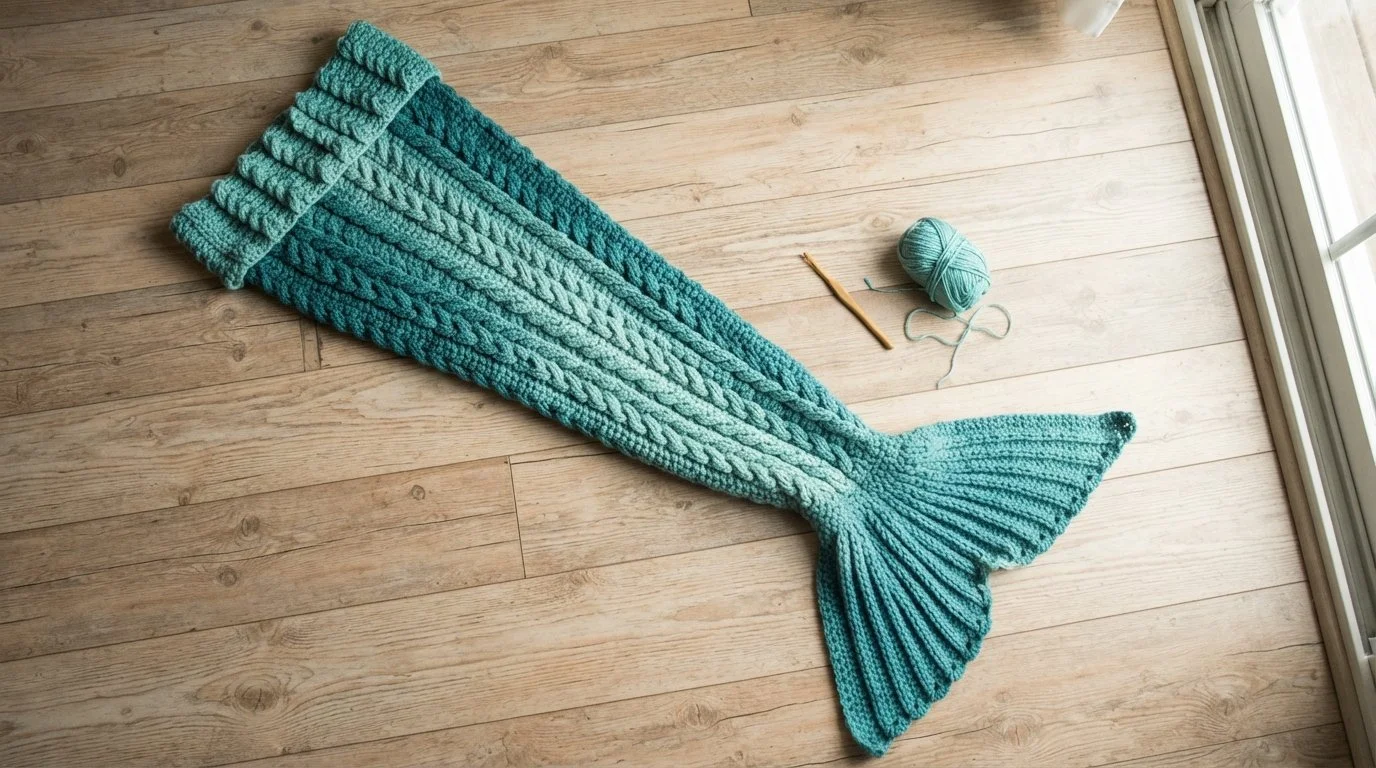
A blanket mermaid tail is really two separate pieces working together: a tapered tube that wraps the legs like a sleeping bag, and a fan-shaped fin attached at the bottom. Neither part is technically difficult on its own — the tube is worked in straight rows with occasional decreases, and the fin is a single shell-stitch motif — but the combination reads as far more impressive than the actual stitch count suggests.
This guide walks through one complete blanket mermaid tail, built from standard shell-stitch and decrease technique rather than a single designer’s copyrighted pattern, so you’re free to change the color palette, resize it, or adjust the fin shape to suit what you’re making.
Table of Contents
What makes a good blanket mermaid tail pattern?
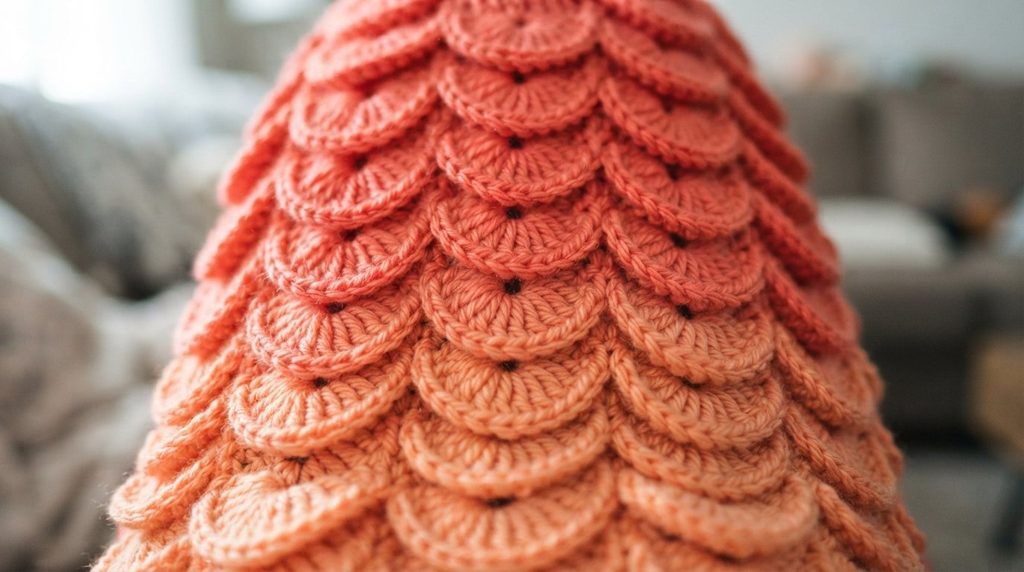
The best versions of this project share three things: a smooth taper from waist to ankle so the tube doesn’t bunch or gap, a scale texture that reads clearly at a distance rather than blending into a flat surface, and a fin sturdy enough to hold its fan shape without flopping. All three come down to stitch and yarn choice rather than anything complicated about a blanket mermaid tail’s construction itself.
Yarn and hook sizing follow the Craft Yarn Council’s standard yarn weight system. This pattern uses worsted weight (#4) for the main tube and a slightly firmer weight or doubled strand for the fin, since the fin needs more structure than the body of the blanket to hold its shape when the piece is picked up.
Materials and sizing
Yarn: Worsted weight (#4) in 2–3 ombre-blending colors (light to dark), approximately 1,400–1,800 yards for a child size, 2,000–2,400 yards for an adult size
Hook: 6 mm (J) for the tube, 5.5 mm (I) for the fin
Notions: Yarn needle, stitch markers
| Size | Tube length | Starting width (ankle) | Finished width (waist) |
|---|---|---|---|
| Toddler | 26″ | 10″ | 16″ |
| Child | 34″ | 12″ | 20″ |
| Teen/Adult | 46″ | 14″ | 26″ |
The pattern
Starting the tube (ankle end): In your darkest color, chain a foundation matching the “starting width” for your size, plus 1 for turning. Work 3–4 rows of single crochet, straight across with no shaping, to establish a firm band at the ankle end.
Building the scale texture: Switch to shell stitch for the body of the tube: skip 2 stitches, work 5 dc into the next stitch, skip 2 stitches, sc in the next stitch repeat across. This creates the fanned “scale” look characteristic of a blanket mermaid tail. Work 4–6 rows in your darkest color, then transition through your middle and lightest shades over the following rows to build the ombre effect — roughly a third of the total rows in each color for an even gradient, though shifting the proportions is a reasonable way to emphasize one shade over the others.
Increasing toward the waist: Starting around a third of the way up the tube, begin increasing width every 4–5 rows by adding one extra shell repeat at each end of the row. Continue shell stitch rows with these periodic increases until the piece reaches the “finished width” for your size at the top.
Finishing the tube: Fold the rectangle in half lengthwise and seam up one long edge, from the ankle end to about two-thirds of the way to the top, leaving the remaining portion open — this becomes the opening you step into. Work a round or two of single crochet around the top opening to neaten the edge.
Making the fin
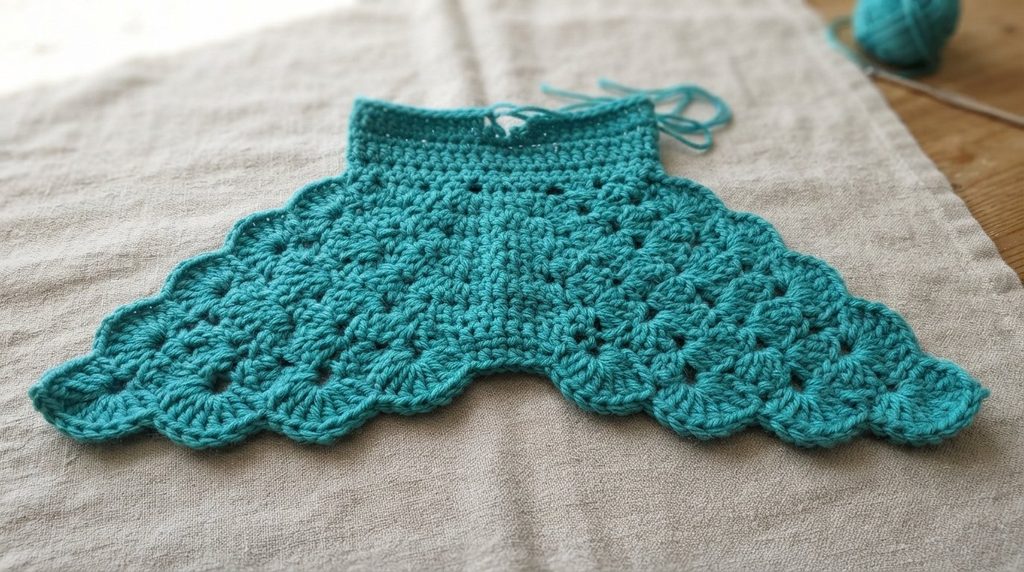
The fin for this blanket mermaid tail is worked as a separate flat piece, then attached at the ankle end.
Chain a foundation about 14–16 inches long (adjust proportionally to your size). Row 1: work shell stitch across, same repeat as the tube — skip 2, 5 dc in next stitch, skip 2, sc in next stitch. Work 3–4 rows total, increasing slightly at the two outer edges every other row to give the fin its fanned, wider-at-the-tips silhouette rather than a plain rectangle. Fasten off and weave in ends.
To attach: fold the finished fin in half to find its center point, then align that center with the seam at the ankle end of the tube. Whip stitch the fin’s straight edge to the closed end of the tube, easing it slightly to create a gentle curve rather than a flat, stiff attachment.
Getting the size right for a blanket mermaid tail
The sizing chart above assumes a snug-but-not-restrictive fit through the tube, similar to how a sleeping bag or a fitted blanket typically fits. If you want a looser, more blanket-like drape rather than a close taper, add roughly 2 inches to both the starting and finished width measurements while keeping the same length. For a child who’s between the toddler and child sizes, lengthening the ankle-band section by a few extra rows before starting the increases is an easy way to add length without changing the overall proportions.
A quick safety note if this blanket mermaid tail is being made for a young child: skip small sew-on embellishments like buttons or beads on the fin, since detachable small parts are a real choking risk for younger kids. The CPSC’s guidance on small parts in children’s products is worth a look if you’re adding any decorative details. A crocheted-in texture, rather than a separately attached piece, avoids the issue entirely.
Common mistakes to avoid
Uneven shell placement is the most common issue with any blanket mermaid tail pattern — if the “skip 2, 5 dc, skip 2, sc” repeat doesn’t land in the same relative position every row, the scale pattern drifts diagonally instead of stacking in clean columns. Counting shell repeats at the end of each row, rather than only checking every few rows, catches drift early enough to fix without unraveling much work.
Rushing the color transitions is the second common one. A true ombre effect needs the color change to happen gradually — swapping colors abruptly partway through a row, rather than at a clean row boundary, creates a visible jog in the pattern rather than a smooth gradient. Always change colors at the start of a new row for the cleanest transition.
Finally, an undersized fin relative to the tube width tends to look disproportionate once attached — the fin should span roughly the same width as the tube’s ankle end, not significantly narrower, or the finished piece reads as a plain tapered blanket with a small decorative tail tacked on rather than a cohesive mermaid shape.
Choosing colors for your blanket mermaid tail
The classic ombre effect — dark at the ankle fading to light near the waist — mimics how real fish and mermaid-tail illustrations typically shade, which is part of why it reads so clearly as a mermaid tail rather than just a striped blanket. Cool tones (teal fading to seafoam to white) are the most common choice, but a warm palette works just as well structurally — coral fading to peach to cream produces the same recognizable silhouette with a completely different mood.
If you’d rather skip the gradient entirely, a two-color contrast between the tube and a solid-colored fin is a simpler alternative that still reads clearly as a blanket mermaid tail, since the fin shape itself carries most of the visual recognition rather than the color transition. This is also the faster route if you’re working against a gift deadline for a blanket mermaid tail, since there’s no need to calculate row counts per color band.
Caring for a finished blanket mermaid tail
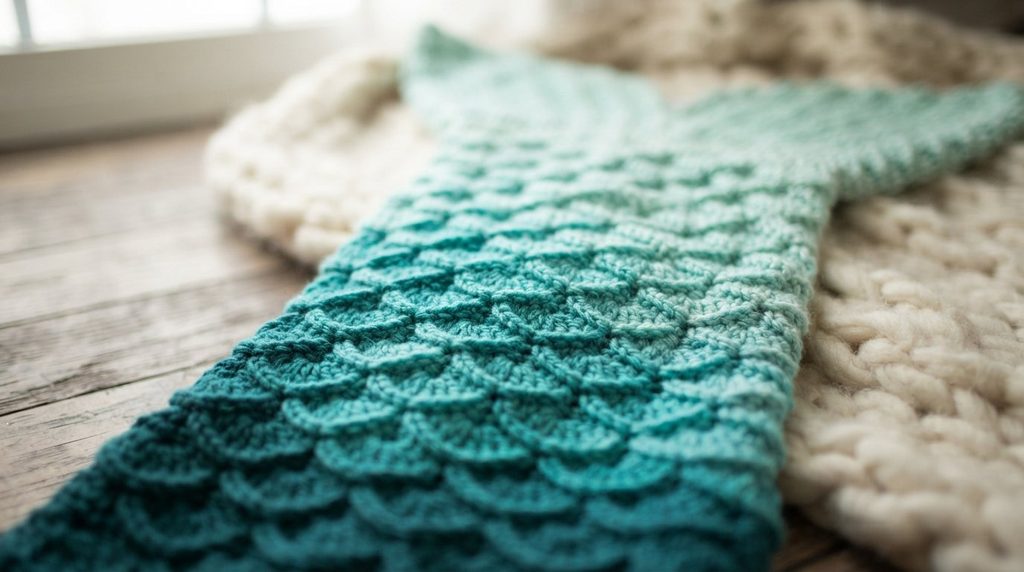
Most acrylic worsted-weight yarns used for this project are machine washable on a gentle cycle, though the dense shell-stitch texture takes longer to dry than a plain-stitch blanket of the same size because of the extra yarn packed into each cluster. Laying the piece flat to dry, rather than using a dryer, helps the shells keep their fanned shape rather than flattening under heat. If the fin loses some of its shape after washing, reshaping it by hand while still damp and letting it air dry flat usually restores the original silhouette.
More Patterns to Try Next
FAQs
Can I make a blanket mermaid tail without the ombre color effect?
Yes — a single solid color still shows the shell-stitch scale texture clearly, and it’s actually a faster project since there’s no need to plan color transitions or track how many rows are left in each shade.
What yarn is best for the fin of a blanket mermaid tail?
A slightly firmer worsted-weight yarn, or the same yarn held double, gives the fin enough body to hold its fan shape when the blanket is picked up or worn. A single strand of a very soft, drapey yarn tends to flop rather than hold the intended silhouette.
How much yarn does a blanket mermaid tail actually need?
The ranges above are reasonable starting points, but shell stitch uses noticeably more yarn per row than plain single or double crochet because of the repeated 5-dc clusters, so it’s worth buying slightly more than a plain-stitch project of the same size would need.
Can this blanket mermaid tail pattern be made for an adult?
Yes — the teen/adult sizing in the chart above works for most adult body sizes; for a taller adult, adding a few extra rows before the increases begin lengthens the tube without changing the overall proportions.
Does a blanket mermaid tail work as a gift for someone who already has a lot of blankets?
It tends to hold up well as a gift precisely because it functions differently from a plain throw — the shaped tube and attached fin make it a novelty item people actually reach for, rather than one more folded blanket competing for shelf space with the ones they already own.

Leave a Reply