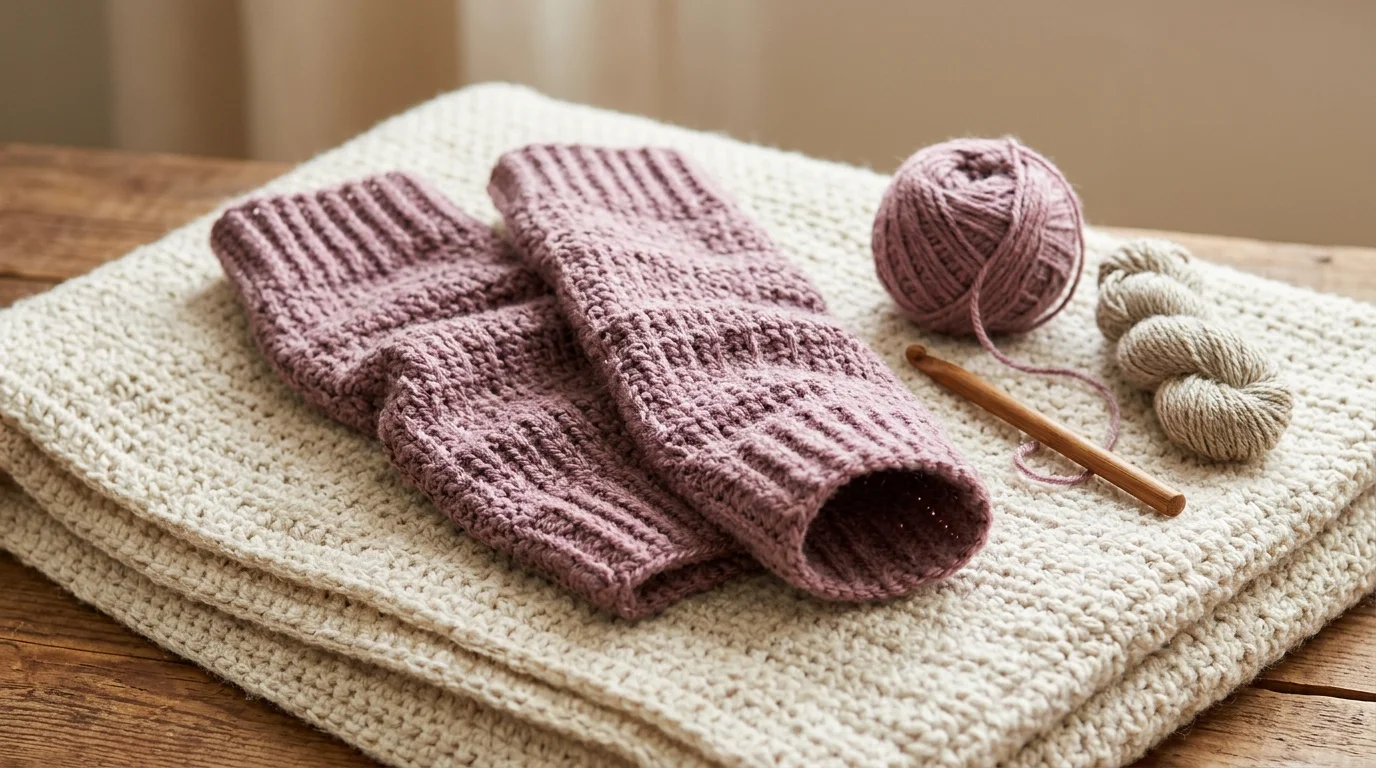
A leg warmer is really just a footless tube for the lower leg — and there are two sensible ways to build one. You can work a ribbed rectangle back and forth and seam it up, or you can work a tube in the round with post-stitch ribbing and skip the seam entirely. The patterns below are formulas rather than fixed stitch counts, which means they’ll fit women, kids, and babies — as long as you swatch your own yarn first. No two legs are quite the same, and that’s fine.
Wikipedia puts it simply: a leg warmer is thicker than a long sock and comes in different lengths. The shortest versions are ankle warmers, which is usually what people mean when they say crochet leg warmers in boot-cuff form or boot toppers.
The first pattern borrows the same sideways ribbing used for the cuff on the free beanie crochet pattern.
Table of Contents
Which style fits your plan?
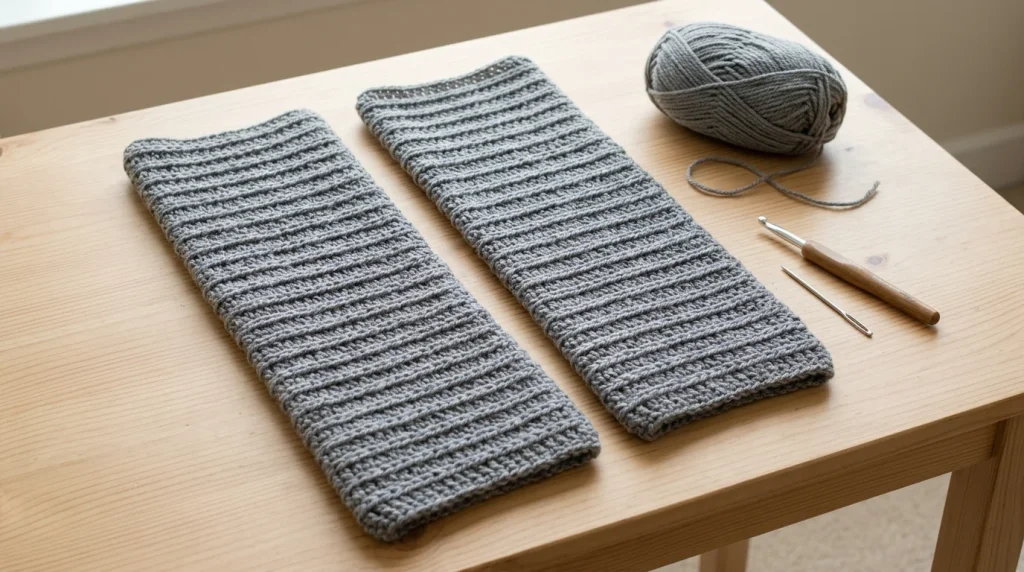
- Flat and seamed: The easiest to size, because a single stitch does all the work and the ridges stretch around the leg.
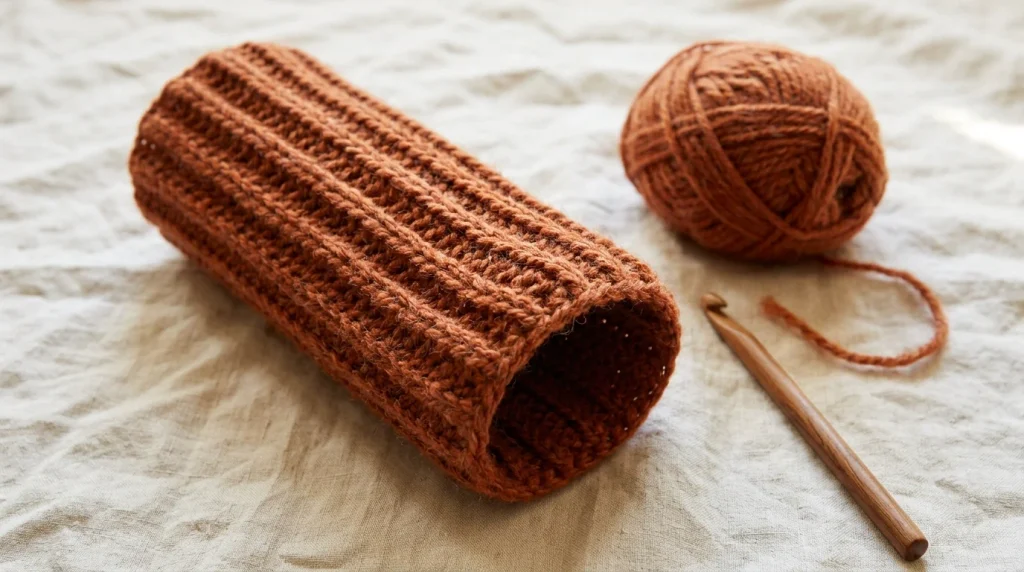
- Worked in the round: No seam rubbing against skin or tights, and post stitches build tall, straight ribs. If you want chunky crochet leg warmers, this is the better route.
- Boot cuffs: A short band that peeks above the boot. Same formulas, just fewer rows.
What you’ll need?
- Yarn: Worsted weight (category 4) gives a thinner, closer fabric. Bulky weight (category 5) works up chunky crochet leg warmers quickly. Yarn weight categories are standardized, but swapping weight changes the finished size, so swatch again.
- Hook: Start with the size on the yarn label. If your swatch looks open, drop down a size — the fabric needs to hold its shape against the leg.
- Tools: A yarn needle, scissors, a tape measure, and a few stitch markers.
Yardage depends on yarn, gauge, height, and leg size, so compare the label with your swatch rather than trusting a single number.
Swatch first, then do the math
Chain about 15 and work half double crochet (hdc) in the third chain from the hook and across. Chain 2, turn, then hdc in the back loop only of every stitch for about 12 rows. Measure the flat swatch and count stitches per inch and rows per inch. For the round version, swatch the post-stitch rib separately — ribbing draws in sideways, so it gives a different stitches-per-inch number.
Now measure the wearer: the calf at its widest point, and the height from the ankle bone to just below the knee for a full-length pair of crochet leg warmers. Two formulas cover it:
- Flat row count = (calf circumference − negative ease) × rows per inch
- Round stitch count = (calf circumference − negative ease) × stitches per inch, rounded to an even number
Negative ease just means the finished piece is a little smaller than the leg. Crochet stretches, so a tube made to the exact measurement will slouch and slide. Wool springs back and can sit closer to the leg size. Cotton stays stretched, so go snugger.
Pattern 1: ribbed crochet leg warmers, worked flat
Foundation chain = (height in inches × stitches per inch) + 2.
Row 1: Hdc in the third chain from the hook and in each chain across. Chain 2, turn.
Row 2 and every row after: Hdc in the back loop only of each stitch. Chain 2, turn.
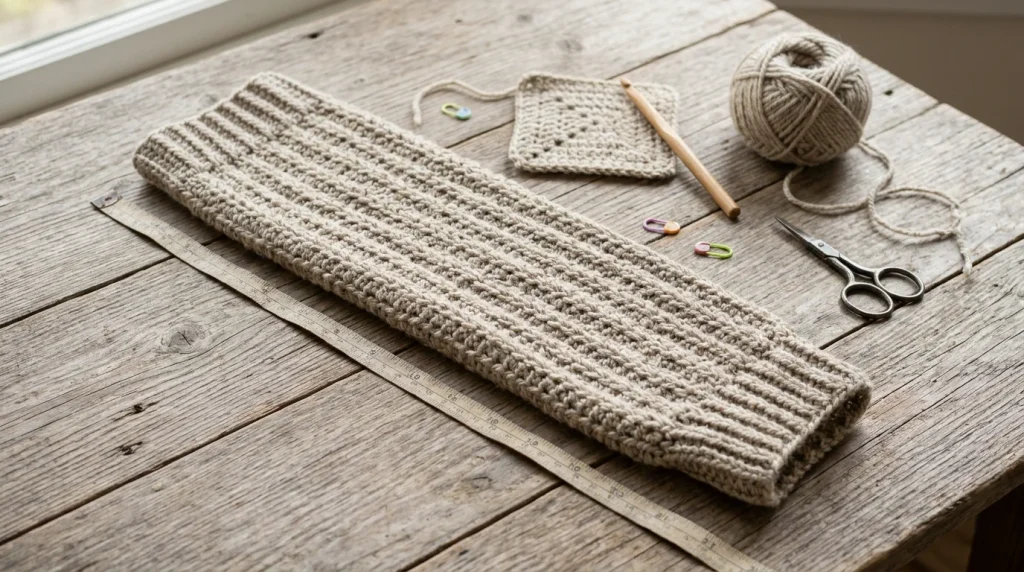
Repeat to your row count, then fasten off with a tail several times the height. With right sides out, hold the short ends together and seam with mattress stitch. Weave the tail along the seam line rather than across the ridges, so nothing lumps against the skin. Put the seam at the back of the leg, out of sight.
Working in the back loop only leaves a ridge on every row. Each ridge runs the full height of the tube, so the ribs stand vertically and the fabric stretches around the leg — the direction a leg warmer has to give. The same logic sits behind the crochet headband free patterns and the cuffs on the easy crochet toque pattern.
Write down the row count so the second one always matches.
Pattern 2: chunky crochet leg warmers in the round
This version starts at the top and works down, so the last rounds land at the ankle.
Foundation: Chain your round stitch count. Lay the chain flat to confirm it isn’t twisted, then join with a slip stitch to the first chain.
Round 1: Chain 2 (doesn’t count as a stitch). Double crochet (dc) in each chain around. Join with a slip stitch to the first dc.
Round 2: Chain 2. Front post double crochet (FPdc) around the next stitch, back post double crochet (BPdc) around the next stitch. Repeat around and join to the top of the first stitch.
Round 3 and every round after: Chain 2. Work an FPdc around each FPdc and a BPdc around each BPdc, then join. Don’t turn at the end of a round. Keeping the right side facing you is what stacks the ribs into straight columns.
Continue to your height. For the last few rounds at the ankle end, switch to a hook one size smaller so the cuff grips. Fasten off.
Fit notes for women’s crochet leg warmers
Adult legs differ more in calf width than in height, so the circumference formula matters more than any standard size. Measure over the tights or leggings the wearer will actually use — a pair worn over jeans needs more room. Slouchy crochet leg warmers take extra height and less negative ease, so the fabric folds at the ankle.
Stitch choices for ribbed crochet leg warmers
Back-loop hdc and the 1×1 post-stitch rib are the dependable options. The flat version also works in back-loop single crochet, turning with chain 1, for a denser fabric. Single crochet gives more rows per inch, so redo your swatch and row count first. Use one stitch for the whole pair — crochet leg warmers worked in two different stitches will stretch differently.
Boot cuffs and boot toppers
Boot cuffs use either pattern with fewer rows or rounds. Measure from the top of the boot to where you want the band to end. For a folded cuff, work double that height and seam it into a tube if you worked flat. Then fold it in half with the right side out so the fold forms the top edge — the fold hides the foundation edge and stops the band curling.
Boot toppers sit inside the boot shaft with only a band showing, so choose worsted over bulky. A thick tube inside a fitted boot presses on the calf. They’re also a good way to use up leftover yarn.
Crochet leg warmers for kids and babies
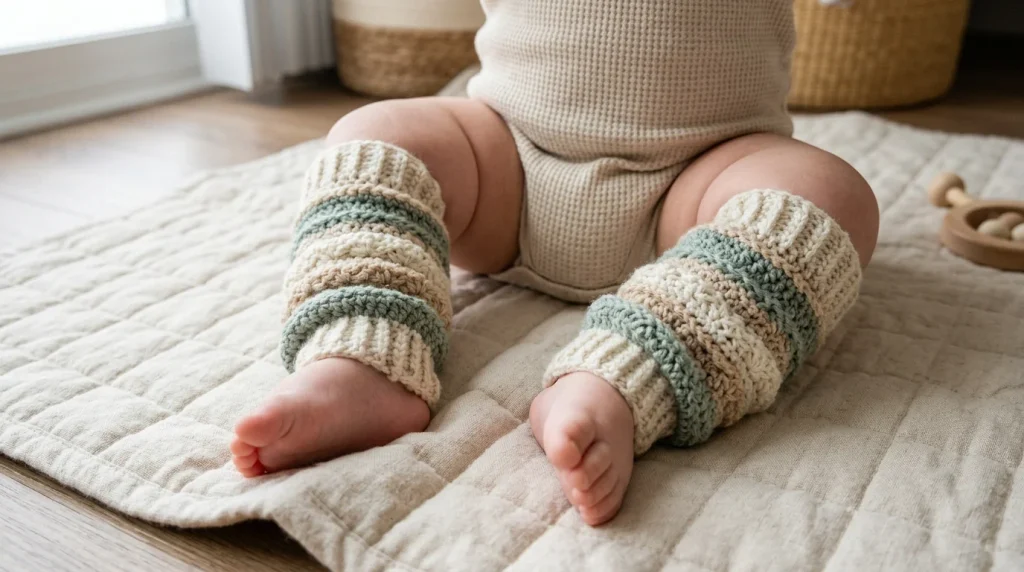
Don’t shrink a women’s pattern by guesswork. Measure the child’s calf and leg height, then run the same formulas. Children outgrow things quickly, so add a little height and keep the ribbing.
Baby leg warmers need extra care:
- Choose soft, washable yarn that doesn’t shed.
- Skip buttons, beads, pompoms, and ties.
- Keep them loose enough to leave no deep marks when removed.
- Take them off for sleep.
For a matching set, use the same yarn as the free crochet hat patterns for adults, or the nine sizes in crocheted hat patterns free, which cover newborn to adult.
Choosing yarn
- Wool and wool blends stretch and recover, so they keep their size.
- Acrylic washes easily and comes in many colors, but it recovers less. If a pair loosens after a few wears, the fiber may be the cause rather than your counting.
- Cotton is heavy and relaxes with wear, so go snugger.
To make a full set, buy enough of one dye lot for the legwear, an easy crochet hat patterns hat, and the crochet mittens pattern — the shade can shift between batches.
Changing the size
Each row adds one divided by your rows per inch to the circumference of a flat pair. Add rows to go bigger, remove rows to go smaller, and change the foundation chain to change the height.
In the round, add or remove stitches in pairs so the front-post and back-post sequence still lines up. A tight band is hard to rescue, so when in doubt, make it a row or a pair longer.
Common problems
The round twisted. Check the foundation chain before joining. If the twist shows after round 1, rip back and start over.
The seam is bulky. The tail was probably woven across the ridges. Redo it with mattress stitch and weave along the line.
Too tight at the calf. Pull the tube over the widest part of the leg before fastening off. If it fights you, add rows.
Blocking and care
Weave in all ends and wash according to the yarn label. To block, dampen the pair, lay it flat, and shape it to your measurements. Dry flat and away from direct heat — a wet leg warmer hung on a rack stretches lengthwise.
US and UK terms
This post uses US terms. In UK terms, hdc is a half treble, dc is a treble, and FPdc is a front post treble.
FAQs
How do I stop crochet leg warmers from sliding down?
They’re usually too loose, or the yarn has too little recovery. Cut the count by a pair of stitches (or a few rows on the flat version), and use a smaller hook at the ankle end.
What’s the best yarn weight for chunky crochet leg warmers?
Bulky (category 5) is the usual choice, and super bulky (category 6) gives a thicker pair. Swatch again when you change weight — thicker yarn makes a bigger tube from the same count.
Are ribbed crochet leg warmers stretchy enough for a wide calf?
Yes, ribbing gives more than flat stitches. Use the widest part of the calf in the formula and test the tube over it before fastening off.
Can I shrink these patterns to make crochet leg warmers for kids?
Not by guessing. Measure the child’s calf and height, run the same formulas, and add a little height.
What’s the difference between crochet leg warmers and boot cuffs?
Leg warmers cover the lower leg from the ankle to just below the knee. Boot cuffs are short bands that show above the boot. The formulas are the same, but cuffs need far fewer rows or rounds.

Leave a Reply