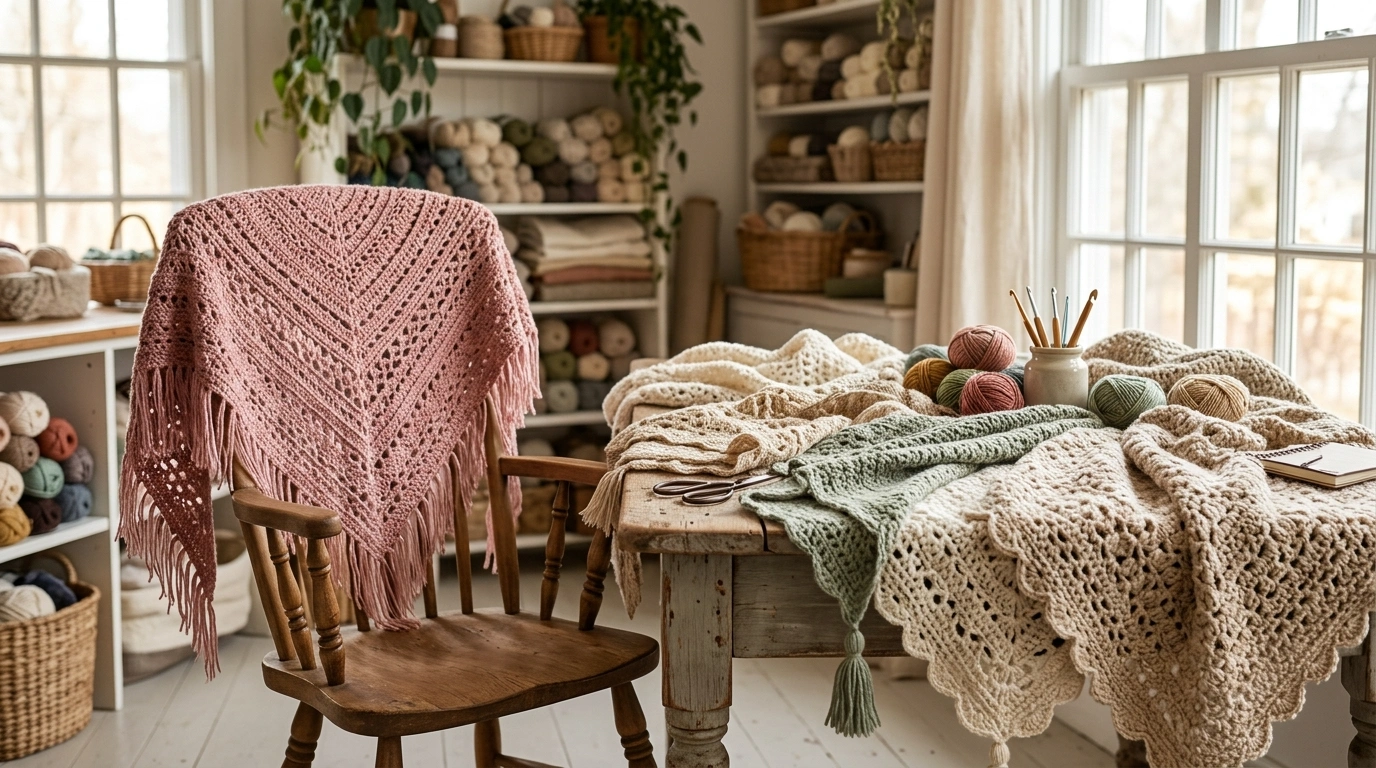
If you can chain and double crochet, you can make a shawl. That’s the whole barrier to entry — a shawl doesn’t need shaping around a body the way a sweater does, so most of the “hard” parts of garment-making just aren’t there. This roundup of easy crochet shawl patterns free for beginners proves it: five shapes, all built from stitches you probably already know.
Below are five shawl constructions that only use basic stitches, plus the sizing and yarn info you need to actually finish one instead of abandoning it in a project bag. Each uses standard, well-established crochet technique rather than a single copyrighted designer pattern, so feel free to adapt any of them — change the yarn, change the stitch count, make it bigger or smaller.
Table of Contents

What “easy” actually means in this roundup?
Every pattern in this easy crochet shawl patterns free roundup uses only chain stitch, single crochet, half double crochet, or double crochet — no shells, no popcorns, no complicated stitch charts to track. Skill level and hook sizing follow the Craft Yarn Council’s standard yarn weight system, which is the reference most US pattern designers build from, so if a pattern elsewhere calls for a “worsted weight” yarn, you’ll know exactly what hook range that means here too.
A quick note on shawls themselves: the shape has been around a lot longer than crochet has. Wikipedia’s overview of the shawl traces the garment back through woven Kashmir shawls, which is worth a read if you’re curious why triangle and rectangular shapes dominate — they’re just the most efficient way to drape fabric over the shoulders.
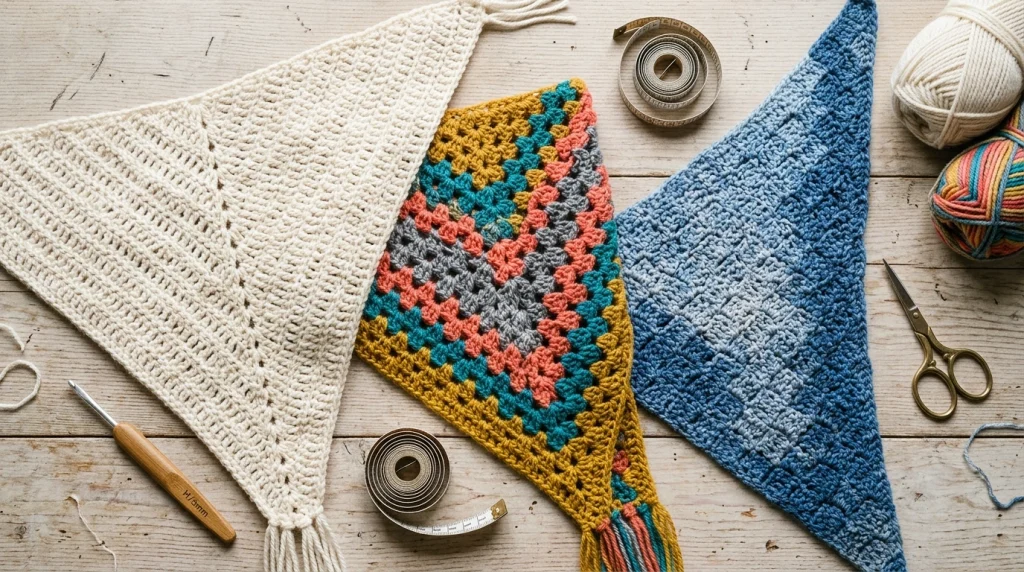
1. The Basic Increasing Triangle
This is the shawl most crocheters make first, and for good reason — it’s one repeated row.
Skill level: Beginner
Yarn: Worsted weight (#4), roughly 600–800 yards depending on how large you want the finished piece
Hook: 5.5–6.5 mm (I–K)
Chain 4, join with a slip stitch to form a ring. Row 1: chain 3 (counts as first dc), work 2 dc into the ring, chain 2, work 3 more dc into the ring. Turn. Every row after that: chain 3, 2 dc in the same stitch, dc across to the chain-2 space, (2 dc, ch 2, 2 dc) in that space, dc across to the end, then 2 dc in the top of the turning chain. Turn and repeat. The chain-2 space at the center forms the point of the triangle, and the shawl grows by four stitches every row. Keep going until you’re close to running out of yarn or you hit your desired wingspan, then fasten off.
2. One-Skein Rectangular Wrap
If counting increases isn’t appealing yet, start here. A rectangle is just rows of equal length, so there’s no shaping to track at all.
Skill level: Absolute beginner
Yarn: One skein of bulky weight (#5), around 300–350 yards
Hook: 6.5–9 mm (K–M)
Chain a foundation of roughly 40–50 stitches (this sets the length of the finished wrap, so measure as you go — a chain around 20–22 inches unstretched gives you a good scarf-width piece). Work half double crochet in the second chain from the hook and across. Chain 2, turn, hdc across every row after that. Stop when the rectangle reaches the width you want, usually somewhere around 18–20 rows for a wrap you can fold and drape over the shoulders. Because it’s bulky yarn on a big hook, this one moves fast — it’s a genuinely reasonable project to finish in a few evenings.
3. Granny Stripe Triangle
Same triangle shape as pattern one, but worked in the granny stitch, which is faster to memorize because you’re working in groups instead of individual stitches.
Skill level: Beginner, comfortable with basic stitches
Yarn: DK or light worsted (#3), around 700 yards if using two or three colors
Hook: 4.5–5.5 mm (7–I)
Start the same way as the basic triangle: chain 4, join into a ring, and set up your first row with a chain-2 space at the center. From there, instead of single double crochets, work groups of 3 dc separated by a chain-1 space across each row, increasing at the center point and at both outer edges by working an extra (3dc, ch1) group. Switching colors every row or two is the easiest way to use up scrap yarn, since granny stitch hides color changes cleanly at the start of each row.
4. Corner-to-Corner (C2C) Shawl
C2C looks more complex than it is — it’s blocks of double crochet built diagonally, and once the first few rows click, it’s genuinely repetitive.
Skill level: Beginner-intermediate
Yarn: Worsted weight (#4), around 650–750 yards
Hook: 5.5 mm (I)
Each “block” is 3 dc worked into a chain-3 space. You start with a single block in the corner, then increase by one block at the start of every row until you reach your desired width across the diagonal, then decrease by one block per row until you taper back down to a point. The result is a triangle with a slightly textured, blocky look that’s distinct from the smoother rows of pattern one — useful if you want a shawl with more visual interest but still no complicated stitch counts.
5. Lightweight Lacy Rectangle (V-Stitch)
For a shawl that drapes rather than insulates, the V-stitch gives you open, airy fabric without any actual lace charting.
Skill level: Beginner, comfortable with basic stitches
Yarn: Fingering or sport weight (#1–2), around 900 yards
Hook: 4–4.5 mm (G–7)
A V-stitch is just (dc, ch1, dc) worked into a single stitch, skipping a stitch between each one. Chain a foundation in a multiple of 3 plus 2, work your first row of V-stitches across, then work a V-stitch into every chain-1 space of the row below for every subsequent row. Because you’re skipping stitches, this uses noticeably less yarn than a solid rectangle of the same size, and the finished fabric has an open, breathable structure that suits warmer weather.
Getting the sizing right
None of these patterns have a fixed row count on purpose — shawl sizing comes down to personal preference and how much yarn you’re willing to use, so treat the yardage estimates above as a starting range rather than an exact target. If you want a firmer number, weigh your yarn before you start, crochet a swatch, weigh the swatch, and calculate roughly how many swatches’ worth of yarn you have — that gives you a realistic sense of how far a given skein will stretch before you commit to a full project.
Gauge matters less here than it would for a fitted garment, but it still affects drape. A looser gauge (a hook size up from what the yarn label recommends) gives you a softer, more open fabric that behaves more like a true shawl; a tighter gauge behaves more like a blanket. Neither is wrong — it depends on what you want the finished piece to do.
Choosing between these easy crochet shawl patterns free
If you’ve never made a shawl before, start with the rectangular wrap (pattern 2) or the basic triangle (pattern 1) — both use a single stitch repeated in a straightforward way, so you can focus on tension and turning rows without also tracking increases in two places at once. The granny stripe triangle is the natural next step once basic stitches feel automatic, since the grouped stitches actually go faster than working individually, even though the fabric looks more intricate.
C2C is worth trying once you want something with more visual texture, but it does take a bit longer to get into rhythm than the others — the first five or six rows tend to feel slow before the increase-then-decrease pattern clicks. The V-stitch rectangle is the odd one out in terms of yarn: it’s the only pattern here built for fingering or sport weight, so it’s the one to reach for if you want a shawl that works for spring and early fall rather than winter warmth.
All five patterns share one thing worth repeating: none of them require you to read ahead or hold a complicated repeat in your head. Row 1 tells you almost everything you need to know about every row that follows.
FAQs
Can I substitute a different yarn weight than the one listed?
Yes, as long as you adjust the hook size to match — the Craft Yarn Council chart linked above gives the standard hook range for each yarn weight. Just expect the finished size and yardage requirement to shift accordingly.
Why is my triangle shawl curling at the edges instead of lying flat?
This is almost always a tension issue rather than a pattern problem — if your edge stitches are noticeably tighter than the rest of the row, the outer rows pull inward. Blocking (wetting the finished piece and pinning it flat to dry) fixes mild curling; consistently loosening your edge stitches prevents it going forward.
Can I make any of these bigger or smaller than the yardage suggests? Yes — all five are open-ended by design. Stop increasing (or add more rows to a rectangle) whenever the shawl reaches the size you want, rather than following a fixed row count.
Do I need to block a crochet shawl?
It’s not required, but it makes a real difference, especially for the V-stitch and granny stripe versions — blocking opens up the stitch pattern and gives the fabric a more finished drape than it has straight off the hook.
Are these easy crochet shawl patterns free to use and share?
Yes. All five are original, technique-based instructions rather than copies of a paid or copyrighted designer pattern, so you’re free to make them, adapt them, and share the results.

Leave a Reply