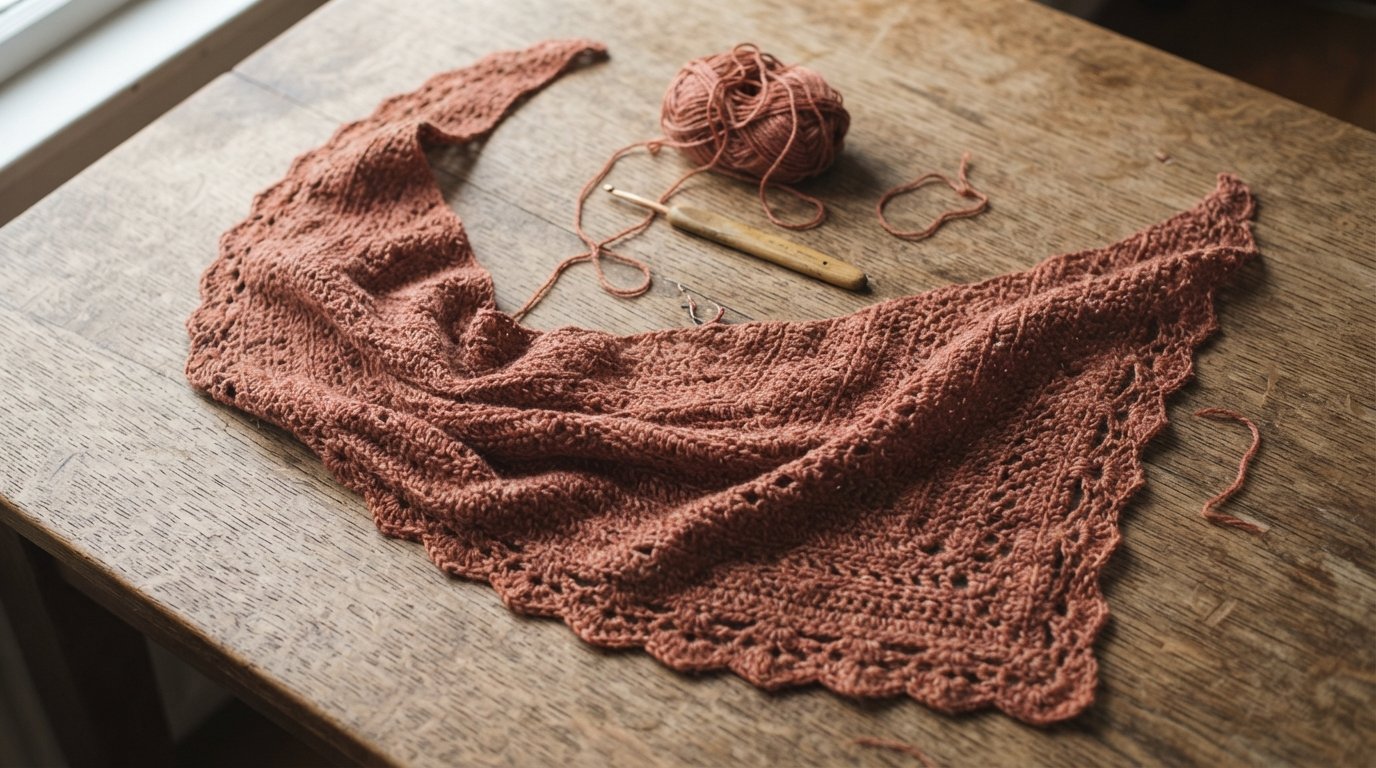
This simple crochet shawl pattern free guide walks through one triangle shawl, start to finish, built from a single repeated row. If you can chain and double crochet, that’s genuinely the entire skill requirement — there’s no shaping beyond one increase point, and no seaming at all once you fasten off.
The shawl has roots in woven garments that predate crochet as a technique entirely, which is part of why the shape adapts so easily to almost any stitch method. This particular simple crochet shawl pattern free design keeps that same basic triangle geometry, just built row by row with a hook instead of woven on a loom.
Table of Contents
Why this counts as a genuinely simple crochet shawl pattern free option?
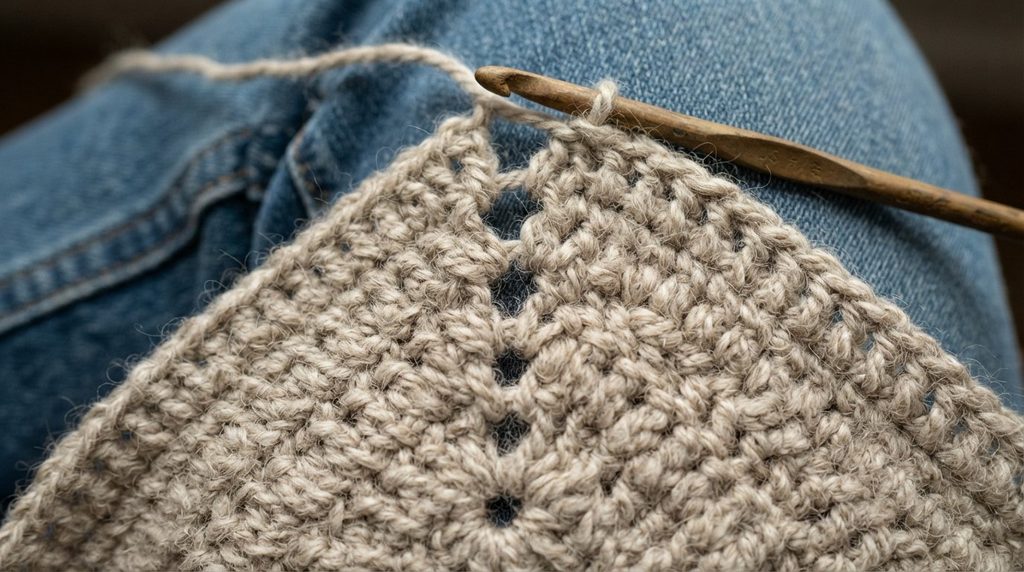
A lot of “easy” patterns still ask you to track two things at once — a stitch pattern and a shaping sequence. This simple crochet shawl pattern free design avoids that by using the exact same instruction on every single row after the first. Once you’ve worked row one, every following row is identical, which means there’s really only one thing to memorize rather than a growing list of exceptions.
Materials and gauge
Yarn: Worsted weight (#4), approximately 600–700 yards
Hook: 5.5–6 mm (I–J)
Notions: Yarn needle for weaving in ends
Gauge: Not critical for this project — a shawl doesn’t need to fit a specific measurement the way a garment does, so slight tension differences mostly just change the finished size rather than causing a fit problem. These modest, easy-to-source materials are part of what keeps this simple crochet shawl pattern free project accessible for a first-time shawl maker.
The pattern
Row 1: Chain 4, join with a slip stitch to form a ring. Chain 3 (counts as first double crochet), work 2 dc into the ring, chain 2, work 3 more dc into the ring. Turn.
Every row after that (repeat until finished): Chain 3, work 2 dc into the same stitch as the turning chain, dc across to the chain-2 space from the previous row, work (2 dc, chain 2, 2 dc) into that space, dc across to the end of the row, then work 2 dc into the top of the turning chain. Turn.
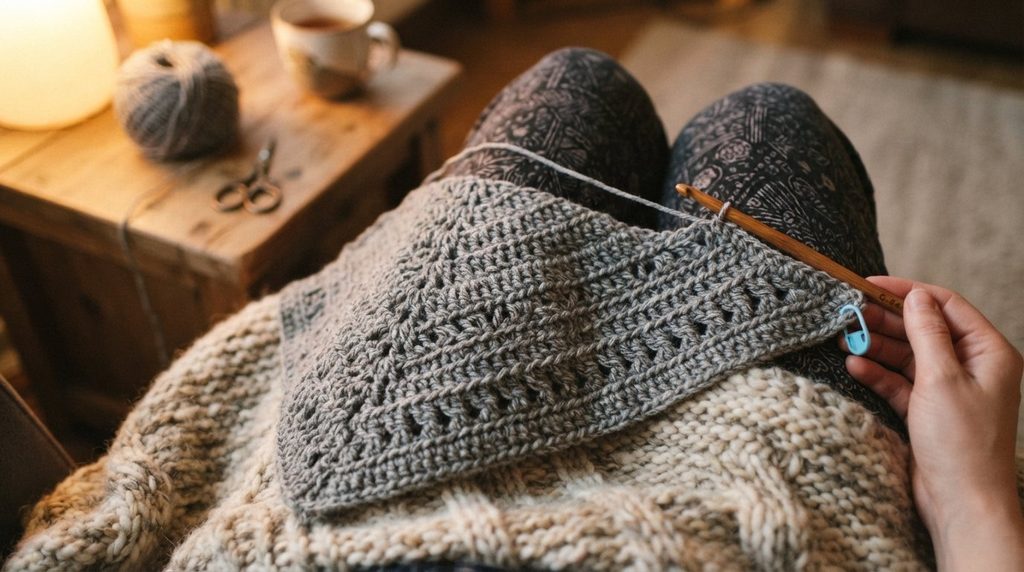
That single repeated row is the entire structure of this simple crochet shawl pattern free design. The chain-2 space at the center becomes the point of the triangle, and the piece grows by four stitches every row without any other shaping to track. Keep working that one row until the shawl reaches the size you want, or until you’re close to running out of yarn, then fasten off and weave in the ends.
Sizing this simple crochet shawl pattern free design up or down
Because every row of this simple crochet shawl pattern free build is identical, resizing is just a matter of working more or fewer rows rather than recalculating anything:
- Smaller, scarf-sized wrap: Stop around 35–40 rows for a narrower, more scarf-like piece that wraps rather than drapes over both shoulders.
- Standard shawl size: 55–65 rows produces a triangle with a wingspan long enough to drape over both shoulders with the point reaching past the waist.
- Oversized, blanket-style wrap: 80+ rows, with proportionally more yarn, for a piece large enough to double as a lap blanket.
Yarn substitution notes
This simple crochet shawl pattern free design is forgiving about yarn choice, since the construction doesn’t depend on a specific gauge the way a fitted garment does.
Substituting a lighter DK or sport-weight yarn on a smaller hook (4.5–5 mm) produces a lacier, more drapey shawl that uses less yarn per row but needs more total rows to reach the same finished size.
Going the other direction with a bulky yarn on a larger hook (7–8 mm) finishes much faster and uses a similar total yardage, since each row covers more ground per stitch — a reasonable option if you want a fast, chunky version of the same shape. Whichever weight you choose, the underlying rows of this simple crochet shawl pattern free design stay exactly the same.
Common mistakes with this simple crochet shawl pattern free design
The most common issue with this simple crochet shawl pattern free build is losing track of the chain-2 space at the center. If you increase into the wrong stitch, or accidentally work into the space without the (2 dc, ch 2, 2 dc) group, the point of the triangle drifts off-center over several rows rather than staying directly in the middle. Marking the chain-2 space with a stitch marker or a scrap of contrasting yarn makes it easy to spot at a glance, especially once the shawl gets wide enough that counting stitches across an entire row takes a while.
The second common issue is inconsistent tension at the two outer edges, which causes the shawl to curl instead of lying flat once finished. This is a tension problem rather than a construction problem, and it’s usually fixed by blocking rather than by reworking the piece.
Blocking this simple crochet shawl pattern free design
Blocking makes a noticeably bigger difference for a triangle shawl than for most other crochet shapes, since the raw fabric straight off the hook often curls slightly at the point and the two long edges. Interweave’s guide to spray blocking covers the general method well: dampen the finished piece, pin it out to the shape and size you want on a flat surface, and let it dry completely before removing the pins. For this particular simple crochet shawl pattern free shape, pinning the center point out to its full length and stretching the two top edges taut gives the most noticeable improvement in drape.
How this simple crochet shawl pattern free design differs from a roundup of shawl styles?
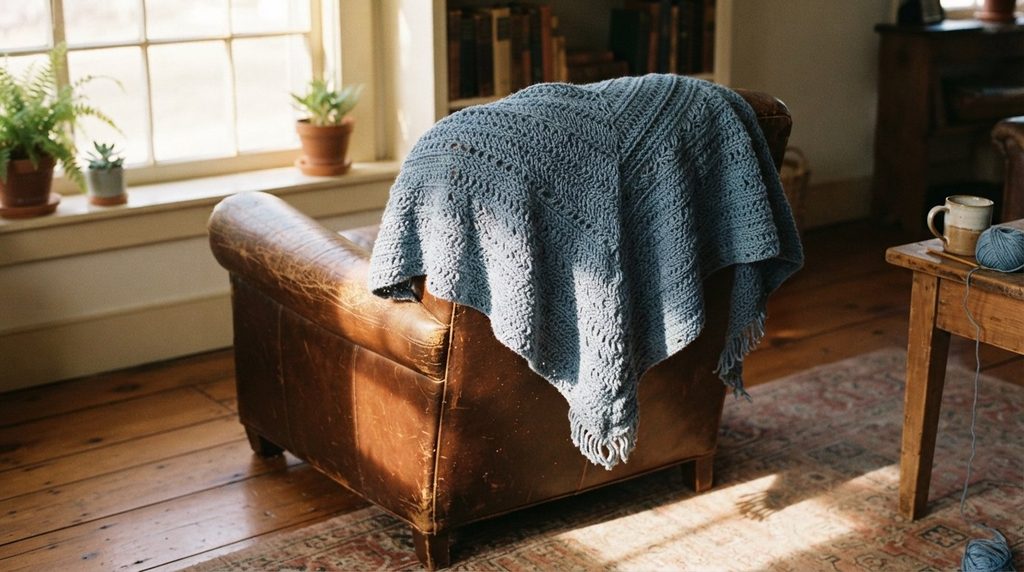
Where a roundup of shawl ideas covers several different constructions side by side, this simple crochet shawl pattern free guide focuses on one shape in full depth — every row, every sizing option, and every troubleshooting note for a single triangle build rather than a short summary of five different ones. If you’ve already tried a few shawl shapes and want the one that’s genuinely the least to keep track of while crocheting, this is the specific pattern to bookmark rather than the general overview.
Choosing color and yarn type
A solid color shows off the clean, repeated stitch structure of this simple crochet shawl pattern free design most clearly, since there’s no textured stitch pattern competing for attention — just the plain rows and the visible increase line running from the center point to each top corner. Variegated or self-striping yarn works well too, and actually highlights the triangle’s construction in an interesting way, since the color shifts land at slightly different points along each row as the piece widens.
Fiber choice affects drape more than almost anything else in this project. A wool or wool-blend yarn gives the finished piece a soft, structured drape that holds a defined point at the center; acrylic is more practical for everyday wear and machine washing, with a slightly stiffer hand straight off the hook that loosens up after the first wash or block; cotton produces a heavier, less elastic fabric that suits a lighter-weight version of this simple crochet shawl pattern free shape better than a true winter wrap.
Gifting and finishing touches
Because this simple crochet shawl pattern free design has no seams and no closures to add, it’s a genuinely low-effort gift project once you’ve made it a time or two — there’s nothing left to finish beyond weaving in the two yarn tails and blocking the piece flat. A simple fringe along the two long top edges is an easy optional addition if you want more visual interest without changing the base construction: cut yarn lengths roughly twice the desired fringe length, fold in half, and pull the folded loop through a stitch along the edge before pulling the tail ends through that loop to secure it.
More Patterns to Try Next
FAQs
Can I make this simple crochet shawl pattern free design with a different stitch than double crochet?
Yes — half double crochet produces a slightly denser, shorter fabric for the same number of rows, while treble crochet produces a taller, more open one. Either substitutes cleanly into the same repeated-row structure without changing the increase logic.
How much yarn does this simple crochet shawl pattern free project actually use?
The 600–700 yard estimate above assumes a standard shawl-sized finished piece around 55–65 rows. Weighing a partial ball after a set number of rows and calculating from there gives a more precise estimate if you’re working from stash yarn rather than buying specifically for this project.
Why is my shawl coming out lopsided instead of a symmetrical triangle?
This almost always traces back to the center increase point — if the (2 dc, ch 2, 2 dc) group isn’t worked into exactly the same space every row, one side of the triangle grows slightly faster than the other. Marking the center space, as noted above, is the most reliable fix.
Is this simple crochet shawl pattern free design suitable for a total beginner?
Yes — it’s genuinely one of the more forgiving first-shawl projects, since the entire piece after row one is a single repeated instruction rather than a changing sequence of rows.
Can I work this simple crochet shawl pattern free design in the evening while watching TV without much counting?
Largely yes, once you’re past the first several rows — since every row uses the same instruction, most crocheters get to a point where they can work several rows without checking written directions, only pausing to confirm the stitch count at the chain-2 space every so often.
Does this simple crochet shawl pattern free shape work for a shawl pin or brooch closure?
Yes — the two top corners near the neck are the natural place to add a shawl pin if you want to wear it closed rather than draped open, and the plain stitch structure doesn’t interfere with pinning the way a heavily textured stitch pattern might.

Leave a Reply